
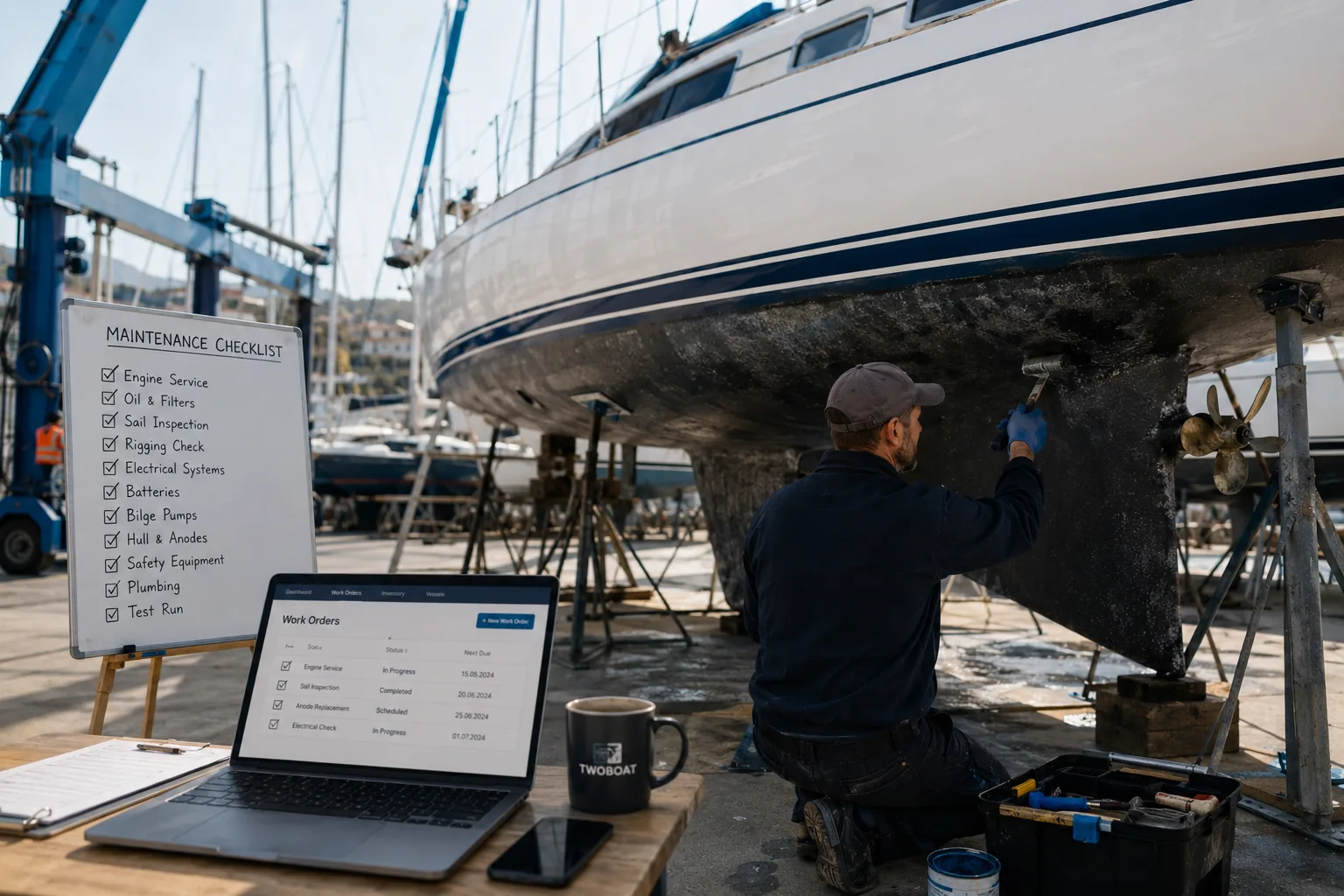
Boat Maintenance Workflow: Complete Service Management Guide
Boat maintenance is not only about fixing broken equipment. A reliable maintenance process connects service requests, inspections, work orders, spare parts, technicians, testing and maintenance history into one clear workflow. For charter companies, fleet managers and boat owners, this is what keeps vessels available, safe and ready for guests.
This guide explains how to organize boat service operations from the first reported issue to the final maintenance record. It covers preventive maintenance, corrective repairs, seasonal servicing, work order management, technician assignment, spare parts planning, service priorities and digital fleet maintenance workflows.
A disconnected maintenance process creates duplicated calls, forgotten tasks, delayed check-ins and unclear vessel status. Twoboat helps charter teams connect reservations, vessels, CRM, tasks and service workflows through Charter Management Software, Fleet Management Software, Work Order Management, Yacht Booking Software and Charter CRM.
What Is Boat Maintenance Management?
Boat maintenance management is the organized process of planning, tracking, performing and documenting all service activities required to keep a vessel safe, reliable and operational. It includes regular inspections, scheduled preventive maintenance, urgent repairs, spare parts management, technician assignments and service history.
In a small private boat, maintenance may be handled with a notebook or spreadsheet. In a charter fleet, that quickly becomes risky. More boats mean more engines, batteries, pumps, sails, electronics, guests, turnovers, service partners and maintenance deadlines. Without a structured workflow, the company becomes dependent on a few people who remember everything manually.
Maintenance, Repair, Inspection and Service: What Is the Difference?
| Term | Meaning | Example |
|---|---|---|
| Maintenance | Planned or routine work that keeps equipment in good condition. | Replacing engine oil, checking batteries, cleaning filters. |
| Inspection | A structured check to identify wear, faults or safety problems. | Pre-charter inspection, weekly bilge check, rigging visual check. |
| Repair | Corrective action after something fails or performs incorrectly. | Replacing a failed bilge pump or repairing a leaking hose. |
| Service | A defined maintenance procedure, often based on time or engine hours. | Annual engine service, generator service, outboard service. |
| Work order | A documented service task with description, priority, assignee, parts, photos and status. | “Replace starboard shower pump on Yacht Aurora before Saturday check-in.” |
Types of Boat Maintenance
A good vessel maintenance system separates different types of work. This helps the team prioritize urgent safety tasks, schedule predictable service jobs and avoid wasting time on unclear requests.
| Maintenance Type | Purpose | Typical Examples |
|---|---|---|
| Daily checks | Catch obvious problems before departure or guest use. | Bilge water, battery voltage, fuel level, water level, safety equipment. |
| Weekly maintenance | Keep frequently used systems reliable during the season. | Pumps, toilets, shore power, navigation lights, deck hardware. |
| Monthly maintenance | Inspect equipment that can degrade slowly. | Filters, belts, hoses, terminals, corrosion, anodes, steering system. |
| Engine-hour service | Service machinery according to usage. | Oil, impeller, fuel filters, gearbox oil, generator service. |
| Seasonal maintenance | Prepare the vessel for charter season or winter storage. | Antifouling, hull polishing, rig inspection, safety equipment renewal. |
| Corrective repair | Fix a reported defect or breakdown. | Broken pump, faulty charger, leaking seacock, damaged sail. |
| Emergency repair | Restore safety or operability immediately. | Engine not starting, steering failure, bilge pump failure, water ingress. |
Complete Boat Service Workflow
The best way to manage boat maintenance is to follow the same workflow every time. This prevents lost information, unclear responsibility and unfinished work. The workflow below can be used by charter companies, yacht service teams, marinas, fleet managers and private boat owners.
Service request received
The process starts when a skipper, guest, technician, owner, sensor or inspection reports a problem. The report should include the vessel name, location, system affected, urgency, description and photos if available.
Create a work order
The issue becomes a structured work order. This prevents the task from being forgotten and gives the team one place to track status, assignee, spare parts, notes, photos and completion evidence.
Initial inspection
A technician or fleet manager checks the vessel to confirm the problem. Inspection helps separate symptoms from the real cause.
Diagnosis and priority
The team identifies the affected system, root cause, operational impact and priority. A safety-critical failure should never be handled like a cosmetic issue.
Estimate labor, parts and downtime
Before work starts, estimate the required labor, spare parts, supplier availability and expected vessel downtime. For charter fleets, this must be checked against future bookings.
Approval
Some jobs require approval from the owner, charter manager, fleet manager or insurance provider. Approval should be documented before expensive parts or labor are ordered.
Assign technician or service partner
The task is assigned to the right person: mechanic, electrician, rigger, sailmaker, diver, cleaner, carpenter or external service partner.
Order or reserve spare parts
Parts availability often decides whether a boat is ready for the next charter. Track part name, supplier, quantity, delivery date, cost and whether the part is onboard or in stock.
Perform maintenance or repair
The technician completes the work following a checklist or service procedure. Notes and photos should be added during the job, not only at the end.
Test the system
Every repair should be tested under realistic conditions. For engines, this may include starting, running, temperature monitoring and sea trial. For electrical systems, test voltage, load and function.
Close the work order
The work order is closed only after the repair is verified. Closing should include labor hours, parts used, photos, test result, invoice reference and completion date.
Update maintenance history
The completed job becomes part of the vessel service history. This helps future troubleshooting, resale value, warranty claims and preventive planning.
Work Order Management for Boat Maintenance
A work order is the central document of a professional maintenance workflow. It turns a vague issue into an actionable task. Instead of “the toilet is broken,” a proper work order explains which boat, which toilet, what symptoms, who reported it, who is responsible and when it must be completed.
For a charter fleet, Work Order Management is especially important because turnaround days are short. If a guest reports a defect on Friday and the next crew arrives Saturday afternoon, the service team needs immediate visibility into what must be inspected, repaired, tested and closed before check-in.
| Work Order Field | Why It Matters | Example |
|---|---|---|
| Vessel | Identifies the exact boat. | Lagoon 42 “Blue Horizon” |
| Location | Shows where the technician must go. | Marina Kaštela, berth C-14 |
| System | Groups tasks by technical area. | Engine, bilge, electrical, plumbing, rigging. |
| Priority | Prevents low-priority tasks from blocking critical repairs. | Critical, high, medium, low. |
| Description | Explains the symptom or service request. | Port engine overheating above 2200 RPM. |
| Photos | Help diagnose problems remotely. | Photo of leaking hose or damaged fitting. |
| Assignee | Clarifies responsibility. | Mechanic, electrician, external rigger. |
| Due date | Connects service work with booking deadlines. | Before Saturday 14:00 check-in. |
| Parts | Tracks what is needed and what was used. | Impeller, belt, pump, hose clamp. |
| Status | Shows current progress. | Open, inspected, waiting parts, in progress, testing, closed. |
Service Priority Matrix
Not every service request has the same urgency. A broken cushion and a failed bilge pump both matter, but they should not receive the same priority. A priority matrix helps the team decide what must be handled immediately and what can be scheduled later.
| Priority | Meaning | Examples | Recommended Action |
|---|---|---|---|
| Critical | Safety or vessel operability is at risk. | Engine failure, steering failure, water ingress, bilge pump failure. | Immediate action. Vessel may be unavailable until resolved. |
| High | Charter experience or legal compliance is affected. | Toilet failure, navigation light failure, VHF issue, gas system concern. | Resolve before next departure where possible. |
| Medium | Important but not immediately dangerous. | Fridge issue, shower pump, minor electrical fault, worn line. | Schedule with technician and parts availability. |
| Low | Cosmetic or comfort issue. | Small gelcoat scratch, cushion stain, loose trim. | Group into planned maintenance window. |
Boat Systems That Need Regular Service
A maintenance workflow should cover every major onboard system. Many breakdowns happen because one system is checked regularly while another is forgotten until it fails.
Engine and propulsion
Oil, filters, belts, impeller, cooling system, gearbox, shaft, propeller, saildrive and engine mounts.
Electrical system
Batteries, charger, alternator, shore power, fuses, switches, corrosion, terminals and 12V/24V circuits.
Plumbing and bilge
Fresh water pump, shower pumps, bilge pumps, hoses, seacocks, toilets, tanks and valves.
Safety equipment
Life jackets, fire extinguishers, flares, EPIRB, VHF, first aid kit, liferaft and emergency tiller.
Hull and underwater gear
Antifouling, anodes, through-hulls, propeller, rudder, keel, hull damage and underwater cleaning.
Rigging and deck
Standing rigging, running rigging, winches, blocks, furling gear, cleats, stanchions and lifelines.
Preventive Boat Maintenance Schedule
Preventive maintenance reduces breakdowns by servicing equipment before it fails. The exact schedule depends on vessel type, manufacturer recommendations, engine hours, seawater conditions, charter intensity and local regulations.
| Interval | Maintenance Tasks | Responsible Person |
|---|---|---|
| Before each departure | Check bilge, fuel, water, batteries, navigation lights, VHF, safety equipment, engine start and visible leaks. | Skipper, base staff or fleet manager. |
| After each charter | Guest defect report review, cleaning inspection, damage check, inventory check, tank levels and urgent work orders. | Base team and charter operations. |
| Weekly | Bilge pumps, toilets, shower pumps, battery voltage, shore power, deck hardware and safety checklist. | Fleet technician or base staff. |
| Monthly | Engine visual inspection, belts, hoses, filters, terminals, corrosion, seacocks, steering and rigging visual check. | Technician or service partner. |
| Every 100–250 engine hours | Engine oil, filters, impeller, gearbox oil, fuel system check and manufacturer-specific service items. | Marine mechanic. |
| Season start | Antifouling, anodes, hull inspection, safety equipment renewal, engine service, rig inspection and sea trial. | Fleet manager, technicians and external partners. |
| Season end | Winterization, deep inspection, damage list, parts planning, major repairs and upgrade planning. | Fleet manager and owner. |
| Annual | Major engine service, liferaft or fire equipment checks where applicable, rigging review, insurance documentation and service history audit. | Certified service providers where required. |
Interactive Boat Maintenance Checklist
Use this checklist as a practical pre-service or turnaround inspection. It can help identify issues before they become urgent work orders.
Boat maintenance inspection checklist
Interactive Maintenance Planner
This simple planner estimates which maintenance category may be due based on engine hours and charter intensity. It is a planning aid only. Always follow the engine manufacturer, equipment manuals and local regulations.
120 hours
7 days
Maintenance Cost Estimator
Boat maintenance costs vary by vessel size, age, engine type, location, usage and service quality. This estimator is not a quote, but it helps explain why organized maintenance planning is cheaper than emergency repairs.
12 m
Spare Parts Management
Many boat repairs are delayed not because the technician is unavailable, but because the correct part is missing. Spare parts management should be part of the maintenance workflow, especially for charter fleets with tight turnaround windows.
| Part Category | Examples | Why It Matters |
|---|---|---|
| Engine service parts | Oil filters, fuel filters, impellers, belts, anodes. | Needed for predictable engine-hour maintenance. |
| Plumbing parts | Pumps, toilet service kits, hoses, clamps, valves. | Common charter-season failures. |
| Electrical parts | Fuses, terminals, switches, battery cables, bulbs. | Small parts can stop important systems. |
| Deck hardware | Blocks, shackles, lines, clevis pins, winch parts. | Important for sailing reliability and guest safety. |
| Safety equipment | Fire extinguishers, flares, life jackets, first aid items. | Compliance and safety-critical. |
Testing and Quality Control
A repair that has not been tested is not finished. Testing should match the system being repaired. A pump should be run long enough to confirm pressure and leaks. An engine should be started, warmed up and checked for temperature, charging, smoke, vibration and water flow. A navigation light should be checked in the correct switch position.
- Test the exact symptom that was reported.
- Check related systems that may have caused the issue.
- Record the test result in the work order.
- Add after-repair photos where useful.
- Do not close a critical task without verification.
Maintenance History and Service Records
Maintenance history is one of the most valuable assets in vessel management. It shows what was done, when it was done, who did it, which parts were used and whether a recurring problem exists.
Good service records help with warranty claims, owner reporting, resale value, insurance questions and future troubleshooting. For example, if the same freshwater pump fails three times in one season, the issue may not be the pump. It may be wiring, pressure switch settings, water contamination or incorrect installation.
Digital Boat Maintenance and Fleet Software
Manual maintenance tracking can work for one boat, but it becomes fragile as soon as the fleet grows. Charter companies need to connect maintenance with reservations, check-ins, guest reports, technician schedules, owner communication and vessel availability.
That is where digital systems become useful. Fleet Management Software helps teams see vessel status, maintenance deadlines and service history across the whole fleet. Work Order Management turns defects into assigned tasks with clear ownership and status. Charter Management Software connects service operations with bookings and turnaround schedules.
Maintenance is also connected to sales and customer communication. If a boat is unavailable because of service, the booking team needs to know. Yacht Booking Software helps avoid selling unavailable inventory, while Charter CRM helps organize communication with guests, owners, leads and service-related follow-ups.
| Operational Need | Relevant Twoboat Solution | How It Helps |
|---|---|---|
| Manage reservations and operational availability | Charter Management Software | Connects bookings, check-ins, fleet status and operational planning. |
| Track vessel status across the fleet | Fleet Management Software | Gives a structured view of boats, service status, deadlines and maintenance records. |
| Create and assign repair tasks | Work Order Management | Turns issues into trackable work orders with priorities, assignees, photos, parts and status. |
| Avoid booking conflicts with service windows | Yacht Booking Software | Helps align vessel availability, booking requests and operational constraints. |
| Communicate with guests, owners and partners | Charter CRM | Organizes follow-ups, guest issues, owner updates and service communication. |
Common Boat Maintenance Mistakes
- No maintenance history: The team repeats troubleshooting because nobody knows what was already repaired.
- Reactive maintenance only: Equipment is fixed only after it fails, usually during the worst possible time.
- No clear priority: Cosmetic tasks compete with safety-critical repairs.
- Missing spare parts: Simple jobs take days because common parts are not stocked.
- Poor photo documentation: Remote diagnosis becomes difficult and owner communication is weaker.
- Unassigned tasks: Everyone knows about a problem, but nobody owns it.
- Closing tasks too early: Repairs are marked done before testing.
- Disconnected bookings and maintenance: The sales team sells a boat that is not operationally ready.
Example: From Guest Report to Closed Work Order
Imagine a guest reports that the starboard toilet is not flushing properly during checkout. In a weak process, someone writes it in a chat message and hopes the technician sees it. In a professional workflow, the issue becomes a work order immediately.
Reported issue: Starboard toilet not flushing
Vessel: Sailing yacht Aurora
Location: Marina berth B-22
Priority: High
Deadline: Before next charter check-in
Initial inspection: Pump activates but no discharge
Diagnosis: Blocked joker valve and worn pump seal
Parts used: Toilet service kit, hose clamp
Technician: Base service team
Test result: Toilet flushed 10 times successfully, no leak
Status: Closed
History: Added to vessel maintenance log
This level of documentation helps the team understand what happened, what was fixed and whether similar problems occur again.
FAQ
How often should a boat be serviced?
A boat should be inspected before each departure and serviced according to manufacturer recommendations, engine hours, season schedule and actual usage. Charter boats usually need more frequent checks than privately used boats.
What is a boat maintenance workflow?
A boat maintenance workflow is the step-by-step process for receiving a service request, creating a work order, inspecting the issue, diagnosing the cause, assigning a technician, completing the repair, testing the system and updating maintenance history.
What is preventive boat maintenance?
Preventive boat maintenance means servicing equipment before it fails. Examples include oil changes, filter replacement, impeller inspection, battery checks, seacock operation and safety equipment verification.
What is corrective maintenance on a boat?
Corrective maintenance is repair work done after a fault is found. Examples include replacing a failed bilge pump, repairing a leaking hose, fixing a broken alternator or replacing damaged rigging parts.
What should be included in a boat maintenance checklist?
A boat maintenance checklist should include engine, bilge, batteries, shore power, plumbing, toilets, seacocks, navigation lights, VHF, safety equipment, rigging, deck hardware, photos and work order creation for unresolved defects.
What is a marine work order?
A marine work order is a structured service task that includes the vessel, location, system, priority, description, assignee, parts, photos, status, deadline and completion record.
How do charter companies manage boat maintenance?
Charter companies manage maintenance by combining pre-charter inspections, guest defect reports, work orders, technician assignments, spare parts tracking, service schedules and vessel availability planning.
Why is maintenance history important?
Maintenance history helps with future troubleshooting, warranty claims, owner reporting, resale value, insurance questions and identifying recurring problems.
What is the difference between fleet management and work order management?
Fleet management gives an overview of vessels, availability, status and service history. Work order management focuses on individual tasks such as inspections, repairs, parts, assignees and completion status.
How can software improve boat maintenance?
Software improves boat maintenance by centralizing work orders, vessel status, technician assignments, photos, parts, service history and booking-related availability in one system.
Conclusion
Efficient boat maintenance depends on structure. A professional workflow starts with a clear service request, continues through inspection, diagnosis, work order management, parts planning, repair and testing, and ends with a reliable maintenance history.
For charter fleets, this workflow is directly connected to guest experience and revenue. A boat that is technically ready, properly documented and clearly marked as available is easier to sell, easier to operate and safer for guests. By connecting maintenance with charter management, fleet management, work order management, booking operations and CRM communication, charter companies can reduce downtime and avoid many common service problems.
Continue reading
Build your Croatia sailing knowledge with related TwoBoat guides, software, guides and planning tools.