
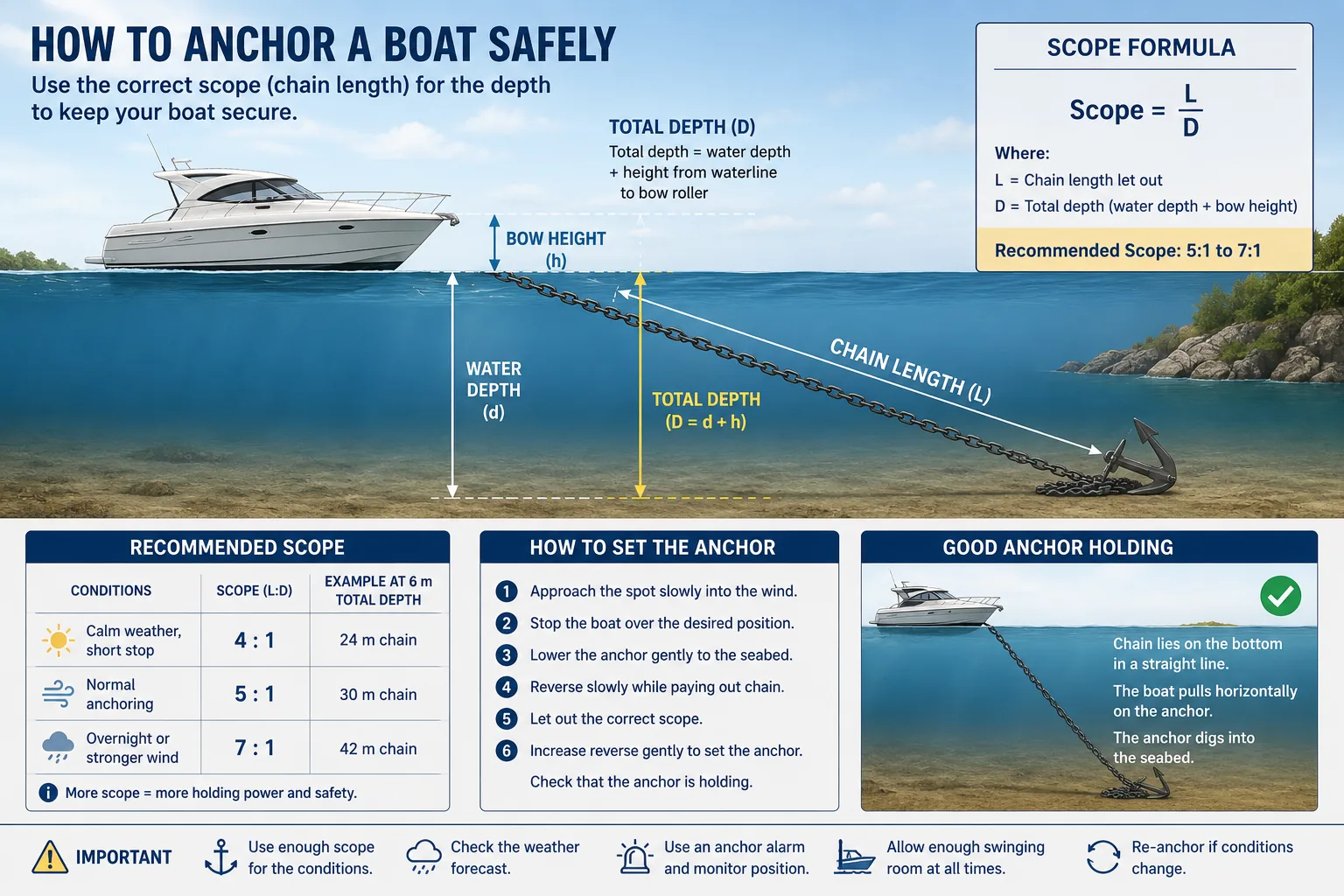
How to Anchor a Boat Safely
Anchoring is one of the most important seamanship skills on any boat. A properly set anchor keeps the vessel secure, protects nearby boats, and prevents dangerous situations such as dragging, grounding or collision.
This guide explains how to anchor a boat safely, from choosing the right location to setting the anchor, checking holding, securing the chain and monitoring the boat while at anchor. It also includes a boat anchor on seabed diagram, practical steps to anchoring a boat, advice on choosing an area to anchor your vessel, basic mooring steps and an interactive anchoring simulator for estimating scope, swing radius and safe distance from shore.
Important Safety Note
Anchoring conditions can change quickly due to wind, swell, current or tide. Always check the weather forecast before anchoring and be prepared to move if the anchorage becomes unsafe.
- Never anchor in a marked navigation channel.
- Keep enough distance from other boats, rocks, shallows and shore.
- Use the correct amount of chain or rode for the depth.
- Always confirm that the anchor is holding.
- Use an anchor alarm whenever possible.
- Re-anchor immediately if the boat is dragging or the holding ground is poor.
Choosing an Area to Anchor Your Vessel: What Factors Should You Keep in Mind?
Choosing an area to anchor your vessel is one of the most important decisions before lowering the anchor. The right anchoring location should give your boat good holding, enough water depth, protection from wind and waves, and enough swinging room if the wind or current changes.
When choosing an area to anchor your vessel, keep these factors in mind:
| Factor | What to Check | Why It Matters |
|---|---|---|
| Water depth | Check charted depth, actual depth sounder reading and expected tide changes. | You need enough depth at low water and enough rode for a safe scope ratio. |
| Seabed type | Look for sand, mud or clay whenever possible. | Good holding ground helps the anchor dig in and reduces the risk of dragging. |
| Wind protection | Choose a bay or anchorage protected from the forecast wind direction. | Less wind pressure means less load on the anchor and more comfort on board. |
| Swell exposure | Check if swell can enter the bay even when the wind is light. | Swell can make an anchorage unsafe or uncomfortable even if the anchor is holding. |
| Current and tide | Check tidal streams, river outflow or local current. | Current can change the boat's direction and increase load on the anchor. |
| Swinging room | Make sure the boat can rotate around the anchor without hitting anything. | The boat may swing 180° or 360° if wind or current shifts. |
| Nearby boats | Compare your swing circle with other anchored boats. | Different boats may use different scope lengths and swing differently. |
| Hazards | Avoid rocks, shoals, reefs, wrecks, cables and shallow areas. | If the anchor drags or the wind shifts, the boat needs safe clearance. |
| Traffic | Stay clear of navigation channels, ferry routes and harbor entrances. | Anchoring in traffic areas is dangerous and often prohibited. |
| Local rules | Check for no-anchoring zones, marine parks and protected seabed areas. | Some locations prohibit anchoring to protect seagrass, coral or underwater infrastructure. |
A good anchoring area should be protected, legally permitted, free from hazards and suitable for the expected wind, swell and tide. If any of these factors are uncertain, choose another location before dropping the anchor.
Steps to Anchoring a Boat: Complete Procedure
The steps to anchoring a boat should be followed in the correct order. Rushing the process, using too little scope or failing to check holding are common reasons boats drag anchor.
- Choose a safe anchoring location with good protection and holding ground.
- Check the chart, water depth, tide, seabed type and nearby hazards.
- Confirm there is enough swinging room for your boat and nearby vessels.
- Prepare the anchor, windlass, chain markings, snubber and crew communication.
- Approach the anchoring spot slowly into the wind or current.
- Stop the boat above the place where you want the anchor to land.
- Lower the anchor under control until it reaches the seabed.
- Let the boat move slowly backward while paying out chain or rode.
- Deploy the correct scope for the depth and conditions.
- Apply gentle reverse power to straighten the chain.
- Increase reverse power gradually to set the anchor.
- Check that the anchor is holding using visual bearings, GPS and an anchor alarm.
- Attach a snubber, bridle or chain stopper so the windlass does not carry the load.
- Monitor the boat, weather, wind shifts and nearby vessels while anchored.
These boat anchoring steps are suitable for beginners, sailing crews and charter skippers. In stronger wind, poor holding ground or crowded anchorages, take extra time to test the anchor and leave more room.
Tools and Equipment Required
- Correct anchor for the boat size
- Anchor chain or rope rode
- Windlass or manual anchoring system
- Chain counter or chain length markings
- Snubber line or bridle
- Anchor swivel or shackle
- GPS or chartplotter with anchor alarm
- Boat hook
- Gloves
Best Seabed Types for Anchoring
The seabed is one of the most important factors in safe anchoring. A good anchor needs to dig into the bottom and stay buried under load. Sand, mud and clay usually provide better holding than weed, seagrass or rock.
| Seabed Type | Holding Quality | Comment |
|---|---|---|
| Sand | Excellent | Usually the best and most reliable holding ground. |
| Mud | Good | Can hold well, but the anchor may need time to dig in. |
| Clay | Good | Often provides strong holding once the anchor is set. |
| Weed / Seagrass | Poor | The anchor may not reach the seabed properly. |
| Rock | Poor | The anchor can get stuck or fail to set. |
Boat Anchor on Seabed Diagram
A boat anchor on seabed diagram helps show why scope and chain angle matter. The anchor should not pull upward. It should pull as horizontally as possible so the flukes can dig into the seabed.
                         Wind / Current
                              ↑

                            Boat
                             ▲
                             |
Sea Surface  -----------------------------------------

                             \
                              \
                               \
                                \
                                 \   Anchor Chain / Rode
                                  \
                                   \
                                    O  Anchor dug into seabed

Seabed       -----------------------------------------
                    Sand / Mud Holding Ground
In a correct setup, the chain lies at a low angle near the seabed. This helps the anchor stay buried. If the chain is too short, the pull angle becomes too steep and the anchor can break free.
Ship Anchor on Seabed Diagram
The same principle applies to larger vessels. A ship anchor on seabed diagram would show a heavier anchor, more chain and a longer catenary curve, but the goal is the same: create a low pulling angle so the anchor can hold the vessel securely.
Large Vessel / Ship
        ▲
        |
Sea Surface  --------------------------------------------------

             \
              \
               \
                \
                 \____ chain lying closer to seabed
                      \
                       O  ship anchor on seabed

Seabed       --------------------------------------------------
Whether it is a small boat anchor on seabed or a ship anchor on seabed, the anchor must be allowed to set properly. The chain should not be piled on top of the anchor, and the vessel should not pull vertically unless recovering the anchor.
Interactive Anchor Swing and Safe Distance Simulator
This anchoring simulator estimates how much chain or rode to deploy, the approximate swing radius around the anchor, and whether the boat has enough distance from shore or hazards. It is useful when deciding where to drop the anchor and how much room the boat needs if the wind shifts.
Important: this simulator is a planning aid only. It does not predict real anchor drag from seabed type, anchor design, wind force, waves, current or poor setting. Always check holding, use an anchor alarm and keep a safe visual watch.
Quick Overview: Steps for Anchoring a Boat
If you want the short version, these are the basic steps for anchoring a boat safely:
- Choose a protected anchorage with good holding ground.
- Check depth, tide and swinging room.
- Calculate the correct scope.
- Approach slowly into the wind or current.
- Lower the anchor under control.
- Reverse slowly and lay the chain straight.
- Set the anchor with gradual reverse power.
- Confirm that the anchor is holding.
- Secure the chain with a snubber or bridle.
- Monitor the boat and use an anchor alarm.
Step 1: Choose a Safe Anchorage
Before dropping the anchor, select a location that gives protection from wind and swell. The best anchorage is not always the closest bay, but the one that offers the safest conditions for the expected weather.
- Check the chart for depth and hazards.
- Look for sand or mud bottom if possible.
- Avoid rocks, cables, restricted areas and ferry routes.
- Make sure there is enough swinging room.
- Check the direction of wind and expected changes overnight.
Step 2: Check the Depth
Use the depth sounder and chart to confirm the water depth. Remember that the total anchoring depth is not only the water depth. You should also include the height from the waterline to the bow roller.
For example, if the water depth is 6 m and the bow roller is 1 m above the water, the total anchoring depth is 7 m.
Step 3: Calculate the Correct Scope
Scope is the ratio between the total depth and the length of chain or rode deployed. Too little scope is one of the most common causes of anchor dragging.
| Condition | Recommended Scope | Example at 7 m Total Depth |
|---|---|---|
| Calm weather, short stop | 4:1 | 28 m chain |
| Normal anchoring | 5:1 | 35 m chain |
| Overnight or stronger wind | 7:1 | 49 m chain |
Step 4: Approach Slowly Into the Wind
Approach the selected anchoring spot slowly with the bow facing into the wind or current, whichever is stronger. Reduce speed before reaching the final position.
- Prepare the anchor before arriving at the spot.
- Communicate clearly between helm and bow crew.
- Stop the boat above the position where you want the anchor to land.
- Do not drop the anchor while moving forward quickly.
Step 5: Lower the Anchor
Lower the anchor under control using the windlass or manually. Do not throw the anchor, because this can tangle the chain and prevent the anchor from setting correctly.
- Stop the boat over the chosen spot.
- Lower the anchor until it reaches the seabed.
- Allow the boat to move slowly backward.
- Pay out chain gradually as the boat moves astern.
Step 6: Reverse Slowly to Lay the Chain
Once the anchor is on the bottom, use gentle reverse power to lay the chain in a straight line. The goal is to avoid piling the chain on top of the anchor.
Do not use strong reverse immediately. Start slowly, let the chain straighten, and then increase reverse power gradually.
Step 7: Set the Anchor
After enough chain is deployed, increase reverse power slowly to help the anchor dig into the seabed. Watch the chain: it should become tight and then hold without skipping or jerking.
- If the boat continues moving backward, the anchor may be dragging.
- If the chain vibrates or jumps, the anchor may not be set.
- If the boat stops firmly, the anchor is likely holding.
Step 8: Check That the Anchor Is Holding
Never assume the anchor is holding just because the chain is tight. Confirm the position using at least two methods.
- Take visual bearings on shore objects.
- Check the GPS position.
- Use an anchor alarm.
- Watch nearby boats and fixed landmarks.
- Check that the boat is swinging naturally, not dragging.
Step 9: Secure the Chain
Do not leave the full load of the boat on the windlass. Use a snubber line, bridle or chain stopper to transfer the load away from the windlass.
- Attach the snubber to the chain.
- Let out a little more chain until the snubber takes the load.
- Check that the windlass is no longer under tension.
- Make sure the chain and snubber cannot chafe.
Step 10: Monitor the Boat While Anchored
Anchoring does not end when the engine is turned off. Conditions can change, and the boat must be monitored regularly.
- Set an anchor alarm on GPS or mobile app.
- Check the wind direction and forecast updates.
- Look for changes in swell or current.
- Make sure nearby boats are not dragging toward you.
- Inspect the snubber, chain and anchor roller.
Interactive Practice: Drag the Tiles Into the Correct Order to Anchor a Boat
Use this simple anchoring order exercise to review the correct sequence. This section is useful for beginners learning the steps for anchoring a boat.
Correct order:
- Choose a safe anchorage.
- Check depth and swinging room.
- Approach slowly into wind or current.
- Lower the anchor under control.
- Reverse slowly and pay out chain.
- Set the anchor with gradual reverse power.
- Check that the anchor is holding.
- Secure the chain with a snubber or bridle.
- Set an anchor alarm and monitor the boat.
Common Anchoring Mistakes
- Using too little chain or rode.
- Anchoring too close to other boats.
- Dropping anchor on weed or rock.
- Not reversing to set the anchor.
- Leaving the load on the windlass.
- Not using an anchor alarm overnight.
- Ignoring wind shifts and weather changes.
- Anchoring in a channel or restricted area.
- Letting the chain pile on top of the anchor.
When to Re-Anchor
If the anchor is dragging, the boat is too close to another vessel, the wind direction changes, or the seabed is poor, it is safer to re-anchor immediately.
- Start the engine.
- Retrieve the anchor carefully.
- Move to a better position.
- Repeat the anchoring process from the beginning.
Anchor Recovery
When leaving the anchorage, start the engine before lifting the anchor. Move slowly toward the anchor while retrieving the chain. Do not use the windlass to pull the boat forward against strong wind or current.
- Start the engine.
- Remove the snubber or bridle.
- Motor slowly toward the anchor.
- Retrieve the chain vertically.
- Break the anchor free when the chain is straight up and down.
- Secure the anchor before getting underway.
Anchoring vs Mooring: What Is the Difference?
Anchoring and mooring both secure a boat, but they are not the same. Anchoring means using your own anchor, chain and rode to hold the boat to the seabed. Mooring means securing the boat to a fixed mooring buoy, dock, quay, pier or marina berth.
| Anchoring | Mooring |
|---|---|
| Uses your own anchor and rode. | Uses a fixed buoy, dock, pier or marina berth. |
| Requires suitable seabed and correct scope. | Requires safe approach, lines and fenders. |
| The boat swings around the anchor. | The boat is held by mooring lines or buoy lines. |
| Good for bays, coves and open anchorages where permitted. | Common in marinas, harbors, town quays and buoy fields. |
How to Moor a Boat Safely: Step-by-Step
Mooring a boat safely requires slow speed, preparation and clear crew communication. Before approaching a dock, quay or mooring buoy, prepare all lines and fenders so the crew does not have to rush at the last moment.
- Check wind, current and available space before the approach.
- Prepare bow line, stern line and spring lines before entering the berth.
- Place fenders on the correct side and at the correct height.
- Brief the crew so everyone knows which line to handle.
- Approach slowly, using short and controlled engine movements.
- Keep hands and feet away from the gap between boat and dock.
- Secure the first control line, usually a bow line, stern line or spring line depending on the situation.
- Attach the remaining bow, stern and spring lines.
- Adjust line tension so the boat cannot move too far forward, backward or sideways.
- Allow for tide, water level changes and wake from passing boats.
- Check that fenders are protecting the hull correctly.
- Turn off the engine only after the boat is fully secured.
- Inspect all knots, cleats and chafe points before leaving the boat unattended.
Basic Mooring Lines Explained
A secure mooring usually uses several lines, not just one rope. Each line controls a different movement of the boat.
| Line Type | Purpose |
|---|---|
| Bow line | Holds the front of the boat close to the dock or mooring point. |
| Stern line | Holds the back of the boat close to the dock or mooring point. |
| Forward spring line | Helps prevent the boat from moving backward. |
| Aft spring line | Helps prevent the boat from moving forward. |
| Breast line | Holds the boat close to the dock, but should not be the only line used where tide changes are large. |
Common Mooring Mistakes
- Approaching the dock too fast.
- Preparing lines and fenders too late.
- Standing between the boat and the dock.
- Trying to stop the boat by hand instead of using the engine and lines.
- Using only bow and stern lines without spring lines.
- Leaving lines too tight where the tide or water level changes.
- Leaving lines too loose so the boat surges against the dock.
- Not checking for chafe on lines and cleats.
Maintenance Checklist
- Inspect the anchor shackle regularly.
- Check the safety pin or seizing wire.
- Inspect chain links for corrosion or wear.
- Check the windlass operation.
- Wash salt and mud from the anchor and chain.
- Inspect the snubber line for chafe.
- Mark the chain length clearly.
FAQ
How much chain should I use when anchoring?
For normal anchoring, use about 5 times the total depth. For overnight anchoring or stronger wind, use about 7 times the total depth.
What is the best seabed for anchoring?
Sand is usually the best holding ground. Mud and clay can also hold well if the anchor is properly set.
What does a boat anchor on seabed diagram show?
A boat anchor on seabed diagram shows the boat, sea surface, anchor chain or rode, seabed and the anchor dug into the bottom. It helps explain why scope and chain angle are important.
Is a ship anchor on seabed different from a small boat anchor?
The principle is similar. A ship anchor on seabed uses heavier gear and more chain, but both systems need a low pulling angle and good holding ground.
How far from shore should I anchor?
The boat should be far enough from shore to allow for the deployed chain or rode, the boat length, wind shifts and an additional safety margin. The interactive simulator above can help estimate the required clearance.
Does the simulator predict anchor drag?
No. It estimates swing radius and clearance only. Real anchor drag depends on anchor type, seabed, scope, wind, current, waves and how well the anchor is set.
Should I throw the anchor?
No. The anchor should be lowered under control so the chain does not tangle and the anchor can set correctly.
Can I anchor on seagrass?
Anchoring on seagrass is not recommended. Holding is often poor and sensitive seabed can be damaged.
Should the windlass hold the boat?
No. The windlass should not take the full load of the boat. Use a snubber, bridle or chain stopper.
What factors should you keep in mind when choosing an area to anchor your vessel?
When choosing an area to anchor your vessel, check water depth, seabed type, wind protection, swell, current, tide, swinging room, nearby boats, hazards, local rules and traffic. The best anchoring area has good holding ground, enough depth, safe clearance and protection from the forecast weather.
What are the basic steps to anchoring a boat?
The basic steps to anchoring a boat are: choose a safe anchorage, check depth and swinging room, approach into wind or current, lower the anchor under control, pay out enough chain or rode, reverse gently to set the anchor, check holding, secure the chain with a snubber and monitor the boat.
Should you anchor into the wind or current?
Approach the anchoring spot with the bow into the stronger force, usually wind or current. This gives better control and helps the anchor and chain lay in the correct direction as the boat moves backward.
How do you know if your anchor is dragging?
Your anchor may be dragging if the boat continues moving backward, GPS position changes outside the normal swing circle, visual bearings shift continuously, the chain vibrates or the boat moves differently from nearby anchored boats.
What is the difference between anchoring and mooring?
Anchoring uses your own anchor and rode to hold the boat to the seabed. Mooring uses a fixed buoy, dock, quay or berth with mooring lines. Anchoring requires good seabed and correct scope, while mooring requires safe approach, lines, fenders and line tension.
What are the basic steps to mooring a boat?
The basic steps to mooring a boat are: prepare lines and fenders, approach slowly, brief the crew, secure the first control line, attach bow and stern lines, add spring lines, adjust line tension for tide or water level changes and check for chafe before leaving the boat.
Conclusion
Safe boat anchoring depends on preparation, correct scope, good seabed selection and careful checking. Always choose a protected anchorage, lower the anchor under control, reverse slowly to set it, and confirm that the boat is holding before leaving the helm.
A well-set anchor gives comfort and safety, but it must be monitored. Weather, wind shifts and nearby boats can change the situation quickly, so always stay ready to re-anchor if needed.
Continue reading
Build your Croatia sailing knowledge with related TwoBoat guides, software, guides and planning tools.