
How to Sail Upwind
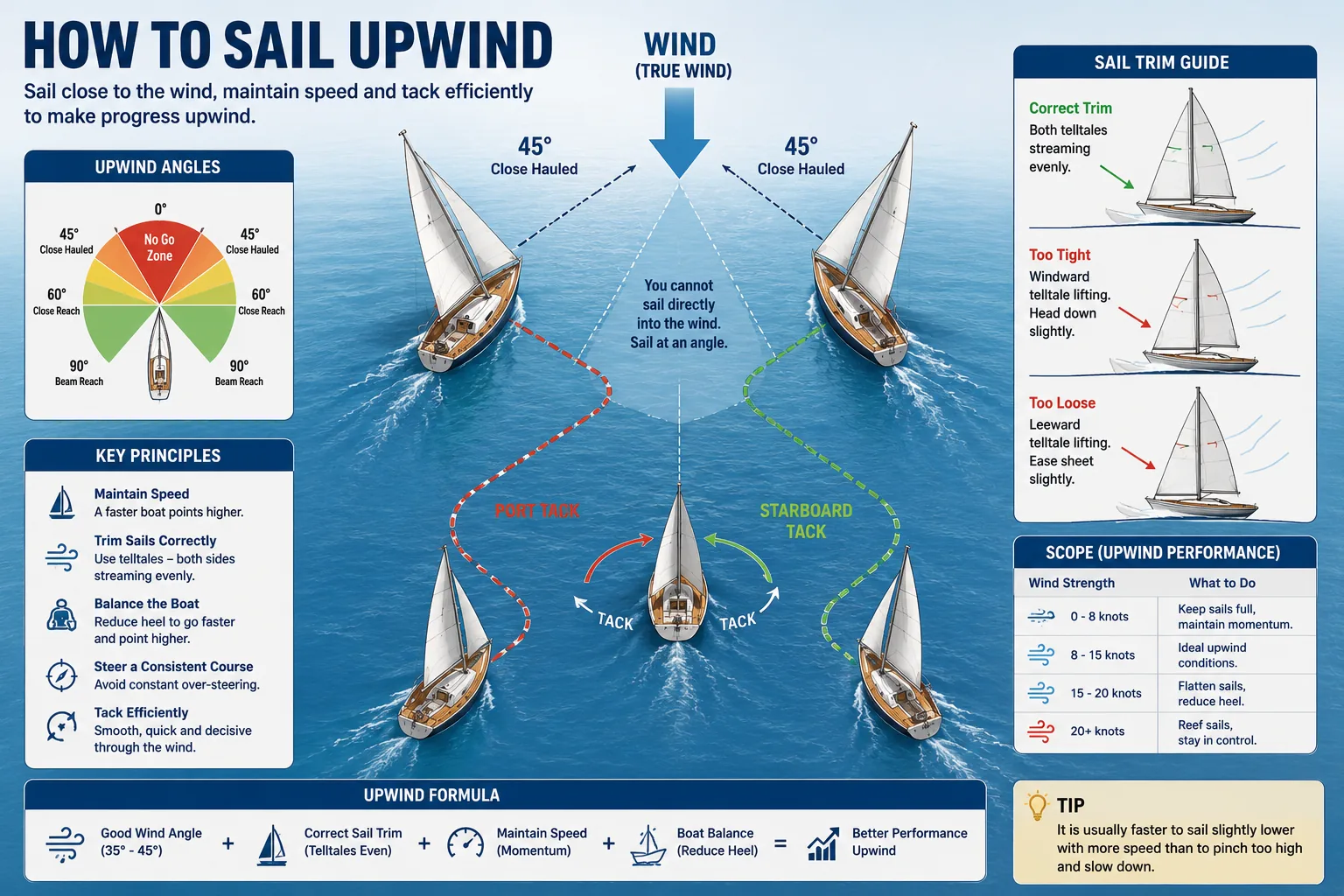
Sailing upwind is one of the most fundamental sailing skills. Since a sailboat cannot sail directly into the wind, it must travel at an angle while generating lift from the sails. Proper sail trim, steering and boat balance are essential for maintaining speed and making efficient progress toward your destination.
This guide explains the principles of sailing upwind, how to trim the sails correctly, when to tack, and how to avoid the most common mistakes.
Important Safety Note
Always ensure there is enough sea room before sailing close-hauled. Watch for other vessels, shallow water and changing wind conditions. Avoid excessive heel and reef early if the wind increases.
- Wear a life jacket in stronger winds.
- Check the weather forecast before departure.
- Keep a proper lookout at all times.
- Reef sails before the boat becomes overpowered.
- Avoid sailing too close to a lee shore.
Equipment Required
- Mainsail
- Headsail (Genoa or Jib)
- Telltales
- Wind indicator
- Compass or chartplotter
- Winches
- Sheets
- Traveler (if fitted)
Typical Upwind Angles
| Point of Sail | True Wind Angle | Description |
|---|---|---|
| In Irons | 0° | Boat cannot sail directly into the wind. |
| Close Hauled | 30–45° | Maximum upwind performance. |
| Close Reach | 45–60° | Fast with good control. |
| Beam Reach | 90° | Fastest point of sail for many boats. |
Interactive Upwind Angle Simulator
Use this simple simulator to understand whether your sailing angle is too close to the wind, properly close-hauled, or too low for efficient upwind progress. Move the slider to change the true wind angle and see the recommendation.
Upwind Angle Simulator
Step 1: Head Close to the Wind
Steer the boat toward the wind until the sails begin to luff, then bear away slightly until they fill again. This is your close-hauled course.
- Do not point higher than the sails can support.
- Maintain steady steering.
- Avoid constant course corrections.
Step 2: Trim the Mainsail
Sheet the mainsail in until it stops luffing. The boom should be close to the centerline without over-sheeting.
- Trim until the luff just stops fluttering.
- Use the traveler to fine-tune sail angle.
- Ease the sheet slightly in gusts if necessary.
Step 3: Trim the Headsail
Trim the jib or genoa until both windward and leeward telltales stream evenly.
- Windward telltale lifting first means trim in slightly.
- Leeward telltale lifting first means ease the sheet.
- Both telltales flowing horizontally indicate good trim.
Step 4: Maintain Boat Speed
Speed is essential when sailing upwind. A slower boat generates less lift and points lower.
- Keep the boat moving.
- Avoid pinching too close to the wind.
- Sail slightly lower if speed drops.
Step 5: Balance the Boat
Excessive heel increases rudder drag and reduces efficiency.
- Move crew weight to windward.
- Flatten the boat when possible.
- Reef early in stronger winds.
Step 6: Watch the Telltales
Telltales provide instant feedback on sail trim and steering.
- Both streaming = correct trim.
- Windward lifting = head down slightly.
- Leeward lifting = head up slightly.
Step 7: Tack Efficiently
Since you cannot sail directly into the wind, you must tack from one close-hauled course to the other.
- Prepare the crew.
- Call "Ready about".
- Turn smoothly through the wind.
- Release the old jib sheet.
- Trim the new sheet.
- Accelerate on the new tack.
Step 8: Avoid Pinching
Trying to point too high often slows the boat dramatically. It is usually faster to sail slightly lower while maintaining speed.
Wind Strength Recommendations
| Wind | Recommended Action |
|---|---|
| 0–8 knots | Keep sails full and maintain momentum. |
| 8–15 knots | Ideal upwind sailing conditions. |
| 15–20 knots | Flatten sails and reduce heel. |
| 20+ knots | Reef sails and reduce weather helm. |
Common Mistakes
- Sailing directly into the wind.
- Over-sheeting the sails.
- Ignoring telltales.
- Pinching too high.
- Allowing excessive heel.
- Poorly timed tacks.
- Not reefing in stronger winds.
Interactive Tacking Diagram
Use this interactive diagram to visualize why a sailboat cannot sail directly into the wind and how it makes progress upwind by tacking from one close-hauled course to the other.
Upwind Tacking Diagram
Maintenance Checklist
- Inspect sail stitching.
- Check telltales.
- Inspect sheets for wear.
- Lubricate winches.
- Inspect blocks and travelers.
- Check standing rigging tension.
FAQ
Can a sailboat sail directly into the wind?
No. Every sailboat must sail at an angle to the wind and tack between courses.
What is the best upwind angle?
Most cruising sailboats perform best between 35° and 45° to the true wind.
Why is my boat slowing down?
You are likely pointing too high or the sails are incorrectly trimmed.
When should I reef?
Reef before the boat becomes difficult to control or heels excessively.
Conclusion
Efficient upwind sailing depends on maintaining boat speed, trimming sails correctly and steering a consistent close-hauled course. Good sailors focus on balance, smooth steering and proper tacking rather than simply pointing as close to the wind as possible.
Continue reading
Build your Croatia sailing knowledge with related TwoBoat guides, software, guides and planning tools.