
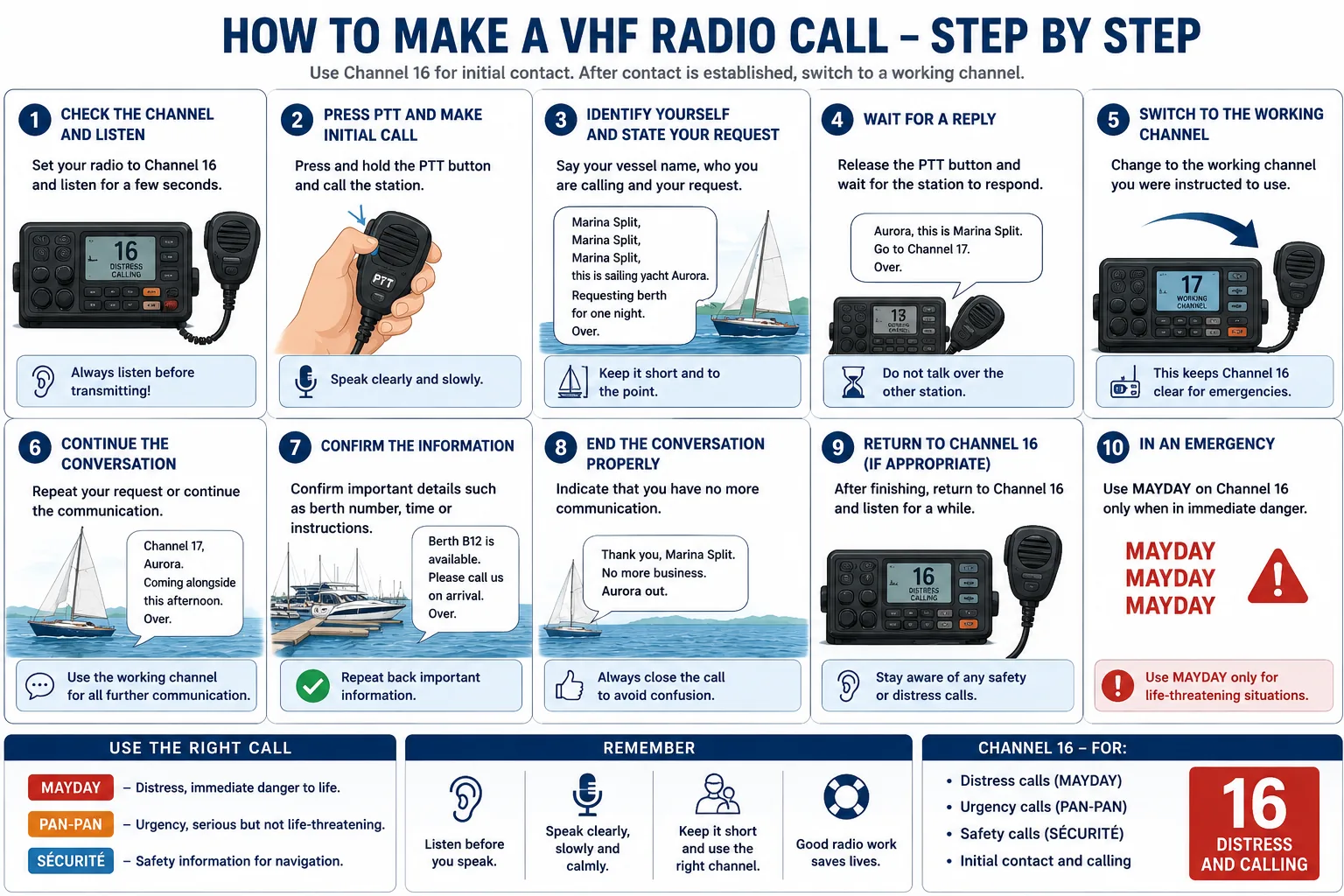
Marine VHF Radio Basics
A marine VHF radio is one of the most important safety devices onboard any boat. It allows you to communicate with marinas, nearby vessels, bridges, locks, coast guard services and emergency responders. Unlike a mobile phone, a VHF radio broadcasts to every vessel within range, making it the primary communication system for distress situations at sea.
This guide explains how VHF radio works, how marine VHF radio works on a boat, the purpose of the most important VHF channels, how to make routine calls, emergency calls, and how to communicate professionally using standard marine radio protocol, VHF radio protocol and proper VHF radio etiquette.
A VHF/SRC radio certificate is often required together with a recognized skipper license. Read the full guide here: Accepted Foreign Boat Licenses in Croatia.
Important Safety Note
- Use clear and short transmissions.
- Never make false distress calls.
- Keep emergency channels free.
- Obtain the required radio operator licence where applicable.
- Always monitor Channel 16 while underway whenever possible.
What is a Marine VHF Radio?
Marine VHF (Very High Frequency) radio is a short-range communication system operating between 156 and 174 MHz. Depending on antenna height, radio power, terrain, vessel position and weather conditions, communication range is typically between 5 and 30 nautical miles.
Every vessel within radio range can hear your transmission when using a standard voice channel, making VHF much more suitable than a mobile phone during emergencies. A mobile phone connects only to the number you call. A VHF call can alert nearby vessels that may be able to help immediately.
How Does VHF Radio Work?
VHF stands for Very High Frequency. A marine VHF radio sends and receives short-range radio signals over marine channels allocated for safety, navigation and vessel communication. When you press the Push-To-Talk button, your voice is converted into a radio signal and transmitted through the antenna. Other VHF radios tuned to the same channel and within range can hear the message.
The most important thing to understand is that VHF is usually a line-of-sight communication system. The signal travels best when antennas can “see” each other without land, high cliffs, buildings or the curvature of the earth blocking the path. That is why a masthead antenna on a sailing yacht normally gives better range than a handheld radio used from the cockpit.
| Factor | Effect on VHF Range | Practical skipper tip |
|---|---|---|
| Antenna height | Higher antennas usually increase range. | A masthead antenna normally performs better than a low deck antenna. |
| Radio power | Fixed radios often transmit with more power than handheld units. | Use low power for nearby calls and high power when range is needed. |
| Obstructions | Islands, cliffs, buildings and terrain can block or weaken signals. | Move into open water or improve antenna position if reception is poor. |
| Antenna condition | Corrosion, loose connectors or damaged coax can reduce performance. | Inspect the antenna and cable before longer trips. |
| Channel traffic | Only one station should speak at a time on the same channel. | Listen before transmitting and keep messages short. |
How Does VHF Marine Radio Work on a Boat?
A marine VHF radio works by connecting the skipper and crew with other vessels, marinas, harbour authorities, coast guard services and rescue stations. On most boats, the fixed VHF radio is connected to the boat battery, an external antenna and often GPS or chartplotter data for DSC distress alerts.
In normal use, you select the correct channel, listen first, press the PTT button, speak clearly, then release the button to receive a reply. In an emergency, a DSC-equipped radio can also send a digital distress alert with the vessel’s MMSI and GPS position, followed by a voice MAYDAY call on Channel 16.
| Communication method | Best use | Main limitation |
|---|---|---|
| Marine VHF | Emergency, safety, marina, ship-to-ship and navigation communication. | Line-of-sight range and correct channel discipline required. |
| Mobile phone | Private calls, marina office calls, booking and non-urgent coordination. | Not broadcast to nearby vessels; depends on coverage and battery. |
| DSC alert | Fast digital distress alert with MMSI and GPS position. | Requires correctly programmed MMSI and GPS connection. |
Main Components of a VHF Radio
Microphone and PTT
The Push-To-Talk button controls transmission. Press to speak, release to listen.
Channel selector
Used to select Channel 16, working channels, marina channels and other allocated channels.
Squelch control
Filters background noise. Set it only high enough to remove static.
High / Low power
Use low power for nearby stations and high power when longer range is needed.
DSC distress button
Sends a digital distress alert on Channel 70 when used correctly.
Antenna and GPS
A good antenna and GPS connection greatly improve safety and DSC usefulness.
Fixed vs Handheld VHF Radios
| Feature | Fixed VHF | Handheld VHF |
|---|---|---|
| Power Output | Usually up to 25 W | Usually 1–6 W |
| Range | Often 20–30 NM with good antenna height | Often 2–8 NM depending on height and battery |
| Power Source | Boat battery | Rechargeable internal battery |
| Antenna | External mast or deck antenna | Small built-in antenna |
| Best Use | Primary communication system | Backup, dinghy, tender, emergency grab bag |
| Weak Point | Depends on vessel power system and antenna condition | Lower range and battery limitation |
Most Important Marine VHF Channels
| Channel | Purpose | Skipper note |
|---|---|---|
| 16 | Distress, safety and initial calling | Keep it clear. Use for MAYDAY, PAN-PAN, SÉCURITÉ and initial calls only. |
| 70 | Digital Selective Calling (DSC) | No voice traffic. Used by DSC equipment for digital alerts. |
| 13 | Bridge-to-bridge navigation | Used in some areas for navigation safety between vessels. |
| 09 | Calling channel in many countries | Local usage varies. Check local regulations. |
| 68 | Working communications | Use after initial contact where locally permitted. |
| 69 | Working communications | Use only according to local channel plan. |
| 71 | Working communications | Common working channel in many cruising areas. |
| 72 | Ship-to-ship communications | Useful after initial contact; do not use for distress traffic. |
| 77 | Intership communications | Local allocation may vary. |
Channel 16
Channel 16 (156.800 MHz) is the international distress, safety and calling channel. Every vessel should monitor this channel whenever practical.
Channel 16 is used for:
- Mayday distress calls
- Pan-Pan urgency calls
- Sécurité safety broadcasts
- Initial contact between vessels
- Calling marinas or coast stations before switching channels
Once contact has been established, both stations should immediately switch to a working channel.
Channel 70
Channel 70 is reserved exclusively for Digital Selective Calling (DSC). Voice communication is strictly prohibited on this channel.
A DSC distress alert automatically transmits:
- Vessel MMSI number
- GPS position if connected
- Time of distress
- Nature of distress if selected
Working Channels
Working channels are used after initial contact has been made on Channel 16 or another local calling channel. Different countries may allocate working channels differently, so always follow local regulations and marina instructions.
Marina Communications
Most marinas publish their preferred VHF working channel in pilot books, nautical charts or on their websites.
- Call the marina on Channel 16 or the published calling channel.
- Wait for a response.
- Switch to the requested working channel.
- Provide your boat name, length and berth request.
Marina Split, Marina Split,
this is sailing yacht Aurora.

Requesting berth for one night.

Over.
Marine Radio Protocol: Basic VHF Call Format
Marine radio protocol is the standard way of speaking on VHF so that messages are short, clear and easy to understand. Good VHF radio protocol reduces confusion, keeps emergency channels clear and helps other vessels understand exactly who is calling, who is being called and what action is needed.
For most routine calls, use this simple structure:
- Say the name of the station or vessel you are calling.
- Repeat the called station name if needed.
- Say “this is” followed by your vessel name.
- State your request or reason for calling.
- Say “over” when you expect a reply.
- Move to a working channel if the call started on Channel 16.
Marina Split, Marina Split,
this is sailing yacht Aurora.

Requesting berth for one night.

Over.
VHF Radio Protocol: Words and Phrases Every Skipper Should Know
| Phrase | Meaning | Example use |
|---|---|---|
| Over | I have finished speaking and expect a reply. | “Requesting berth for tonight. Over.” |
| Out | The conversation is finished and no reply is expected. | “Thank you, Aurora out.” |
| Say again | Please repeat your last message. | “Say again your position.” |
| Stand by | Wait before transmitting again. | “Aurora, stand by.” |
| Roger | Message received and understood. | “Roger, switching to Channel 72.” |
| MAYDAY | Immediate danger to life or vessel. | Used only for grave and imminent danger. |
| PAN-PAN | Urgent situation, not immediately life-threatening. | Disabled vessel, medical advice, loss of steering. |
| SÉCURITÉ | Safety message. | Navigation hazard or weather warning. |
Routine Ship-to-Ship Calls
When calling another vessel, state the vessel name, identify yourself and request a channel change.
Blue Horizon,
Blue Horizon,
Blue Horizon,

This is Sea Breeze.

Request switch to Channel 72.

Over.
Interactive VHF Call Simulator
Use this simulator to practice the structure of a VHF call. It does not transmit anything. It only helps crew members understand what information must be said and in which order.
Distress Call — MAYDAY
MAYDAY is used only when there is immediate danger to life or the vessel. Examples include sinking, fire, serious collision, person overboard not recovered, abandonment or another immediate life-threatening emergency.
MAYDAY
MAYDAY
MAYDAY

This is sailing yacht Aurora.
Call sign 9A1234.
MMSI 238123456.

Position:
43 degrees 30 minutes North
016 degrees 20 minutes East.

We are taking on water.

Require immediate assistance.

Four persons onboard.

Over.
Urgency Call — PAN-PAN
PAN-PAN is used for urgent situations that are serious but not immediately life-threatening.
- Engine failure in a dangerous position
- Disabled vessel
- Medical emergency requiring advice
- Loss of steering
- Rig damage without immediate danger to life
Safety Broadcast — SÉCURITÉ
SÉCURITÉ is used to broadcast navigational or weather safety information.
- Floating containers
- Navigation hazards
- Derelict vessels
- Severe weather warnings
- Unlit buoys or damaged navigation marks
How to Use the Radio Correctly
- Turn on the radio.
- Adjust volume.
- Set squelch until background noise disappears.
- Select the desired channel.
- Listen before transmitting.
- Press and hold the PTT button.
- Wait half a second before speaking.
- Speak clearly and slowly.
- Release the PTT button when finished.
- Wait for a reply.
VHF Radio Etiquette
VHF radio etiquette means using the radio in a disciplined, professional and respectful way. Marine VHF is a safety system, not a chat room. Poor radio etiquette can block urgent calls, confuse other vessels and create unnecessary risk.
- Listen before transmitting so you do not interrupt another call.
- Keep transmissions short, especially on Channel 16.
- Speak slowly, clearly and directly into the microphone.
- Do not interrupt distress, urgency or safety traffic.
- Avoid unnecessary conversation and move to a working channel after initial contact.
- Use standard marine terminology instead of slang.
- Never use offensive language or make false distress calls.
- Always identify your vessel by name.
- Use “Over” when expecting a reply and “Out” when the conversation is finished.
- Use low power for nearby routine calls when possible to reduce interference.
Marine Radio Rules Every Beginner Should Know
Marine radio rules vary by country, but the basic safety principles are similar in most cruising areas. Before operating a VHF radio, check local requirements for operator certificates, vessel radio licences, channel plans and DSC/MMSI registration.
| Rule | Why it matters | Good practice |
|---|---|---|
| Keep Channel 16 clear | It is used for distress, safety and initial calling. | Switch to a working channel after contact. |
| Do not use Channel 70 for voice | Channel 70 is reserved for DSC digital alerts. | Use voice channels only for spoken calls. |
| Never make false distress calls | False calls can trigger rescue operations and block real emergencies. | Use MAYDAY only for immediate danger. |
| Identify your vessel | Other stations must know who is transmitting. | Say your vessel name clearly. |
| Use correct priority words | MAYDAY, PAN-PAN and SÉCURITÉ have specific meanings. | Choose the correct call type for the situation. |
| Check local channel plans | Working channels and marina channels differ by area. | Follow harbour, marina and coast station instructions. |
Common Mistakes
| Mistake | Why it matters | Better habit |
|---|---|---|
| Talking before pressing PTT | The first part of the message is cut off. | Press PTT, pause briefly, then speak. |
| Holding PTT after speaking | You block replies and may block emergency traffic. | Release PTT immediately after “Over”. |
| Long conversations on Channel 16 | Channel 16 must remain clear for safety traffic. | Move to a working channel. |
| Speaking too quickly | Important details are misunderstood. | Use short sentences and repeat key data. |
| No radio check before departure | Faults are discovered too late. | Check radio, antenna and GPS before leaving. |
| Using DSC without MMSI/GPS | The distress alert may lack useful identification or position. | Verify MMSI and GPS display. |
Interactive VHF Maintenance Checklist
VHF departure check
VHF Licence Practice Questionnaire
This popup quiz helps skippers and crew practice the type of knowledge usually needed for a VHF/SRC radio operator certificate: distress procedure, DSC, Channel 16, Channel 70, urgency calls, safety broadcasts, radio checks, MMSI, GPS, PTT discipline and standard phraseology.
Frequently Asked Questions
Do I always have to monitor Channel 16?
Whenever practical, yes. Channel 16 is the international distress, safety and calling channel.
Can I talk to friends on Channel 16?
No. Channel 16 is not for long conversations. After initial contact, switch to a designated working channel.
What is DSC?
Digital Selective Calling allows vessels to send digital distress alerts and individual calls automatically, usually including MMSI and GPS position if the radio is configured correctly.
What is the difference between MAYDAY and PAN-PAN?
MAYDAY indicates immediate danger to life or the vessel. PAN-PAN is used for urgent situations that are not immediately life-threatening.
What does SÉCURITÉ mean?
SÉCURITÉ introduces a safety broadcast, such as a navigation hazard or weather warning.
Can I make a radio check on Channel 16?
Avoid unnecessary radio checks on Channel 16. Use a local working channel, marina channel or automated radio check service where available.
Do I need a VHF certificate for yacht charter in Croatia?
In practice, most Croatian charter yachts require a recognized VHF/SRC radio certificate because the vessel is equipped with marine VHF radio. Also check the guide on accepted foreign boat licenses in Croatia.
How does VHF radio work?
VHF radio works by transmitting voice signals over marine radio frequencies. Other radios on the same channel and within line-of-sight range can receive the message.
How does VHF marine radio work on a boat?
On a boat, a VHF radio uses an antenna, power supply, selected channel and Push-To-Talk microphone to communicate with nearby vessels, marinas, harbour authorities and coast guard services.
What is marine radio protocol?
Marine radio protocol is the standard structure and language used for VHF calls, including identifying the called station, identifying your vessel, giving a clear message and using words such as “Over” and “Out”.
What is VHF radio etiquette?
VHF radio etiquette means listening before transmitting, keeping calls short, using correct channels, speaking clearly, identifying your vessel and avoiding unnecessary traffic on safety channels.
What are the most important marine radio rules?
The most important rules are to keep Channel 16 clear, never use Channel 70 for voice, never make false distress calls, identify your vessel, use the correct priority words and follow the local channel plan.
Conclusion
A marine VHF radio is an essential safety device for every boat. Understanding the purpose of each channel, knowing how to make routine and emergency calls, and following proper radio etiquette improves communication and can save lives in an emergency.
Practice using your VHF radio regularly so you can operate it confidently when it matters most. Before any bareboat charter, especially in Croatia, also verify whether your skipper license and VHF radio certificate are accepted. Read the full guide here: Accepted Foreign Boat Licenses in Croatia.
Continue reading
Build your Croatia sailing knowledge with related TwoBoat guides, software, guides and planning tools.