
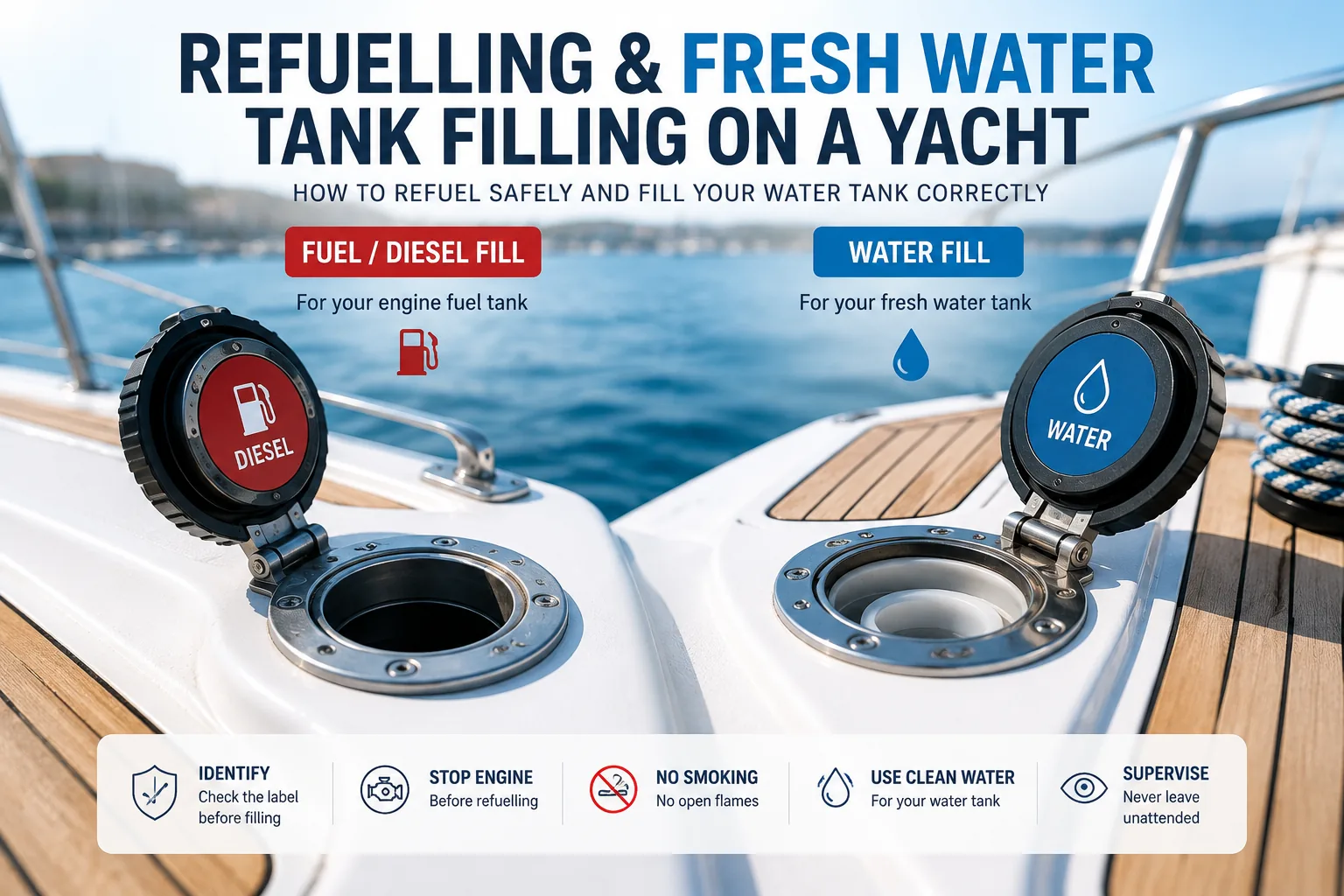
Refuelling & Fresh Water Tank Filling on a Yacht
Two routine operations can cause surprisingly expensive problems when performed incorrectly. Putting water into a diesel tank, diesel into a fresh-water tank, overflowing fuel, contaminating drinking water or damaging a tank because its vent cannot breathe can quickly turn a normal charter stop into a serious problem.
The Three Deck Fittings You Must Not Confuse
FUEL / DIESEL
Connected to the vessel's fuel tank. On many sailing yachts this means diesel, but never assume the required fuel solely from the type of vessel.
WATER
Connected to one or more fresh-water tanks supplying sinks, showers and other domestic-water consumers.
WASTE
Connected to the black-water or holding-tank system for pump-out. It is not a filling point for either fuel or fresh water.
Before Approaching a Fuel or Water Dock
Preparation should happen before the boat reaches the berth—not after somebody is already standing on the dock with a hose.
Prepare the boat
- Prepare bow and stern lines.
- Position fenders on the correct side.
- Identify the expected wind and current.
- Determine which side provides access to the required deck filler.
- Brief the crew before entering the station.
Prepare the crew
- One person remains responsible for manoeuvring.
- Assign crew members to lines.
- Identify who will handle the fuel or water hose.
- Keep unnecessary crew away from the working area.
- Do not rush because other boats are waiting.
Part 1 — Refuelling the Yacht
Before Filling
During Refuelling
- Keep control of the nozzle at all times.
- Do not leave the filling operation unattended.
- Use a controlled filling rate.
- Watch the tank vent and listen for changes that may indicate the tank is approaching full.
- Reduce the filling rate as the expected tank level approaches full.
- Do not deliberately fill fuel into the filler neck.
- Stop immediately if fuel appears at the vent or filler.
- Contain any spill immediately and follow marina/fuel-station procedures.
After Refuelling
- Remove the nozzle carefully and avoid dripping fuel onto the deck or water.
- Securely reinstall the fuel cap.
- Inspect the deck and fuel-filler area.
- Check for unexpected fuel smell or visible leakage.
- For gasoline installations, follow the vessel manufacturer's required ventilation/blower procedure before starting engines.
- Confirm lines and crew are ready before leaving the berth.
Part 2 — Filling the Fresh-Water Tank
Fresh-water filling does not have the same fire risk as refuelling, but incorrect handling can contaminate the drinking-water system or damage plumbing.
Before Filling
Flush the Hose First
A hose exposed to the sun can contain warm stagnant water, dirt or material that has entered the hose while stored. Before filling the yacht:
- Connect the hose to the potable-water supply.
- Run water through it away from the deck filler.
- Allow stagnant water and debris to clear.
- Keep the hose end clean.
- Only then begin filling the yacht.
During Water Filling
- Use a moderate flow rate.
- Do not leave the hose unattended.
- Do not force the hose tightly into the filler in a way that prevents air from escaping.
- Do not assume the tank vent can handle unlimited filling pressure.
- Listen for changes in sound as the tank approaches full.
- Watch the tank vent and filler.
- Reduce the flow rate as the tank approaches full.
- Stop when the tank is full or water begins returning from the filler/vent as appropriate for the installation.
After Filling
- Stop the shore-water flow before removing the hose.
- Remove the hose without allowing its end to fall into dirty harbour water.
- Securely reinstall the WATER filler cap.
- Wipe away water around the filler.
- Inspect nearby lockers or bilges if unexpected water appeared during filling.
- Check the tank-level indication if fitted.
- If the tank was previously empty, purge air from the domestic-water system according to the vessel procedure.
Fuel vs Fresh Water — Important Differences
| Action | Fuel tank | Fresh-water tank |
|---|---|---|
| Confirm filler | FUEL / DIESEL | WATER |
| Confirm product | Correct fuel grade/type | Potable water |
| Main contamination risk | Water/wrong fuel | Fuel, dirty hose or unsafe water |
| Ignition precautions | Critical | Not normally applicable to water filling |
| Tank vent | Monitor during filling | Must allow displaced air to escape |
| Overflow | Environmental and fire hazard | Stop filling and investigate abnormal overflow |
| Hose cleanliness | Fuel equipment | Potable-water hygiene important |
| After filling | Cap, spill/leak check, safe restart procedure | Cap, leak check, restore water system |
What If You Put Something Into the Wrong Tank?
Water entered the fuel tank
Do not start the engine. Stop filling immediately. Inform the skipper, charter company or vessel operator and arrange appropriate fuel-system inspection and removal of the contaminated contents.
Diesel entered the fresh-water tank
Do not use the water system. Stop filling immediately and notify the vessel operator. The contaminated tank and plumbing require an appropriate decontamination procedure before the water can again be considered suitable for normal use.
Interactive: What Are You About to Fill?
Common Mistakes
Wrong deck filler
The most serious avoidable mistake. Read the marking and verify before inserting the hose.
Dirty water hose
Using an unknown or contaminated hose can compromise fresh-water hygiene.
Filling too quickly
A high flow rate gives less time to react and may overwhelm restricted tank ventilation.
Leaving the hose unattended
Overflow can happen quickly. Someone should continuously supervise both fuel and water filling.
Trusting the gauge completely
Marine tank-level gauges may not accurately represent the actual remaining volume.
Rushing at a busy marina
Fuel docks can become congested during charter changeover periods. Other boats waiting are not a reason to skip checks.
30-Second Final Check Before Leaving
Golden Rule
If you are not completely certain which deck fitting you are looking at, do not put anything into it until you have confirmed it.
Continue reading
Build your Croatia sailing knowledge with related TwoBoat guides, software, guides and planning tools.