
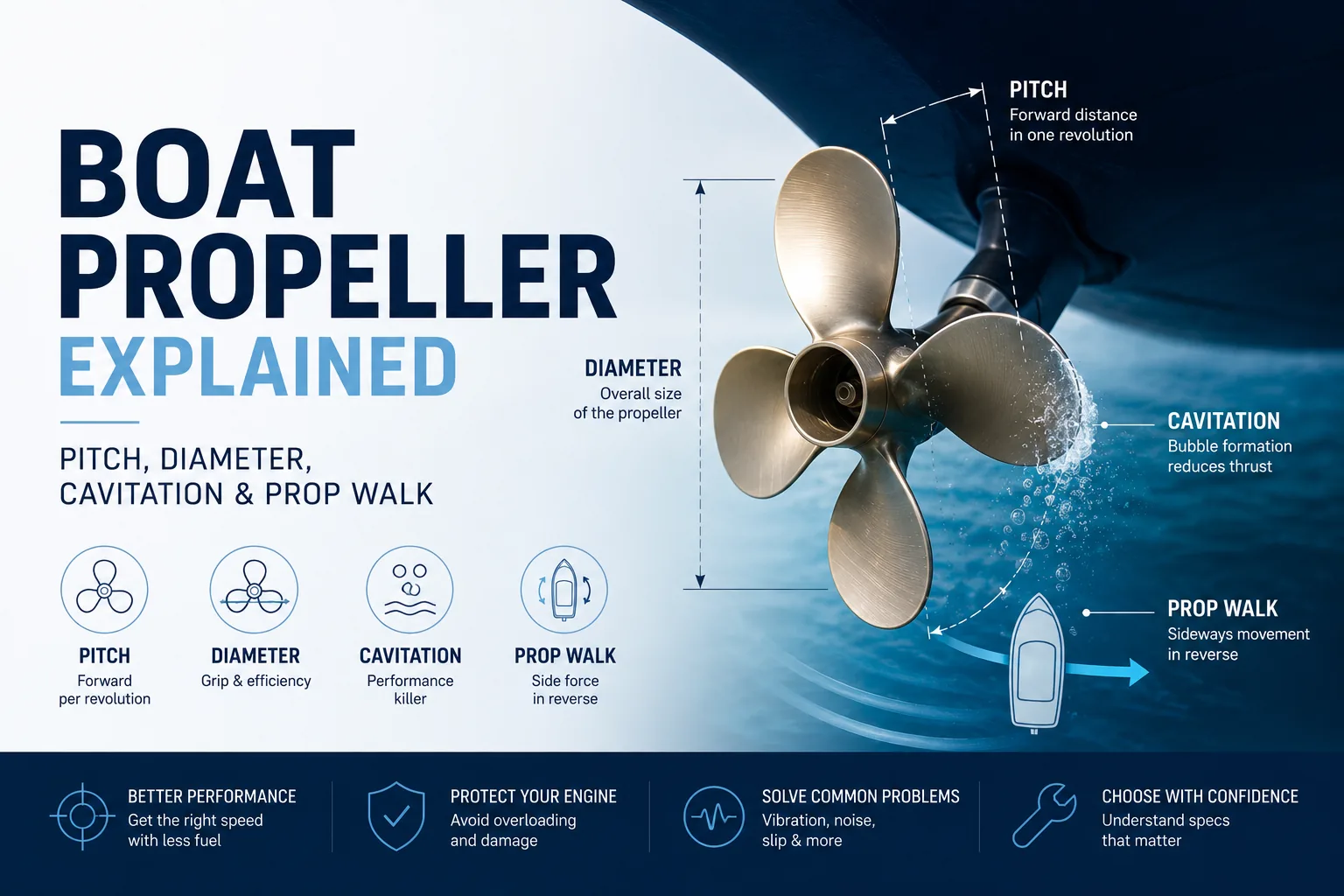
Boat Propeller Explained – Pitch, Diameter, Cavitation & Prop Walk
The propeller is where engine power finally becomes thrust. Learn what diameter and pitch actually mean, why RPM changes when propeller load changes, what propeller slip is, how cavitation differs from ventilation and why a single-propeller boat often kicks its stern sideways in reverse.
The propeller in one minute
A rotating propeller accelerates water and produces thrust. Its behavior depends on much more than simply the number of blades. Diameter, pitch, blade area, blade shape, rotation, gearbox ratio, engine power, hull resistance and operating conditions all interact.
Diameter
The diameter of the circle swept by the blade tips.
Pitch
The theoretical distance the propeller would advance in one revolution if it moved through a solid without slip.
Blade count
Common recreational propellers have 2, 3, 4 or more blades, depending on application.
Rotation
Right-hand and left-hand propellers rotate in opposite directions when producing ahead thrust.
Interactive propeller anatomy
Change diameter, pitch and blade count to visualize the concepts. The drawing is educational and intentionally simplified.
What is propeller diameter?
Diameter is twice the distance from the propeller's center to the blade tip. Increasing diameter generally increases the area of water the propeller can act upon, but available clearance, engine power, gearbox ratio and hull geometry limit what can be fitted.
What is propeller pitch?
Pitch is often described using a screw analogy. A nominal 16-inch pitch propeller would theoretically advance 16 inches per revolution if there were no slip. Water is not solid, so a real boat advances less.
Higher pitch
More theoretical advance per revolution and generally more load on the engine, all else being equal.
Lower pitch
Less theoretical advance per revolution and generally less engine load, all else being equal.
Pitch, RPM and theoretical speed calculator
Use propeller pitch, engine RPM and gearbox ratio to calculate theoretical zero-slip propeller advance. Then apply an assumed slip percentage to estimate speed.
What is propeller slip?
Propeller slip is the difference between theoretical pitch advance and actual advance through the water. Some slip is normal and necessary for a propeller to generate thrust.
Calculate observed propeller slip
Two, three or four blades?
2 blades
Common on some sailing applications where low drag under sail is valuable. Exact performance depends heavily on propeller design.
3 blades
A very common compromise for recreational boats, providing useful blade area and relatively smooth thrust.
4+ blades
Additional blade area can be useful where diameter is constrained or where thrust, smoothness and specific operating requirements justify it.
Fixed, folding and feathering propellers
Fixed propeller
Simple and robust, but on a sailboat its blades remain exposed to the water stream while sailing.
Folding propeller
Blades fold to reduce drag under sail and open when propulsion is applied.
Feathering propeller
Blades rotate toward a low-drag orientation when sailing and reposition for powered operation.
What is cavitation?
Cavitation occurs when local pressure around the blade falls sufficiently for vapor cavities to form. Their collapse can create noise, vibration, performance loss and, when severe or persistent, blade-surface damage.
Cavitation vs ventilation
Cavitation
Vapor cavities form because local pressure becomes very low around the blade. It is a pressure phenomenon occurring in the water around the propeller.
Ventilation
Air or exhaust gas is drawn into the propeller from the surface or another source, causing the propeller to lose its normal grip on solid water.
What is prop walk?
Prop walk is a sideways stern tendency associated with propeller rotation, particularly noticeable on many single-screw boats in reverse. Its strength varies dramatically with hull, propeller, rudder, shaft angle, RPM, water flow and vessel speed.
Using prop walk while docking
Once you know your own boat's behavior, prop walk can become useful rather than annoying. Short controlled bursts of reverse may help move the stern toward a preferred side while maneuvering at low speed.
Prop wash and the rudder
In ahead gear, a conventional shaft-driven propeller can direct a strong stream of water over the rudder. This means a short burst of ahead power can create useful steering force even before the boat develops much forward speed.
Ahead burst
Prop wash over the rudder can create immediate turning force on many conventional shaft-drive boats.
Reverse
Rudder authority may initially be weaker because the propeller is no longer driving the same strong stream aft across the rudder.
Propeller pitch and engine loading
The engine and propeller must operate as a matched system. Too much propeller load can prevent the engine from reaching its specified full-throttle RPM under normal loaded conditions. Too little load may allow RPM to rise too easily.
Why a boat may not reach full RPM
Too much propeller load
Pitch, diameter or blade area may be excessive for the engine/gearbox installation.
Fouling
Marine growth on the hull or propeller can dramatically increase resistance.
Propeller damage
Bent or damaged blades can reduce efficiency and introduce vibration.
Engine problem
Fuel, air, exhaust, turbo or other engine faults can also prevent rated RPM. Do not blame the propeller automatically.
Propeller troubleshooting wizard
Common propeller symptoms
| Symptom | Possible categories | First checks |
|---|---|---|
| Engine cannot reach expected WOT RPM | Overloading, fouling, engine fault | Prop/hull condition, engine health, installed prop specification |
| RPM high but speed poor | Ventilation, excessive slip, fouling, wrong prop | Prop condition, immersion, hull condition, speed/RPM data |
| New vibration | Blade damage, fouling, shaft issue | Stop and inspect propulsion safely |
| Thrust pulses | Damaged prop, disturbed inflow, fouling | Propeller and underwater gear inspection |
| Strong sideways stern movement in reverse | Prop walk | Learn direction and strength in open-water practice |
| Sudden RPM flare near surface/turns | Ventilation or loss of clean inflow | Operating condition, prop immersion and installation |
Propeller damage: what to look for
Bent blade
Even modest deformation can create imbalance, vibration and unequal blade loading.
Nicks / erosion
Damaged edges and surface erosion can reduce efficiency and may indicate impact or cavitation-related damage.
Fishing line
Line around a shaft can damage seals and should be removed safely before it causes a larger problem.
Fouling matters more than many skippers expect
Barnacles and marine growth change blade shape and surface roughness. A fouled propeller may cause reduced speed, poor acceleration, vibration and increased fuel consumption.
Propeller clearance
The blade tips need appropriate clearance from the hull and surrounding structure. Insufficient clearance can increase noise, vibration and pressure pulses. Required clearance depends on the installation and should follow the vessel/propulsion designer's specifications.
Right-hand vs left-hand propeller
Rotation is normally described when viewed from astern looking forward at the propeller. A right-hand propeller turns clockwise in ahead operation when viewed from astern; a left-hand propeller turns counterclockwise.
Before buying a replacement propeller
Propeller inspection checklist
Propeller knowledge quiz
Use propeller knowledge while maneuvering
After understanding prop walk and prop wash, continue with the Docking a Boat in Wind – Interactive Simulator, Boat Electrical System Guide and TwoBoat troubleshooting guides.
Frequently asked questions
What does 18 × 16 mean on a propeller?
It commonly indicates approximately 18 inches of diameter and 16 inches of pitch, although markings and conventions should be confirmed with the propeller manufacturer.
Does more pitch make a boat faster?
Not automatically. More pitch increases theoretical advance but also changes engine loading. If the engine cannot reach its intended operating RPM, performance can become worse rather than better.
What is propeller slip?
It is the difference between theoretical pitch-based advance and actual advance through the water. Some slip is inherent in real propeller operation.
What is cavitation?
Cavitation is the formation of vapor cavities in locally low-pressure regions around a propeller blade. Their collapse can cause noise, vibration, efficiency loss and erosion.
What is propeller ventilation?
Ventilation occurs when air or exhaust gas reaches the propeller, reducing its ability to work in solid water.
What is prop walk?
Prop walk is a sideways stern tendency caused by propeller-related hydrodynamic effects. It is often most useful and noticeable during low-speed reverse maneuvering on single-screw boats.
Why does my boat vibrate after hitting something?
A blade may be bent or damaged, but the shaft and other underwater components can also be affected. Stop using the propulsion system if vibration is severe and inspect it safely.
How do I choose the correct propeller?
Use the engine's rated RPM range, gearbox ratio, vessel characteristics, shaft/hub compatibility, current performance data and manufacturer or propeller-specialist recommendations. Propeller selection is an engineering match, not simply choosing the largest diameter or pitch that fits.
Continue reading
Build your Croatia sailing knowledge with related TwoBoat guides, software, guides and planning tools.