
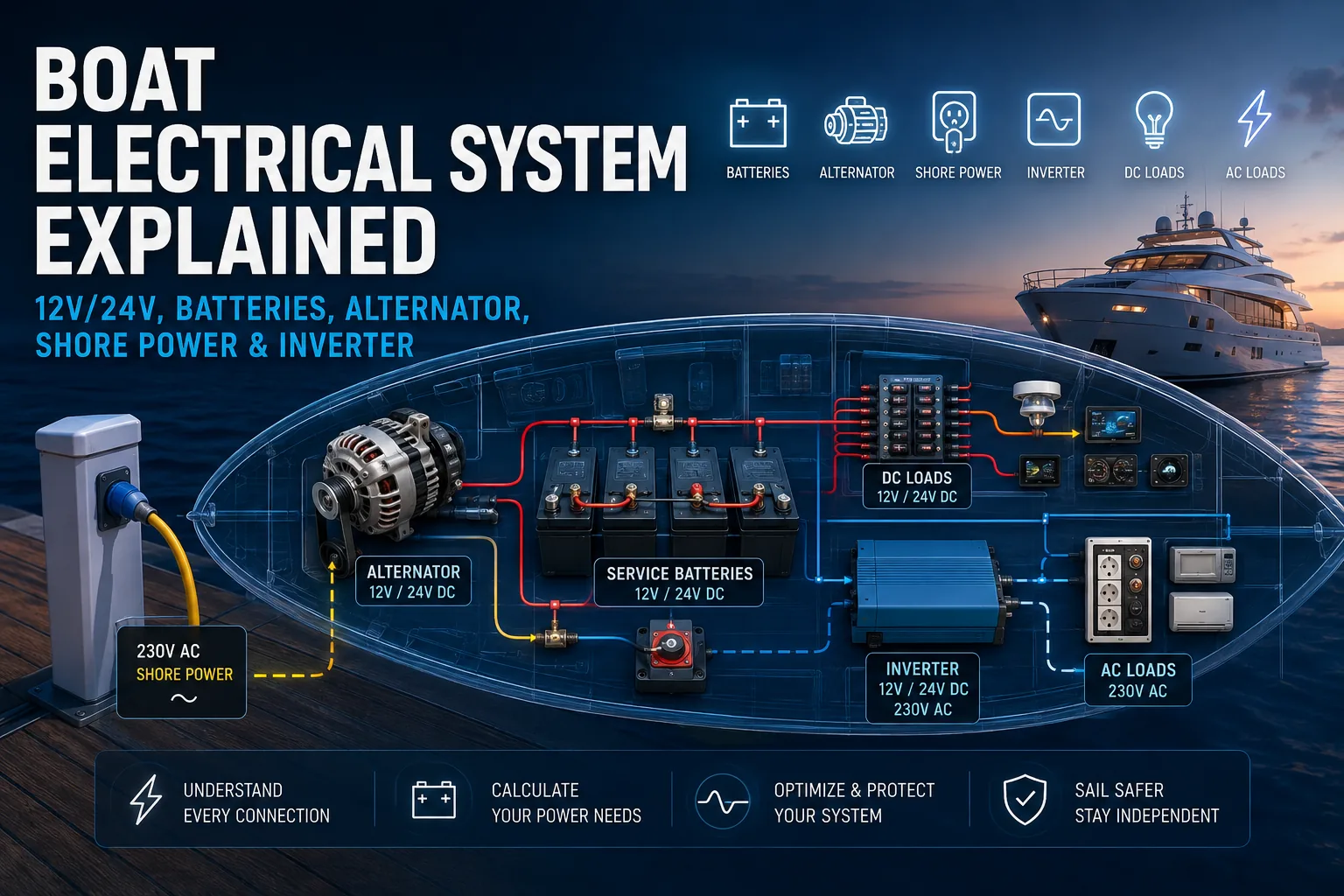
Boat Electrical System Explained – 12V/24V, Batteries, Alternator, Shore Power & Inverter
A yacht electrical system becomes much easier to understand when you stop seeing hundreds of wires and start following energy. Learn where electricity comes from, where it is stored, how it is distributed and why common failures happen. Then use the interactive system map and calculators to diagnose realistic onboard problems.
The electrical system in one minute
Most recreational boats contain two linked electrical systems. The DC system is normally 12V or 24V and runs essential equipment from batteries. The AC system is commonly 230V/50Hz in Europe or 120V/60Hz in North America and is supplied from shore power, a generator or an inverter.
Battery
Stores DC electrical energy and supplies loads when no charging source is available.
Alternator
Uses engine rotation to supply electrical power and recharge batteries.
Battery charger
Converts shore or generator AC into controlled DC charging power.
Inverter
Converts battery DC into AC for selected household-style loads.
Interactive yacht electrical-system map
Switch charging sources and faults on or off. Green paths are energized; grey paths are unavailable. This is a simplified training diagram rather than a wiring plan for a specific vessel.
Why boats use 12V or 24V
Small and medium recreational boats commonly use 12V DC. Larger yachts often use 24V DC, particularly where long cable runs and large electrical loads are involved.
The key relationship is P = V × I. For the same power, doubling the voltage approximately halves the current.
Example: 1,200 W load
12V: approximately 100 A before losses.
24V: approximately 50 A before losses.
Real inverter current will be higher because conversion is not perfectly efficient and battery voltage changes under load.
Interactive power/current calculator
Starter battery vs house battery
Starter battery
Designed to deliver a large current for a short period to crank the engine. Its energy should be protected from normal overnight hotel loads.
House bank
Supplies refrigeration, lighting, pumps, VHF, navigation electronics, USB charging and other loads while engines are stopped.
Battery chemistry
Flooded lead-acid
Traditional, economical and proven. Requires correct charging and, depending on type, maintenance and ventilation.
AGM
Sealed lead-acid technology with good high-current performance and relatively low maintenance.
Gel
Sealed lead-acid chemistry requiring charger settings appropriate to its voltage limits.
LiFePO₄
High usable capacity, low weight and strong charge acceptance, but requires a correctly engineered BMS, charging strategy and protection system.
Interactive battery-state visualizer
For a resting 12V lead-acid battery, voltage can provide a rough indication of state of charge. Values are approximate and change with chemistry, temperature, recent charging and load.
Battery capacity and runtime calculator
Series and parallel batteries
Parallel
Two identical 12V 100Ah batteries connected correctly in parallel remain approximately 12V while capacity becomes approximately 200Ah.
Series
Two identical 12V 100Ah batteries connected correctly in series become approximately 24V / 100Ah.
Battery switches, busbars, fuses and breakers
Battery switch
Isolates or selects major battery circuits. Some boats include emergency parallel/combined operation.
Busbar
Provides an organized common connection point for positive or negative circuits.
Fuse
Interrupts excessive current and is selected primarily to protect the conductor and circuit.
Breaker
Provides overcurrent protection with a resettable switching function where appropriate.
Why cable size matters
A 12V system may be low voltage, but it can carry very high current. Long runs, undersized conductors and poor connections can create unacceptable voltage drop and heat.
Interactive voltage-drop calculator
Estimate voltage drop for a simple copper DC circuit. The result is educational; conductor sizing must also consider ampacity, installation method, insulation rating, temperature and applicable marine standards.
12.0 V
12.0 V
The alternator
When the engine is running, the alternator converts mechanical rotation into electrical output. It supplies active loads and replaces energy removed from the battery bank.
Healthy charging clue
A resting 12V lead-acid battery may be around 12.5–12.8V, while charging voltage is normally higher. Exact voltage depends on regulator strategy, battery type and charging stage.
If voltage does not rise
Investigate the alternator, regulator, belt, charging fuse, cables, grounds, isolators, DC-DC equipment and battery/BMS state.
Lithium warning
Lithium banks can accept large sustained currents. Alternator thermal protection or controlled charging may be necessary.
Alternator charging trainer
Shore power
Shore power brings marina AC electricity aboard through the shore cable, inlet, main protection and AC distribution panel. It may power outlets, water heaters, air-conditioning and the battery charger.
Pedestal
The marina source must match the vessel's electrical system and be in serviceable condition.
Main AC protection
The vessel needs appropriate disconnect and protective devices. Exact arrangements vary by region and installation.
Connections
Dirty, loose or worn connectors can create resistance, heating and fire risk.
Shore-power connection inspection
Battery charger: AC → DC
An onboard charger converts shore or generator AC into regulated DC charging current. Modern chargers normally use charging profiles selected for the installed battery chemistry.
Inverter: DC → AC
An inverter allows selected AC equipment to run from the battery bank when shore or generator AC is unavailable.
High-power AC appliances create very high DC current. A 1,500W appliance on a nominal 12V system theoretically needs 125A before inverter losses. That is why inverter installations use heavy conductors, short DC runs, appropriate protection and strong battery banks.
Typical shutdown reasons
Low battery voltage, overload, high temperature, poor DC connections, blown fuse or an internal inverter fault.
Inverter load simulator
Solar charging
A common arrangement is solar panel → MPPT/PWM controller → battery bank. Solar performance depends on panel area, sun angle, shading, temperature, controller design and battery acceptance.
Daily energy-budget calculator
Add typical loads and compare estimated daily consumption with solar/charging production.
Voltage drop: one of the most common hidden faults
A battery can show 12.6V while a pump receives only 10.8V when running. The lost voltage may be across an undersized cable, corroded connector, poor fuse holder, failing switch or bad negative connection.
Follow the power: the core troubleshooting method
1. Source
Battery, alternator, shore power, charger or solar.
2. Protection
Main fuse, local fuse, breaker or protective device.
3. Distribution
Battery switch, busbar, panel, relay and wiring.
4. Load + return
Device, connector and negative/return path.
Interactive electrical troubleshooting wizard
Select the symptom. The trainer returns a logical diagnostic sequence instead of encouraging random parts replacement.
Common electrical symptoms
| Symptom | First checks | Likely categories |
|---|---|---|
| Nothing DC works | Battery voltage, isolation switch, main fuse, DC bus | Source or common distribution fault |
| Only one device fails | Breaker, local fuse, voltage at device, return path | Branch circuit or device fault |
| Battery repeatedly flat | Charging, hidden loads, battery capacity, energy budget | Insufficient charging, parasitic load, degraded battery |
| No alternator charging | Belt, alternator, regulator, fuse, cable, BMS | Charging-system fault |
| Shore AC works, battery does not charge | Charger breaker/input, charger status, DC fuse | Charger/output-path fault |
| Electronics reboot when pump starts | Battery voltage under load, grounds, cable drop, pump current | Voltage sag/high resistance |
| Inverter trips | Battery voltage under load, overload, temperature, cables | Low DC supply or inverter protection |
| Connector becomes hot | Stop and inspect load, contact condition and tightness | High resistance or overload |
Why electronics reboot when a pump starts
Motors can draw a larger current at startup. If the battery is weak or there is resistance in a shared cable/negative path, system voltage can briefly sag below the operating threshold of sensitive electronics.
Corrosion and poor connections
Look for
Green copper corrosion, white deposits, blackened strands, cracked insulation, burned plastic and moisture in connectors.
Feel for
Unexpected heating at terminals, fuse holders and connectors while circuits are carrying load.
Measure
Compare voltage on each side of switches, fuses and connections while the load is active.
Using a multimeter aboard
A digital multimeter is one of the most useful onboard diagnostic tools. It can help locate where voltage disappears, identify continuity problems and compare battery voltage with voltage at a running load.
Emergency electrical warning signs
Heat or smell
Burning smell, hot cable, melted insulation or overheated shore connector.
Battery distress
Abnormal swelling, smoke, unusual heating or electrolyte-related problems.
Repeated trips
A fuse that repeatedly blows or breaker that repeatedly trips indicates a fault or overload that must be investigated.
What every skipper should be able to locate
Electrical tools worth carrying
Diagnosis
Digital multimeter, DC clamp meter where appropriate, flashlight and the vessel wiring diagram.
Basic repair
Correct spare fuses, marine-grade terminals, suitable crimping tool and heat-shrink materials.
Documentation
Label wires, record fuse ratings and keep charger/inverter manuals accessible offline.
Build a simple electrical diagram
Even a simplified diagram can save hours during a failure. Start with batteries, main fuses, switches and busbars. Add charging sources, panels and large consumers such as inverter, windlass and thrusters.
Energy sources
Alternator · shore charger · solar · generator
Energy consumers
DC panel · electronics · pumps · refrigeration · inverter · AC loads
Five-minute pre-departure electrical inspection
Boat electrical-system knowledge quiz
Continue your onboard systems training
Combine electrical-system knowledge with the Fresh Water System Guide, Boat Fire Safety, Docking a Boat in Wind and Boat Safety Checklist.
Frequently asked questions
Is a boat normally 12V or 24V?
Many smaller recreational boats use 12V DC. Larger yachts and systems with large loads may use 24V. Some vessels use several voltage systems simultaneously.
What voltage should a 12V battery show?
A rested, fully charged lead-acid battery is commonly around the upper 12V range, while charging voltage is higher. Exact values depend on chemistry, temperature and charging state. Lithium state of charge is poorly estimated from voltage alone.
Can I run household appliances from a boat battery?
Yes, if the vessel has a correctly designed inverter and sufficient battery capacity. High-power appliances can draw very large DC currents, especially on a 12V system.
Why is my battery not charging while the engine is running?
Possible causes include alternator, regulator, belt, fuse, cable, connection, isolator/DC-DC charger or BMS problems. Follow the charging path systematically.
Why does my inverter shut down when I use a kettle?
A kettle can demand well over 1kW. The inverter may see low battery voltage, excessive load, poor DC cabling or high temperature. Measure voltage at the inverter while the load is active.
Why do lights dim when the water pump starts?
The pump motor creates a startup current demand. Weak batteries, undersized wiring or poor shared connections can cause a temporary voltage drop.
Can a 12V system start a fire?
Yes. Although the voltage is low, battery banks can deliver extremely high fault currents. Short circuits and poor high-current connections can create intense heat.
Should I disconnect the battery while the engine is running to test the alternator?
No. Do not use battery disconnection as a crude alternator test; voltage transients can damage electronics. Use proper voltage/current testing instead.
Continue reading
Build your Croatia sailing knowledge with related TwoBoat guides, software, guides and planning tools.