
Marine Toilet & Holding Tank System Explained
Understand the complete waste-water path aboard a yacht: toilet, pump, Y-valve, holding tank, vent, deck pump-out and any legal overboard-discharge equipment. Learn why toilets smell, why bowls fill back up, why tanks refuse to empty and how to troubleshoot problems without randomly dismantling the system.
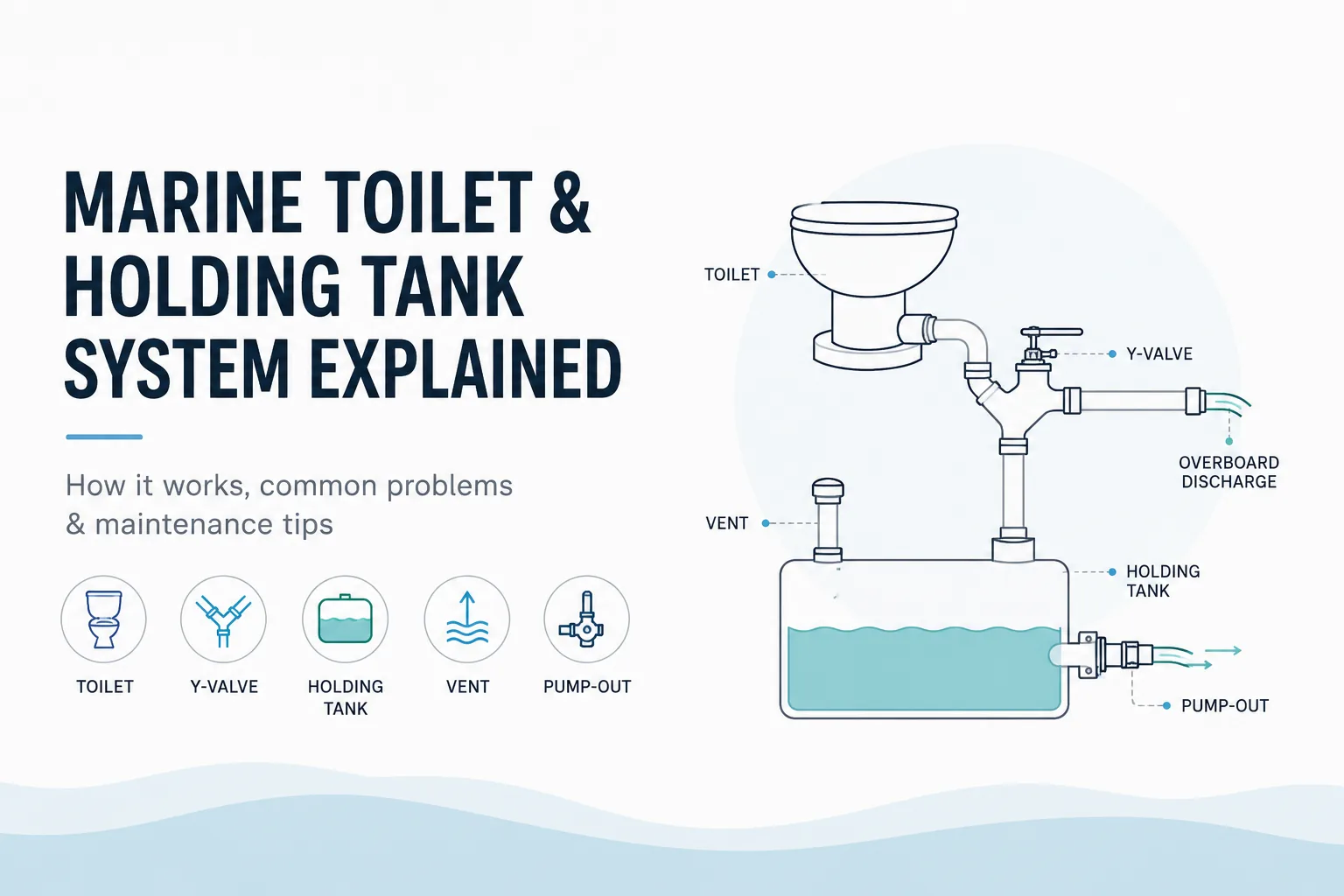
The complete system in one picture
A marine toilet is not simply a household toilet installed on a boat. It is part of a compact pumping, storage, ventilation and discharge system.
How a marine toilet works
1. Flush water
Water enters the bowl from a dedicated freshwater supply or, on many systems, through a raw-water intake and pump arrangement.
2. Waste pump
A manual piston pump or electric macerating/pumping mechanism moves bowl contents into the sanitation hose.
3. Destination
Plumbing routes waste toward a holding tank or another permitted destination according to the vessel's design and valve configuration.
Manual vs electric marine toilets
Manual toilet
A hand-operated pump moves flush water and waste. It is mechanically simple and can often be diagnosed by checking valves, seals, pump action and hose restrictions.
Electric toilet
An electric pump or macerator performs the flush cycle. Troubleshooting therefore includes both plumbing and electrical checks: breaker, fuse, switch, motor, pump and blockage.
What does the Y-valve do?
A Y-valve is a routing valve. Depending on the vessel's plumbing, it may direct waste toward the holding tank or toward another discharge path. The exact arrangement differs from boat to boat.
The holding tank
The holding tank temporarily stores sewage until it can be emptied appropriately. It normally has several connections: inlet from the toilet, pump-out pickup, vent and sometimes an additional discharge connection.
Why the tank vent matters
The vent allows air to move as the tank fills and empties. A blocked vent can create pressure or vacuum problems and can make flushing or pump-out difficult.
During flushing
Waste enters the tank and displaces air. That air needs a path out.
During pump-out
Waste leaves the tank and replacement air needs a path in.
Odor control
Good tank ventilation and a healthy sanitation system help reduce persistent odor problems.
Deck pump-out fitting
The deck fitting provides access for a marina sewage pump-out hose. Suction removes waste from the tank through the tank's pump-out tube or connection.
Holding-tank fill simulator
Estimate how quickly the tank could fill based on your own assumptions.
Why does a marine toilet smell?
Persistent odor does not automatically mean the holding tank itself is leaking. The source may be sanitation hoses, stagnant flush water, poor ventilation, leaking seals, contaminated bilge areas or waste trapped in plumbing.
Sanitation hose
Old or unsuitable hose can become odor-permeable.
Stagnant intake water
Raw-water toilet plumbing can develop unpleasant odor after sitting unused.
Vent problem
Poor tank ventilation can contribute to odor and pressure problems.
Leak / seal
Inspect connections, pump seals, joker valves and surrounding compartments.
Interactive troubleshooting wizard
Select the symptom and follow the checks in order.
Toilet will not flush
First determine whether the problem is water entering the bowl, waste leaving the bowl, or the pump not operating.
No flush water
Check the intended water source, seacock where applicable, strainer, pump/valves and supply hose.
Water enters but waste remains
Investigate the discharge pump, joker/check valve, hose restriction and downstream valve position.
Electric toilet silent
Check breaker/fuse, switch, supply voltage, wiring and motor before assuming a plumbing blockage.
Why does the bowl fill back up?
Backflow can occur when waste or water returns through the discharge plumbing. Possible causes include a worn joker/check valve, plumbing arrangement, restriction downstream or siphoning conditions.
Why is manual pumping suddenly difficult?
A manual toilet that becomes unusually hard to pump is warning you that resistance has increased. Do not simply apply more force.
Closed valve
A routing valve or seacock may not be in the expected position.
Blocked hose
Foreign material or scale can restrict sanitation plumbing.
Tank/vent issue
A full tank or blocked vent can create abnormal system resistance.
What should never go into a marine toilet?
The safest general rule is that the system should only receive what it was designed to handle. Wipes and other foreign material are a common source of blockages.
Wet wipes
Even products marketed as flushable can create serious problems in compact marine plumbing.
Sanitary products
They can obstruct valves, hoses, pumps and macerators.
Foreign objects
Paper towels, cloth, packaging, excessive paper and other debris can stop the system.
Tank will not pump out
| Check | Why it matters | Possible symptom |
|---|---|---|
| Tank vent | Air must enter as waste is removed | Strong vacuum, poor/no flow |
| Deck fitting seal/connection | Pump-out needs an effective suction connection | Air leakage, weak suction |
| Pump-out hose/tube | Restriction prevents waste reaching deck fitting | No or very slow removal |
| Tank contents | Heavy solids or deposits may obstruct pickup | Intermittent flow |
| Valve configuration | Some installations include valves in the pump-out path | Completely blocked path |
Odor diagnostic trainer
Freshwater-flush vs raw-water-flush toilets
Freshwater flush
Uses the vessel's freshwater system or a dedicated arrangement. It avoids bringing seawater organisms into the bowl but consumes potable water.
Raw-water flush
Uses seawater through an intake system. It preserves freshwater but introduces additional seacock, hose and pump considerations and may develop odor after stagnant seawater remains in plumbing.
Seacocks and siphon protection
Any toilet connected to the sea deserves special attention because a plumbing failure can become a flooding problem. Know which seacocks serve the toilet and understand the vessel's anti-siphon/vented-loop arrangement where fitted.
Pre-charter toilet briefing
Holding-tank maintenance checklist
Emergency: sewage leak inside the boat
Stop using the toilet, prevent additional material entering the affected plumbing, isolate relevant pumps and valves as appropriate to the vessel, protect yourself from contact, contain contamination and determine whether the leak involves a hose, fitting, tank or pump.
Quick troubleshooting table
| Symptom | First checks |
|---|---|
| No flush water | Water source, seacock, strainer, inlet pump/valves |
| Electric toilet completely dead | Breaker, fuse, switch, supply voltage, wiring |
| Manual pump very hard | Valve position, blockage, full tank, vent |
| Bowl refills after flushing | Joker/check valve, siphoning, downstream restriction |
| Persistent sewage odor | Hoses, seals, vent, leaks, stagnant flush water |
| Tank cannot be pumped out | Vent, pump-out connection, pickup tube/hose, valves |
| Tank appears full too quickly | Level sensor, excessive flush water, actual tank capacity |
| Waste leak | Stop use; inspect hose, clamps, pump, tank fittings |
Marine toilet knowledge quiz
Understand the systems behind the bulkheads
Continue with the Boat Electrical System Guide, Fresh Water System Guide and your other TwoBoat safety and troubleshooting guides.
Frequently asked questions
Why does my marine toilet smell?
Possible causes include permeated sanitation hose, stagnant raw-water flush plumbing, leaking seals or fittings, poor tank ventilation and contamination around the toilet or tank.
Why is my marine toilet hard to pump?
Possible causes include a downstream blockage, incorrect valve position, full holding tank, blocked vent or a problem inside the manual pump.
Why does waste return to the bowl?
A worn joker/check valve, restriction, plumbing geometry or siphoning may allow liquid to return after flushing.
Why will my holding tank not pump out?
Check the tank vent, deck connection, pickup tube/hose and any valves in the pump-out path. A tank that cannot admit replacement air can be difficult to empty.
Can I put wet wipes in a marine toilet?
It is best not to. Compact marine pumps, valves and sanitation hoses are much more vulnerable to foreign material and blockages than many users expect.
What is a Y-valve?
It is a plumbing valve that routes flow between different paths. On sanitation systems its legal operating position can depend on local discharge rules.
Should I leave toilet seacocks open?
Follow the specific vessel's procedures. Seacock management is an important flooding-safety issue and arrangements differ between boats.
Continue reading
Build your Croatia sailing knowledge with related TwoBoat guides, software, guides and planning tools.