
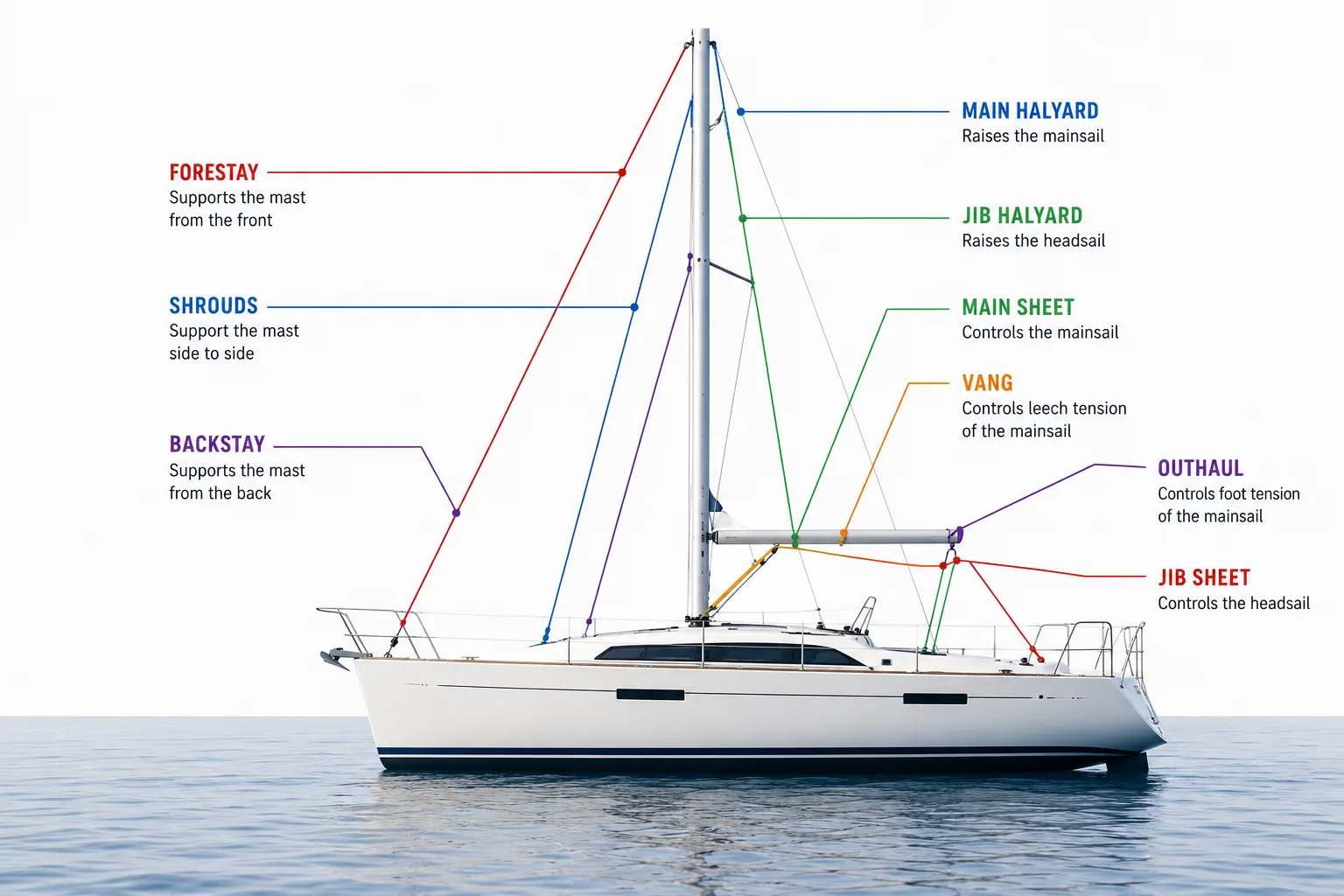
Sailboat Rigging Explained – Every Line & What It Does
A cockpit full of ropes looks complicated until you understand that each line has a specific job. Explore an interactive sailboat and learn the difference between standing and running rigging, what each major control does, how the lines work together and which controls matter when hoisting, reefing, trimming and maneuvering.
First: ropes become lines when they have a job
On a sailboat, the generic material may be rope, but once it has a defined function it is normally called a line. A halyard hoists something, a sheet controls a sail's angle, a reefing line reduces sail area, and a control line changes sail shape or hardware position.
Halyards
Primarily raise and support sails or other equipment.
Sheets
Control the angle of a sail relative to the boat and wind.
Control lines
Adjust sail shape, boom position, reefing systems and other rig functions.
Interactive sailboat – click a line
Use the filters or click the colored rigging on the sailboat. The drawing represents a typical modern sloop; actual boats can route and name controls differently.
Choose a line
Click a colored line on the sailboat to see what it does and when you use it.
Red = standing rigging · Green = halyards · Blue = sheets · Orange = sail controls
Standing rigging vs running rigging
Standing rigging
The structural rigging that supports and stabilizes the mast: typically forestay, backstay and shrouds/stays. These components are normally not handled continuously while sailing.
Running rigging
The movable lines used to hoist, lower, trim and control sails: halyards, sheets, reefing lines and sail-shape controls.
The major lines – what each one actually does
HALYARDJob: Raises and supports the mainsail.Used when: Hoisting, lowering and adjusting luff tension.
HALYARDJob: Raises/supports the headsail on non-furling or appropriate furling systems.Effect: Halyard tension influences luff tension and sail shape.
SHEETJob: Controls the boom/mainsail angle and contributes to leech tension.Used constantly: Ease or trim as apparent wind angle and load change.
SHEETJob: Control the headsail clew and sail angle.Tacking: Release the old working sheet and trim the new one.
CONTROLJob: Pulls the mainsail clew aft along the boom.Effect: Changes lower-mainsail depth.
CONTROLJob: Pulls the boom downward.Effect: Controls boom rise and influences mainsail twist/leech tension, especially when eased off the wind.
CONTROLJob: Applies downward tension near the mainsail luff.Effect: Fine-tunes luff tension and draft position.
CONTROLJob: Moves the mainsheet attachment point sideways.Effect: Helps change boom position without exactly the same effect on sheet tension.
CONTROLJob: Helps reduce mainsail area using reef points or a configured reefing system.Used when: Wind/load increases beyond comfortable full-sail operation.
CONTROLJob: Rotates a furling drum/system to roll a sail around its foil or stay.Important: Maintain control of both furling line and sheet during operation.
Halyards: the lines that raise sails
The word halyard generally identifies a line used to hoist something. The main halyard raises the mainsail; a jib or spinnaker halyard raises the corresponding sail. Halyard tension can also affect sail shape.
Sheets: the lines you trim constantly
Sheets control sails rather than raising them. On a typical sloop, the mainsheet controls the mainsail/boom and two jib sheets allow the headsail to be trimmed from either side after a tack.
Trim in
Pulling a sheet generally brings the sail closer toward the boat's centerline.
Ease
Letting a sheet out allows the sail to move farther away from the centerline.
Do not over-trim
A sail can look tight yet perform poorly if it is pulled farther in than the wind angle requires.
Interactive mainsheet trainer
Move the mainsheet control and compare it with the selected point of sail. This is a simplified teaching visualization rather than an aerodynamic simulator.
Outhaul – controlling lower mainsail depth
The outhaul tensions the mainsail foot by pulling the clew aft. More outhaul tension generally flattens the lower part of the mainsail; easing it allows more depth, within the sail and rig's designed range.
Vang / kicker – controlling boom rise
The boom vang runs between the lower mast area and boom. Its most obvious job is resisting upward boom movement. This makes it particularly important when the mainsheet is eased and no longer provides as much downward component.
Traveler – sideways mainsheet position
The traveler allows the mainsheet's lower attachment point to move to port or starboard. This gives the trimmer another way to manage boom position and mainsail power without relying only on sheet tension.
Cunningham – fine control of luff tension
The Cunningham applies tension near the lower mainsail luff. It is commonly used as a fine sail-shape control after the sail has been hoisted, helping influence luff tension and draft position.
Reefing lines – reducing sail area
Reefing reduces the exposed mainsail area as wind and loads increase. Systems vary: traditional slab reefing may use reefing lines through the boom, while in-mast or in-boom furling rigs use different controls.
Headsail furling line
On a roller-furling headsail, the furling line turns the drum to roll the sail around the forestay foil. The sheet controls the sail as it rolls in or out. Keep controlled tension on the appropriate lines so the sail does not unfurl violently.
Forestay, backstay and shrouds
Forestay
Supports the mast toward the bow. Many modern cruising boats also carry the furling headsail around the forestay/foil.
Backstay
Supports the mast toward the stern on rigs that use one. Adjustable backstays can also affect rig tension and sail shape.
Shrouds
Support the mast laterally. Multiple shrouds may connect through spreaders and chainplates depending on rig design.
What happens during a tack?
- The boat turns its bow through the wind.
- The previously loaded jib sheet is eased/released in a controlled way.
- The headsail crosses the foretriangle.
- The opposite jib sheet becomes the new working sheet.
- The new sheet is trimmed for the new apparent wind angle.
- The mainsail crosses automatically with the boom — keep crew clear of the boom and mainsheet system.
Working sheet vs lazy sheet
The working sheet is the jib/genoa sheet currently carrying the sail load. The opposite sheet is often called the lazy sheet. After a tack, their roles swap.
Rigging troubleshooting wizard
Common line problems
| Symptom | Possible cause | Check first |
|---|---|---|
| Halyard very hard to pull | Line twist, clutch, block/sheave resistance, sail-track friction or load | Stop forcing it; trace the complete line path |
| Jib will not furl | Furling line jam, override, excessive sheet tension, drum/foil problem | Control the sail and inspect line/drum routing |
| Mainsheet jams | Winch override, tangled line, block problem | Reduce load safely before clearing |
| Mainsail shape too full low down | Outhaul setting among possible causes | Review outhaul and overall trim |
| Boom rises excessively off wind | Insufficient vang control | Check vang setting and system |
| Unknown line in cockpit | Never assume | Trace it physically from tail to attachment/control |
How to identify an unknown line
Do not identify a line only by its color because owners often replace ropes with different colors. Instead, physically trace where it begins, which blocks or clutches it passes through and where it ends.
Does it go up the mast?
It may be a halyard or mast-related control.
Does it attach to a sail clew?
It may be a sheet or outhaul depending on the sail and location.
Does it reach the boom?
It may belong to mainsheet, vang, outhaul or reefing systems.
Does it reach a furling drum?
It is likely part of the furling system.
Winches, clutches and blocks
Winch
Provides mechanical advantage and friction for controlling highly loaded lines.
Clutch / rope clutch
Holds a loaded line so it can be secured without continuously leaving it on a winch.
Block
A marine pulley that redirects a line and can form mechanical-advantage systems.
Before leaving the marina – rigging checklist
Rigging knowledge quiz
Learn the boat as a complete system
Continue with Boat Propeller Explained, Docking a Boat in Wind, Sailing at Night and the TwoBoat troubleshooting guides.
Frequently asked questions
What is the difference between a halyard and a sheet?
A halyard generally raises or supports a sail, while a sheet controls a sail's angle and trim.
What is standing rigging?
Standing rigging is the structural system supporting the mast, typically including stays and shrouds.
What is running rigging?
Running rigging consists of movable lines used to hoist, lower, reef and trim sails and operate associated controls.
What does the mainsheet do?
It controls boom and mainsail angle and also influences mainsail leech tension and twist depending on the rig and traveler position.
What does the outhaul do?
It pulls the mainsail clew aft and changes tension along the foot, affecting lower-sail depth.
What does the boom vang do?
It pulls the boom downward and helps control boom rise and mainsail twist, especially when the mainsheet is eased.
What does a Cunningham do?
It adds luff tension near the lower mainsail and helps fine-tune sail shape and draft position.
What is a lazy sheet?
It is the currently unloaded headsail sheet. After a tack it usually becomes the new working sheet.
Why are there two jib sheets?
One is used for each tack so the headsail can be controlled from the appropriate side of the boat.
How can I learn all the lines quickly?
Learn by function rather than color: first halyards, then sheets, then reefing/furling controls, then fine sail-shape controls. Physically trace every line on the actual boat before sailing.
Continue reading
Build your Croatia sailing knowledge with related TwoBoat guides, software, guides and planning tools.