
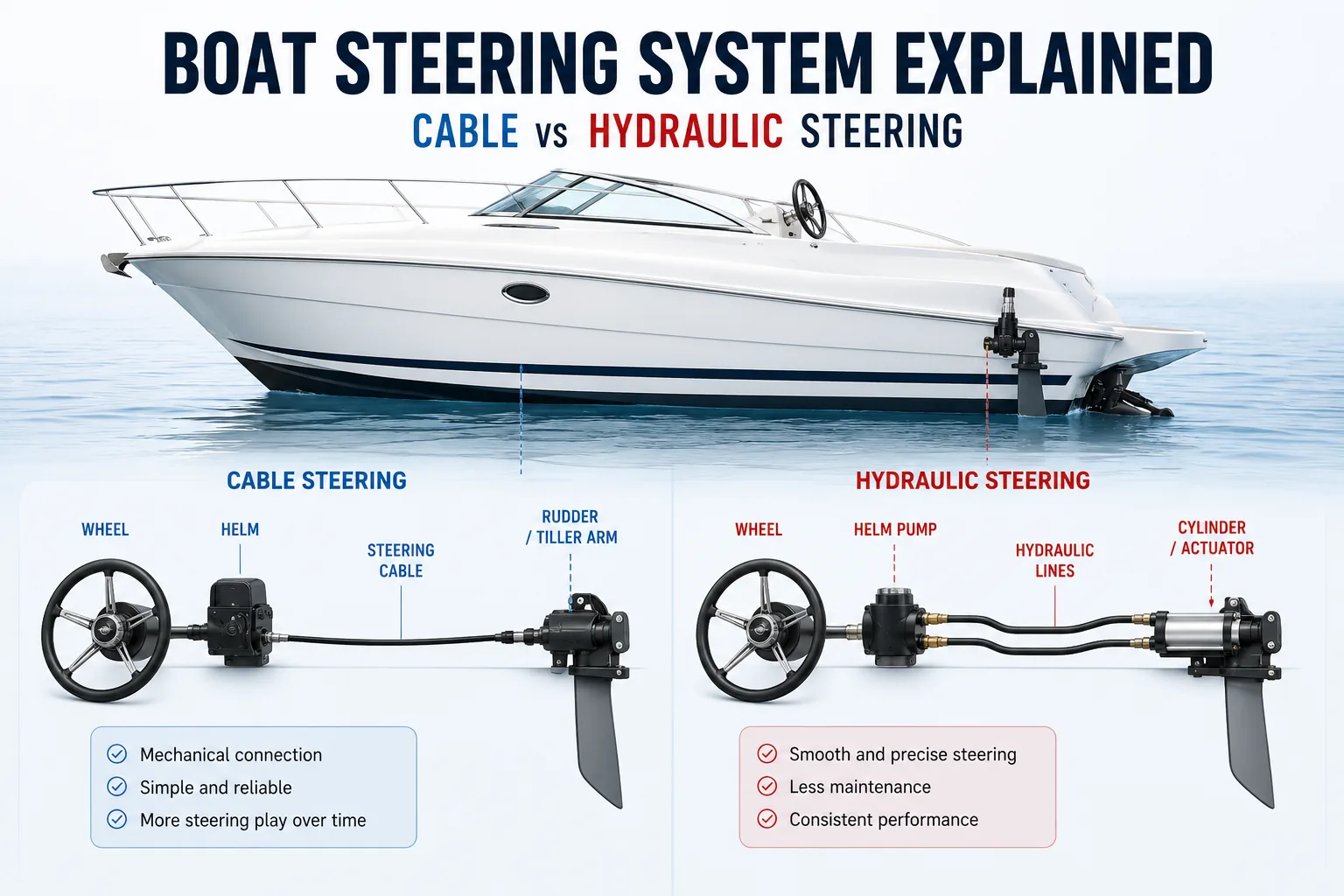
Boat Steering System Explained – Cable vs Hydraulic Steering
Turning the wheel is only the beginning. Learn how helm movement reaches a rudder, sterndrive or outboard through mechanical cable or hydraulic steering, what each component does, why steering becomes stiff or develops play, how air enters hydraulic systems and what to inspect before a steering problem becomes dangerous.
Boat steering in one minute
A steering system converts movement at the helm into controlled movement of the boat's steering surface or propulsion unit. The exact hardware depends on the vessel: an inboard sailboat may turn a rudder, while an outboard boat may physically pivot the engine.
1. Helm input
The skipper turns the wheel.
2. Force transfer
A cable or hydraulic fluid carries the steering command.
3. Actuation
A linkage, quadrant, ram or cylinder moves.
4. Boat turns
The rudder, outboard or sterndrive changes direction.
Interactive steering system
Select cable or hydraulic steering and move the wheel. The simulator shows the basic force path rather than a vessel-specific installation.
Mechanical cable steering
Mechanical systems use a steering helm and cable to transfer wheel rotation into push-pull movement. Common arrangements include rotary and rack-and-pinion helms. At the engine or steering linkage, cable movement physically changes the steering angle.
Helm mechanism
Converts steering-wheel rotation into cable travel.
Steering cable
Transfers the mechanical push-pull force.
Connection / linkage
Transfers cable travel to the engine, drive or steering arm.
Rotary vs rack-and-pinion cable steering
Rotary helm
The cable is driven by a rotary helm mechanism behind the wheel. It is compact and common on many smaller recreational boats.
Rack-and-pinion helm
Wheel movement drives a rack mechanism that moves the steering cable. It requires a different amount and shape of space behind the dashboard.
Hydraulic steering
Hydraulic steering replaces the long mechanical push-pull cable with hydraulic pressure. Turning the helm pump moves fluid through hoses to a steering cylinder. The cylinder then moves the rudder linkage, sterndrive or outboard.
Helm pump
Moves hydraulic fluid when the wheel turns.
Hydraulic lines
Carry fluid between helm and cylinder.
Cylinder / ram
Converts hydraulic pressure and flow into linear movement.
Steering arm
Transfers cylinder movement to the steering device.
Cable vs hydraulic steering
| Characteristic | Mechanical cable | Hydraulic |
|---|---|---|
| Force transfer | Mechanical push-pull cable | Hydraulic fluid and cylinder |
| Typical complexity | Relatively simple | More components, hoses and seals |
| Steering feel | Can transmit more mechanical feedback | Often smoother and can isolate some feedback |
| Common problems | Stiff cable, corrosion, wear, excessive play | Leaks, low fluid, air, seal or cylinder problems |
| Maintenance focus | Cable, helm and linkage condition | Fluid, hoses, fittings, seals, cylinder and bleeding |
| Application | Common on smaller/lighter installations | Common where steering loads or installation requirements favor hydraulics |
Why does steering become stiff?
Cable friction
Internal corrosion, wear or damage can make a mechanical cable difficult to move.
Pivot/linkage
Corroded or poorly moving steering pivots can create resistance independent of the cable.
Hydraulic fault
Hose, helm, valve or cylinder problems may create abnormal steering effort.
External load
High hydrodynamic steering load or a damaged steering component can make steering feel abnormal.
Interactive steering symptom analyzer
Steering play: how much is normal?
A small amount of movement may exist in some systems, but increasing or excessive free play deserves investigation. The important question is not simply how far the wheel moves: determine where movement is being lost between the helm and the rudder, engine or drive.
Air in hydraulic steering
Hydraulic systems rely on an effectively incompressible fluid column. Air is compressible, so trapped air can produce a soft, spongy or inconsistent steering feel and excessive wheel movement.
Possible signs
Spongy helm feel, delayed response, excessive wheel turns or inconsistent steering.
Why air appears
Low fluid, leaks, opened hydraulic lines or incorrect bleeding/service procedures.
Correction
Find and correct leaks first, then fill and bleed exactly according to the steering manufacturer's procedure.
Hydraulic fluid leaks
Inspect the helm, hose fittings, hose runs and steering cylinder. A hydraulic leak is not merely a cleanliness problem: loss of fluid can eventually result in reduced steering authority or steering failure.
Hydraulic steering bleeding – concept
Bleeding removes trapped air while replacing it with the specified steering fluid. Exact procedures differ by manufacturer and system, so use the correct service instructions. Conceptually the process is:
- Confirm the system is mechanically sound and leaks are repaired.
- Use only the specified steering fluid.
- Maintain the correct fluid supply at the helm or filling point.
- Move fluid through the circuit using the manufacturer's bleeding sequence.
- Operate the steering through its range while purging air as specified.
- Verify fluid level, fittings, steering response and absence of leaks.
What if the wheel turns but the boat does not?
Cable system
Possible cable, helm, connection or steering-linkage failure.
Hydraulic system
Possible fluid loss, severe air ingress, helm/cylinder failure or disconnected linkage.
Rudder system
Possible failure between the steering actuator and rudder stock/quadrant/tiller arm.
Emergency steering
Larger sailboats and many offshore-capable vessels have an emergency steering method, often an emergency tiller that connects more directly to the rudder stock. Its location and installation procedure should be understood before departure—not discovered after the primary steering fails.
Steering troubleshooting wizard
Common steering symptoms
| Symptom | Possible categories | First checks |
|---|---|---|
| Wheel suddenly much harder to turn | Cable, linkage, helm, pivot, cylinder or external steering load | Do not force it; isolate where resistance begins |
| Increasing free play | Helm/cable/linkage wear or hydraulic air/fault | Observe movement through complete steering chain |
| Spongy hydraulic helm | Air, low fluid, leak | Inspect fluid level and entire system for leakage |
| Fluid at cylinder rod | Possible cylinder seal leak | Clean, inspect and service per manufacturer |
| Wheel turns, actuator does not | Major helm/cable/hydraulic failure | Treat as safety-critical steering fault |
| Actuator moves, rudder does not | Mechanical linkage failure | Inspect quadrant/tiller arm/linkage safely |
Pre-departure steering checklist
Cable or hydraulic – which should you choose?
Do not choose steering solely on price or helm feel. The system must be appropriate for the engine power, vessel speed, steering load, number of engines, installation geometry and manufacturer requirements.
Cable can make sense when…
The boat and propulsion system are specifically suited to an approved mechanical steering system and steering loads remain within its rating.
Hydraulic can make sense when…
The application benefits from hydraulic force transfer, routing flexibility, higher steering loads or a system specifically specified for the propulsion package.
Steering knowledge quiz
Understand the systems that control your boat
Continue with Boat Propeller Explained, Sailboat Rigging Explained, Boat Electrical System Explained and Docking a Boat in Wind.
Frequently asked questions
How does cable steering work on a boat?
The helm converts wheel rotation into push-pull movement of a mechanical steering cable, which then moves the steering linkage, engine or drive.
How does hydraulic boat steering work?
Turning the wheel operates a helm pump that moves hydraulic fluid through hoses to a steering cylinder. Cylinder movement then changes the steering angle.
Is hydraulic steering better than cable steering?
Not universally. The correct system depends on vessel type, engine power, steering loads, speed, installation and manufacturer specifications.
Why is my boat steering suddenly stiff?
Possible causes include cable corrosion or wear, binding pivots or linkages, helm problems, hydraulic faults or abnormal loads. Sudden changes should be investigated rather than forced.
Why does my hydraulic steering feel spongy?
Air in the hydraulic system is a common possibility. Inspect for leaks and low fluid, correct the underlying fault and bleed the system using the manufacturer's procedure.
Why is there play in my steering wheel?
Free play can originate in the helm, cable, linkage, hydraulic system or rudder/engine connection. Trace the complete steering chain to find where input movement is being lost.
Can I use any hydraulic fluid?
No. Use only fluid specified or approved by the steering-system manufacturer.
What should I do if steering fails?
Treat it as an emergency, reduce immediate navigational risk, alert crew and deploy the vessel's emergency steering method when appropriate. The correct response depends on vessel type and conditions.
Continue reading
Build your Croatia sailing knowledge with related TwoBoat guides, software, guides and planning tools.