
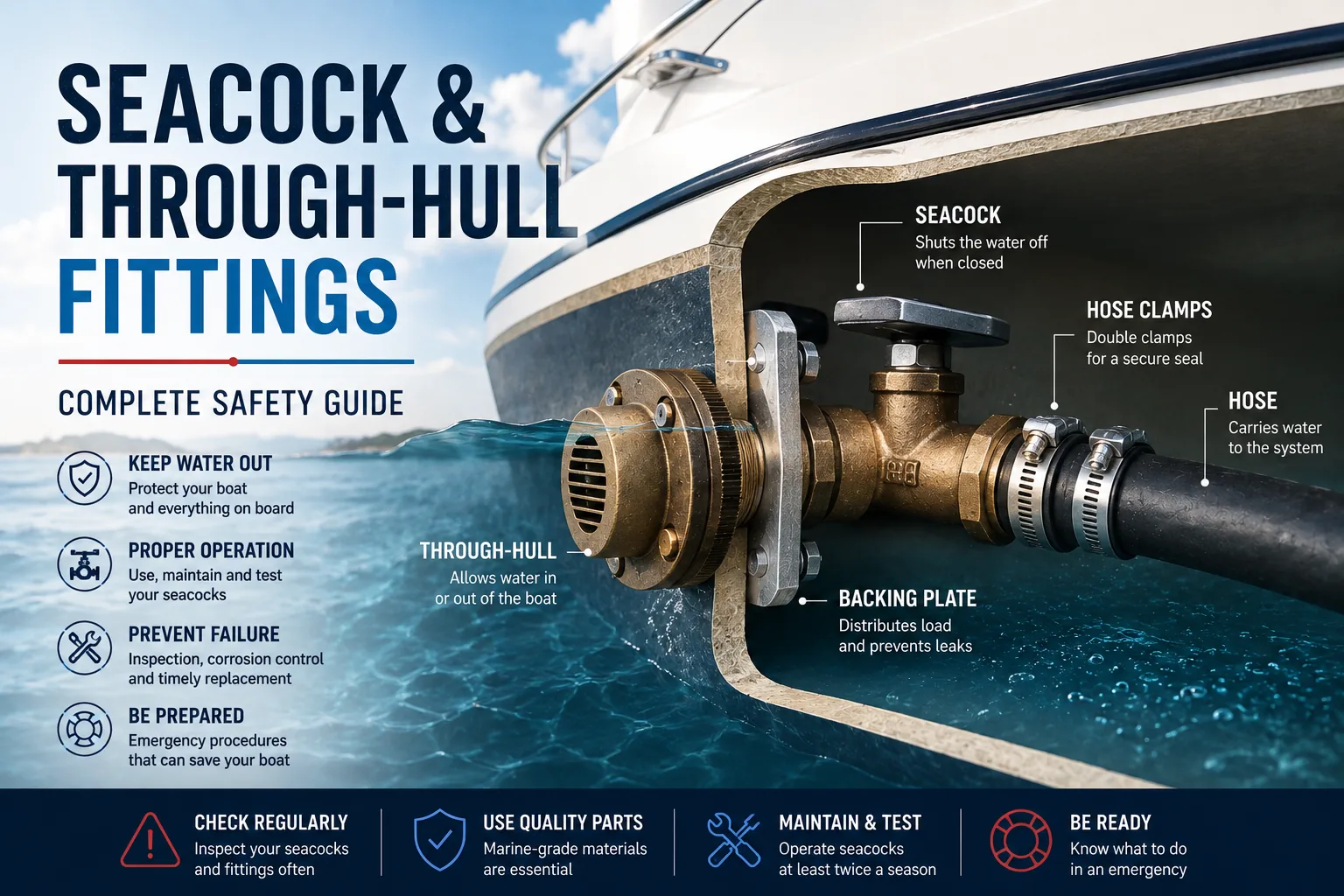
Seacock & Through-Hull Fittings – Complete Safety Guide
A through-hull fitting is one of the few places where a deliberate hole exists below or near the waterline. That makes its valve, backing structure, hose, clamps and maintenance critical. Learn how the complete assembly works, which systems depend on it, how failures develop and what to do if water starts entering the boat.
What is a through-hull fitting?
A through-hull fitting is a fitting that passes through the hull so water can enter or leave the vessel for a specific system. It may serve an engine cooling-water intake, toilet system, sink drain, generator intake, air-conditioning system, livewell, deck drain or another installation.
Interactive through-hull and seacock anatomy
Move the valve handle and simulate common faults. The drawing is simplified but shows the basic arrangement of a below-waterline installation.
Normal installation
Open valve, secure hose and structurally sound fitting.
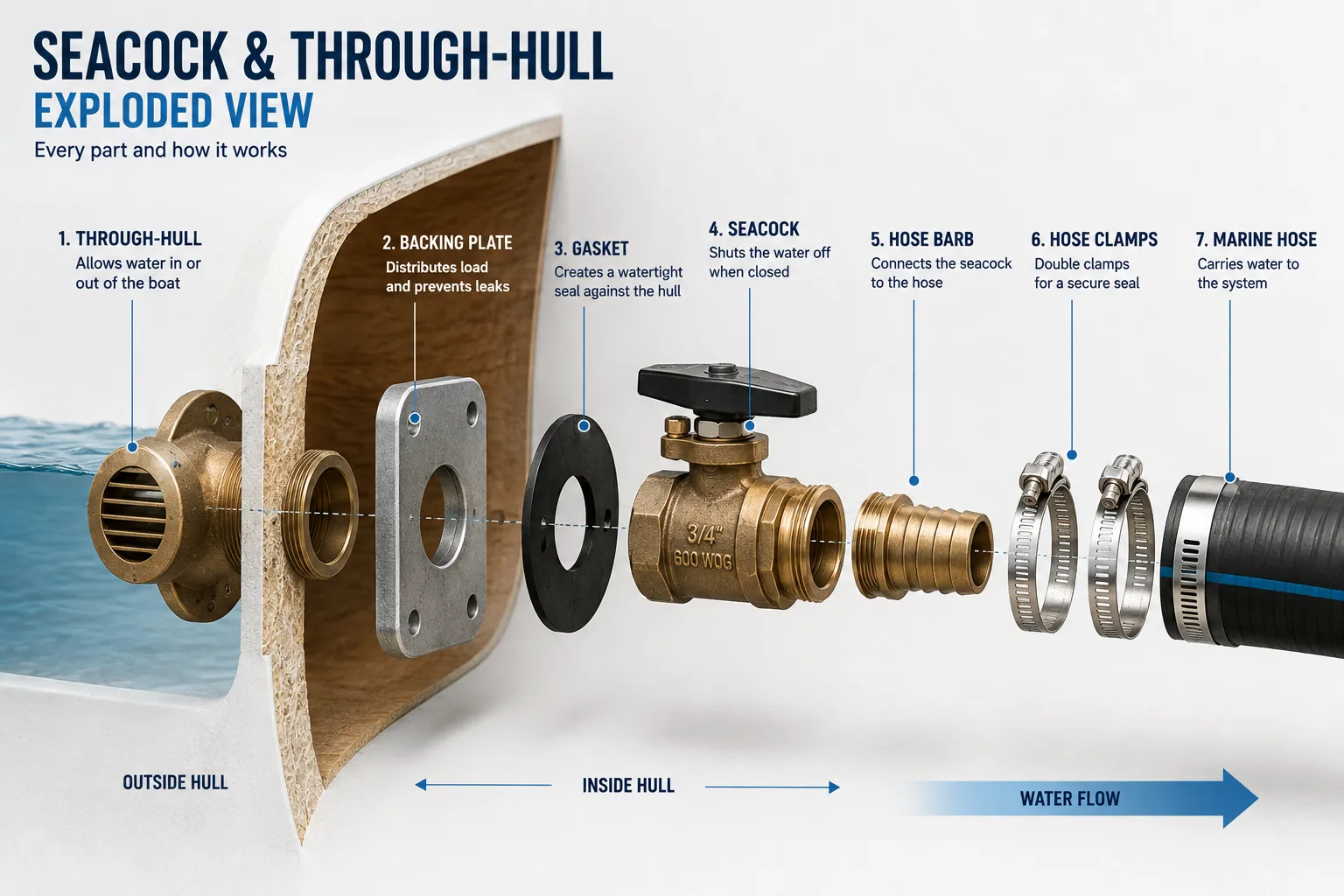
The complete below-waterline assembly
Through-hull body
Passes through the hull and provides the basic water opening.
Backing plate
Spreads loads over a larger hull area and provides a stable foundation for the valve assembly where the design requires one.
Seacock
Provides a positive shutoff so seawater flow can be stopped inside the boat.
Hose connection
Hose tail/barb, sanitation or reinforced hose and appropriate clamps complete the plumbing path.
Why the seacock is so important
The seacock is the valve that allows the crew to isolate seawater from the vessel's internal plumbing. If a downstream hose splits, a pump breaks or a toilet fitting fails, closing the correct seacock can turn a potentially serious flooding event into a manageable repair.
Ball valves, gate valves and true seacocks
Marine installations vary. A proper seacock is designed to act as a hull-mounted shutoff valve. Ball-type valves are common in modern systems because they provide a clear quarter-turn open/closed action. Older boats may contain other valve arrangements.
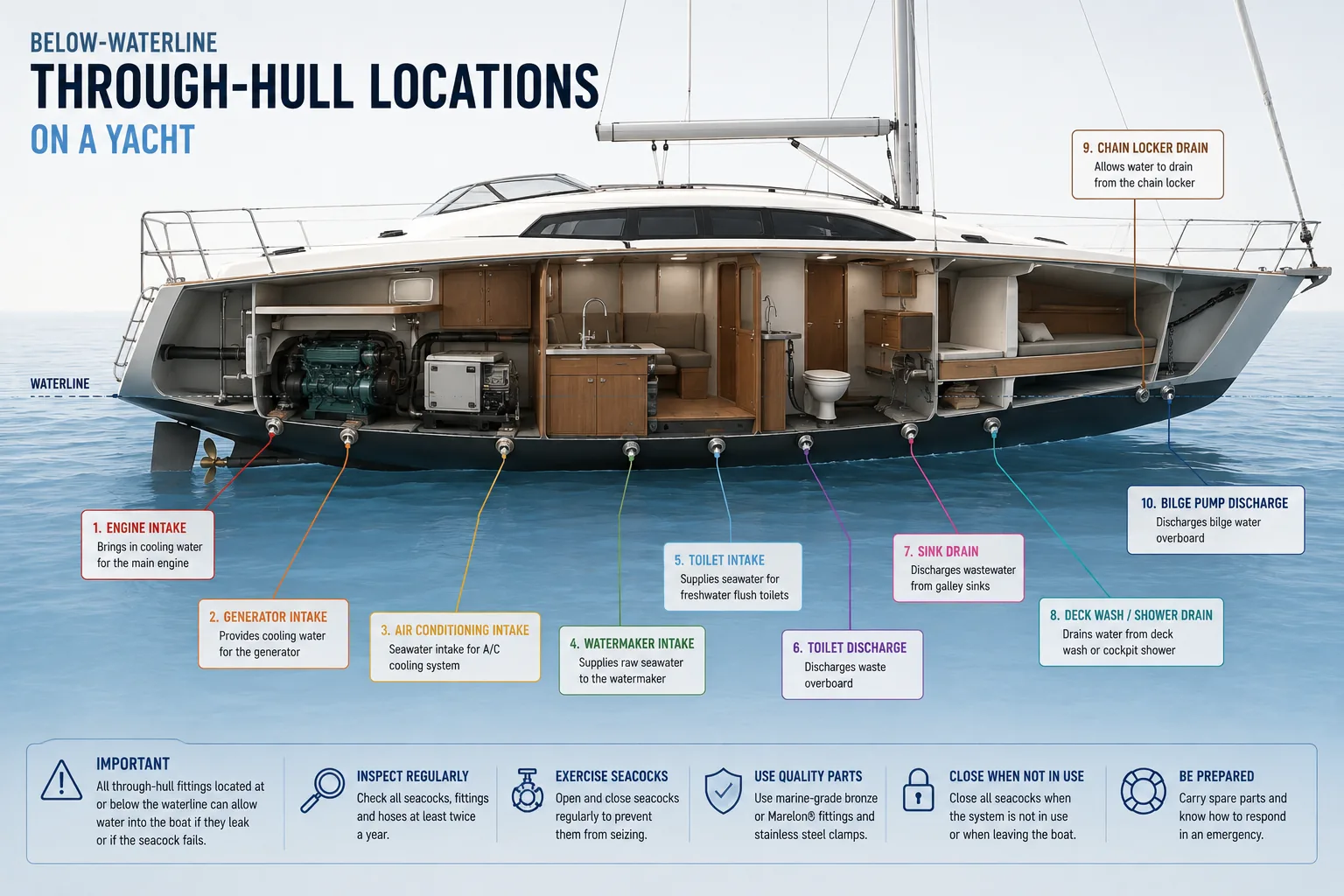
Which systems typically use through-hulls?
| System | Typical connection | Why it matters |
|---|---|---|
| Engine raw-water cooling | Seawater intake | Supplies cooling water to strainer and raw-water pump |
| Generator cooling | Seawater intake | Feeds generator cooling circuit |
| Marine toilet | Flush-water intake and/or discharge path depending on design | Can create both sanitation and flooding risk |
| Sink / basin drain | Overboard drain | Can become seawater entry path if installation or hose fails |
| Air-conditioning | Seawater intake/discharge | Usually requires pump, strainer and continuous-flow plumbing |
| Watermaker | Raw-water intake | Provides feedwater to filtration system |
| Deck/cockpit drains | Drain outlet | Some terminate close to waterline and require careful routing |
Materials: bronze, composite and stainless steel
Marine bronze
Traditional material for many seacocks and through-hulls. Correct marine alloy selection matters because not every brass-colored alloy is suitable for continuous seawater immersion.
Composite
Purpose-designed marine composites can avoid galvanic corrosion and are widely used in approved marine through-hull systems.
Stainless steel
Can be used in some installations but requires correct alloy, oxygen exposure, crevice-corrosion awareness and compatible installation design.
Dezincification and corrosion
Some copper-zinc alloys can lose zinc in seawater, leaving a weakened porous copper-rich structure. A fitting may still look roughly intact while having lost significant mechanical strength.
Possible signs
Pinkish or reddish metal, surface deterioration, unusual softness or crumbling when mechanically stressed.
Galvanic effects
Dissimilar metals connected electrically in seawater can create corrosion problems depending on the bonding and installation system.
Do not over-test
If a fitting looks severely degraded, aggressively hitting or twisting it may create the failure you are trying to diagnose.
Backing plates
A backing plate provides a stable structural interface between the valve assembly and the hull. Its design must match the hull construction and fitting. Water-damaged plywood, cracked laminate or an unstable mounting surface can undermine even a high-quality valve.
Hose tails, hoses and clamps
Hose tail / barb
Provides a secure mechanical connection between the valve and hose. Diameter and hose type must match.
Reinforced hose
Below-waterline hose must resist collapse, chafe and environmental degradation appropriate to its service.
Clamps
Clamps must be correctly sized, positioned and made from material suitable for the marine environment.
Why hoses fail
Age
Rubber and plastic materials harden, crack and lose flexibility.
Chafe
Movement against structure can slowly wear through hose walls.
Heat / chemicals
Service conditions can weaken inappropriate hose material.
Bad support
Heavy unsupported hose can load fittings and clamps.
Operate your seacocks regularly
A valve that is never moved can become difficult or impossible to close when needed. Exercise seacocks according to the manufacturer's maintenance guidance and vessel operating procedure.
Open or closed when leaving the boat?
There is no universal answer for every seacock because some systems must remain available and vessel procedures differ. Many owners close non-essential below-waterline valves when leaving the boat unattended, while certain required systems may remain configured differently.
Emergency simulator – water entering the boat
Estimate how quickly a leak can become serious. Real flow depends on hole size, depth below the waterline and plumbing geometry; this tool is intentionally simplified.
What to do if a hose starts leaking
- Identify the source and confirm whether it is connected to the sea.
- Close the relevant seacock immediately if it is safe and structurally sound to do so.
- Start bilge pumps and monitor water level.
- Use plugs, softwood bungs, emergency clamps or other appropriate temporary measures if required.
- Reduce vessel motion if it worsens the leak and conditions allow.
- Alert crew and prepare emergency communications if control of flooding is uncertain.
- Do not reopen the valve until the failed hose or connection has been safely repaired.
What if the seacock breaks off?
A broken fitting at or below the waterline is a more severe problem because closing the valve may no longer isolate the sea. Emergency plugging then becomes critical.
Softwood plugs and emergency bungs
Many boats carry tapered softwood plugs sized for through-hull fittings. They should be stored where they can be found immediately—ideally close to the fittings they may need to plug rather than buried in a distant locker.
Leak troubleshooting wizard
Common failure modes
| Failure | Why it happens | Risk | Action |
|---|---|---|---|
| Loose clamp | Improper installation, corrosion, hose compression | Leak or hose separation | Inspect and correct with appropriate hardware |
| Cracked hose | Age, heat, chemical attack, chafe | Potential uncontrolled water entry | Close seacock and replace hose |
| Seacock seized open | Lack of use, fouling, corrosion | Cannot isolate failed downstream plumbing | Service/replace before relying on it |
| Seacock seized closed | Corrosion/fouling | Loss of cooling or system supply | Service without forcing a structurally suspect assembly |
| Degraded fitting | Corrosion/dezincification/material incompatibility | Structural failure at hull penetration | Replace with appropriate marine component |
| Backing plate damage | Rot, delamination, poor original installation | Movement and loss of structural support | Repair structure, not only valve |
How to inspect a seacock installation
Visual
Look for green/white corrosion, pink metal, cracks, water stains and distorted hose.
Mechanical
Check whether the assembly is firmly supported and the valve operates appropriately.
Hose
Inspect for softness, hardening, cracks, bulges and chafe.
Clamps
Inspect band, screw housing, positioning and corrosion.
Haul-out inspection
When the vessel is hauled, inspect both sides of the hull penetration. Outside, examine through-hull bodies, strainers/scoops and bedding condition. Inside, inspect the valve, backing plate, bonding arrangements where applicable, hose tails and connected plumbing.
Bonding and galvanic corrosion
Some vessels electrically bond underwater metals; others use different corrosion-control strategies. Do not automatically connect or disconnect a seacock from a bonding system without understanding the vessel's original corrosion-control design.
When should a seacock be replaced?
Replacement is appropriate when the fitting is structurally degraded, the valve cannot be serviced to reliable operation, threads or hose tails are damaged, corrosion is significant, backing support is compromised or the installation uses unsuitable material/hardware.
Before buying replacement fittings
Pre-departure seacock checklist
Seacock safety knowledge quiz
Below-waterline systems deserve special attention
Continue with Marine Toilet & Holding Tank System Explained, Boat Electrical System Explained, Boat Steering System Explained and TwoBoat emergency guides.
Frequently asked questions
What is a seacock?
A seacock is a marine shutoff valve installed at a hull penetration so seawater flow can be isolated from the vessel's internal plumbing.
What is a through-hull fitting?
It is a fitting that passes through the hull to allow water into or out of a specific boat system.
Should seacocks be left open all the time?
Not necessarily. The correct position depends on the system and vessel procedure. Build a vessel-specific plan for which valves remain open underway or unattended.
How often should seacocks be operated?
They should be exercised and maintained according to the manufacturer's guidance and vessel maintenance plan so they remain operable when needed.
Why are there two hose clamps on some through-hull hoses?
Many marine installations use two correctly positioned clamps where the hose tail provides sufficient length and the design calls for it, adding redundancy at a critical below-waterline connection.
What is dezincification?
It is a corrosion process in some copper-zinc alloys where zinc is preferentially removed, potentially leaving a weakened copper-rich structure.
What should I do if a seacock handle will not move?
Do not blindly apply excessive force, especially if the fitting looks degraded. Assess the valve and fitting condition and service or replace as appropriate.
What should I do if a through-hull breaks?
Treat it as a flooding emergency. Control the opening with an appropriate plug or temporary method, activate pumping and prepare communications/assistance if flooding cannot be controlled.
Where should emergency bungs be stored?
Ideally immediately accessible near the seacocks or through-hulls they are intended to plug.
Continue reading
Build your Croatia sailing knowledge with related TwoBoat guides, software, guides and planning tools.