
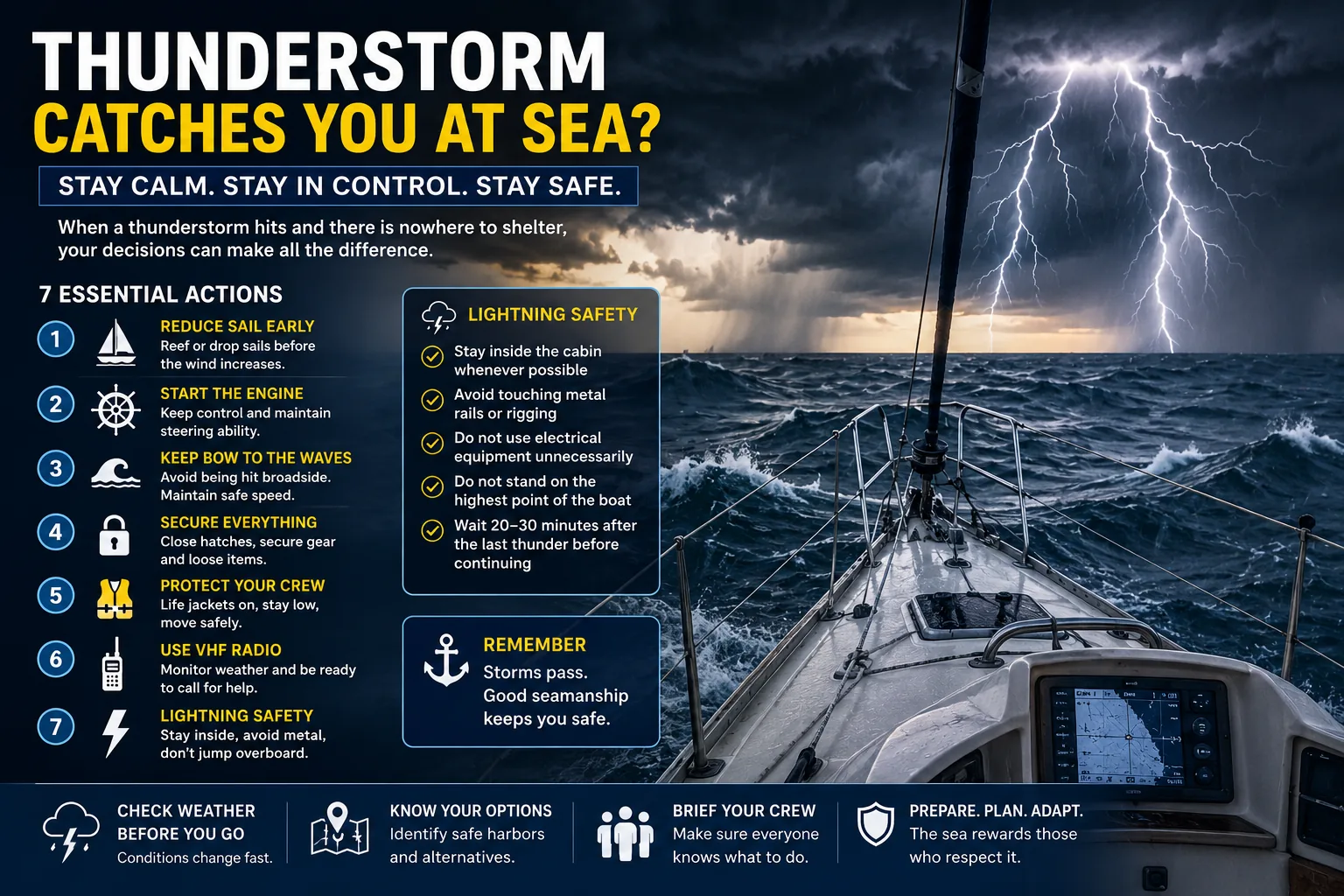
A sudden thunderstorm at sea can turn a normal boating trip into a serious situation within minutes. One moment you may have light wind, sunshine, and manageable waves. A short time later the wind can shift, gusts can increase sharply, rain can reduce visibility, lightning can approach, and the sea can become steep and confused.
If there is no marina, harbor, or sheltered bay close enough to reach safely, the skipper’s goal changes immediately. The priority is no longer reaching the original destination. The priority is keeping control of the boat, protecting the crew, avoiding panic, and making conservative decisions until the worst part of the storm passes.
This guide explains what to do if a thunderstorm catches you at sea, how to recognize the warning signs, how to handle sudden wind and waves, how to behave during lightning, and what mistakes to avoid when there is nowhere to shelter.
Recognize the Warning Signs Early
Most thunderstorms do not arrive without warning. The problem is that many boaters notice the signs too late or underestimate how quickly the situation can change on open water.
Warning signs can include:
- Dark clouds building quickly on the horizon
- A visible curtain of rain moving across the sea
- Distant thunder, even if the sky above you is still clear
- A sudden drop in temperature
- Wind becoming gusty or unstable
- A rapid change in wind direction
- Whitecaps appearing faster than expected
- Falling pressure if you monitor a barometer
- Other boats suddenly heading toward shelter
The most dangerous mistake is waiting until the rain reaches you before taking action. In many thunderstorms, the strongest wind arrives before the heavy rain. That first burst of wind can be the moment when sails overpower the boat, loose equipment flies across the cockpit, or waves begin hitting the boat from an unsafe angle.
If you are planning a trip, always check the latest forecast before departure. For Croatian waters, start with the Twoboat sailing weather Croatia guide and compare it with official marine weather information and local observations.
Why the Wind Can Change So Fast
One of the most surprising parts of a thunderstorm at sea is how quickly the wind can change direction and strength. A light breeze can become a strong gusty wind in only a few minutes. Sometimes it can even shift by 90 or 180 degrees.
This often happens because of a gust front. Inside a thunderstorm, cold air descends rapidly toward the surface. When that cold air hits the sea, it spreads outward like water poured onto a table. This spreading air can push ahead of the rain and replace the existing wind near the surface.
To a skipper, it may feel as if a completely different wind has suddenly appeared. In reality, the thunderstorm has sent out a moving boundary of colder, denser air. That boundary can overpower the local sea breeze or normal wind pattern for a short time.
When this happens, expect:
- Rapid wind direction changes
- Short, sharp gusts
- Confused sea conditions
- New waves building from a different direction
- Reduced control if the boat is not prepared
This is why early preparation matters. Once the gust front reaches you, it may be too late to safely reef sails, organize the crew, close hatches, or secure loose gear.
Your First Priority: Control the Boat
When a storm catches you at sea and there is nowhere to shelter, the most important goal is control. You need enough speed for steering, enough stability to avoid being knocked around by waves, and enough awareness to keep clear of other boats, shorelines, rocks, shallow water, and navigation hazards.
Do not focus on speed. Do not try to “beat” the storm unless a safe harbor is very close and clearly reachable before the worst conditions arrive. Many storms move faster than small boats can safely travel, especially once the sea state worsens.
Instead, focus on these priorities:
- Keep the boat steerable
- Keep the crew seated and protected
- Reduce sail or power as needed
- Avoid beam seas when possible
- Maintain safe distance from lee shores
- Monitor VHF and weather information
- Prepare for lightning and reduced visibility
This is where basic preparation helps. A good pre-departure routine reduces the number of problems you need to solve during bad weather. Use the Boat Safety Checklist before every trip so safety equipment, batteries, VHF, engine, bilge pump, anchor, and crew briefing are not forgotten.
Reduce Sail Before the Gusts Arrive
For sailing yachts, reducing sail early is one of the most important safety decisions. A boat that is comfortable under full sail in 10 knots of wind may become difficult to control in sudden gusts of 25 or 35 knots.
Reefing or reducing sail after the wind arrives is harder, slower, and more dangerous. Crew must move around the deck while the boat is heeling, lines are loaded, waves are growing, and visibility may be poor. That is why experienced skippers reduce sail before the storm reaches them.
Depending on the boat and conditions, options include:
- Reefing the mainsail
- Partially furling the headsail
- Dropping the headsail completely
- Dropping the mainsail if motoring is safer
- Using a storm sail if the boat is equipped for it
There is no shame in reducing sail too early. There is real danger in reducing sail too late.
If the boat is already overpowered, avoid sudden panic maneuvers. Ease sheets carefully, head up or bear away depending on the situation, and regain control before asking crew to move. The skipper should communicate clearly and avoid shouting unless it is necessary for safety.
Start the Engine and Keep It Ready
Even on a sailing yacht, the engine is a major safety tool during sudden bad weather. It can help maintain steerage, control the boat’s angle to the waves, avoid drifting toward danger, and maneuver around other vessels.
If a storm is approaching, start the engine early while conditions are still manageable. Confirm that cooling water is flowing, the engine is responding normally, and there are no alarms.
The engine may help you:
- Keep the bow at a safer angle to the waves
- Maintain steerage in confused seas
- Move away from a lee shore
- Hold position if visibility drops
- Assist while reducing or dropping sails
- Enter shelter after the storm weakens
Do not use excessive speed in steep waves. The goal is controlled movement, not speed. Too much speed can cause heavy slamming, loss of control, crew injuries, or damage to the boat.
How to Handle Waves During a Sudden Storm
When strong wind arrives quickly, the sea can become chaotic. New waves may build from the storm wind direction while older waves continue from the previous wind direction. This creates confused water that can feel much worse than a steady sea state.
The most dangerous position is often having waves hit the boat directly from the side. Beam seas can roll the boat heavily, throw crew off balance, and increase the chance of losing control.
In many cases, a safer approach is to keep the bow pointed into the waves or slightly off the bow. A heading of roughly 20 to 40 degrees off the waves may reduce slamming while still preventing dangerous side impacts. The exact angle depends on the vessel type, wave shape, speed, and available sea room.
General wave-handling principles:
- Avoid taking steep waves directly on the beam
- Maintain enough speed for steering
- Reduce speed if the boat is slamming heavily
- Do not turn sharply in front of breaking waves
- Keep crew seated and holding on
- Watch for other vessels and floating debris
Motorboats and sailing yachts behave differently. A motorboat may need careful throttle control to avoid launching off waves or burying the bow. A sailing yacht may need a balanced combination of reduced sail, engine power, and steering angle.
What to Do If There Is Nowhere to Shelter
Sometimes the nearest marina or bay is too far away, too exposed, or unsafe to enter during the storm. In that situation, trying to reach shelter at all costs may create more danger than staying offshore with enough sea room.
If there is nowhere safe to shelter:
- Stay away from rocky shores and shallow water
- Avoid getting trapped on a lee shore
- Keep enough room to maneuver
- Do not attempt a difficult harbor entrance in poor visibility unless necessary
- Prepare to wait out the strongest part of the storm
- Keep the crew secure and informed
A storm can feel endless while you are inside it, but many local thunderstorms pass relatively quickly. Your job is to manage the most dangerous period calmly and avoid creating a second emergency through rushed decisions.
If engine failure, grounding risk, injury, water ingress, or loss of control occurs, treat it as an emergency and follow proper distress procedures. The Emergency Procedures Croatia Yacht Charter guide explains how to think through different onboard emergencies.
How to Protect the Crew
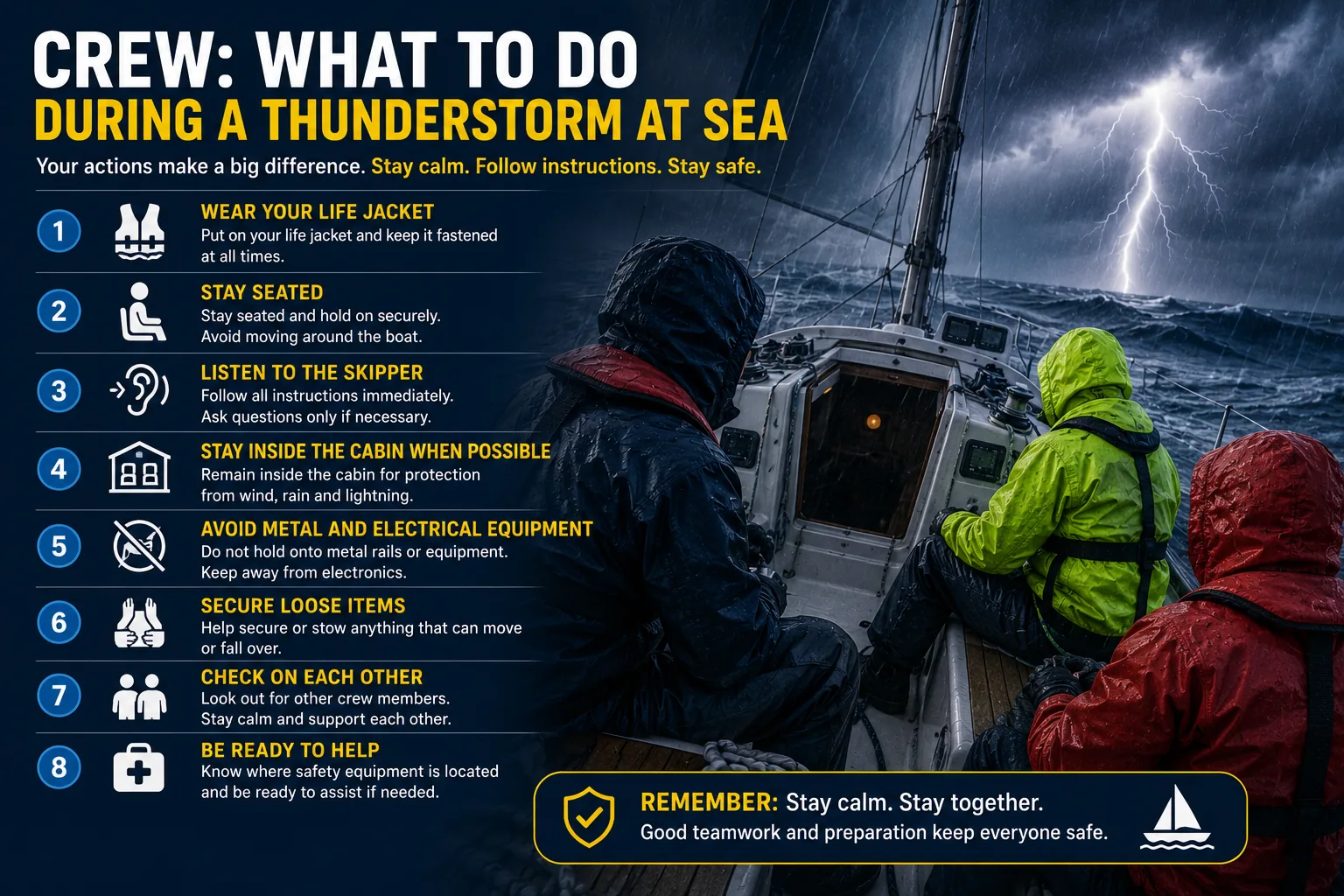
The crew is your most important responsibility. Boats can be repaired. People must be protected.
As soon as severe weather threatens, everyone should wear a life jacket. On deck, crew should move only when necessary. Inexperienced passengers should remain seated in the cockpit or cabin, away from sheets, winches, boom movement, and slippery deck areas.
Give simple instructions:
- “Put on life jackets now.”
- “Stay seated.”
- “Hold on with one hand at all times.”
- “Do not go forward unless I ask you.”
- “Keep clear of ropes and winches.”
- “Tell me immediately if you feel unsafe or injured.”
Clear communication prevents panic. Avoid long explanations during the storm. The skipper should give calm, direct instructions and assign tasks only to people capable of doing them safely.
For family trips or charter guests, the safety briefing before departure is essential. Passengers should already know where life jackets are, where the first aid kit is, and what to do if someone falls overboard.
What to Do During Lightning at Sea
Lightning is one of the most frightening parts of a thunderstorm at sea because there is often no perfect protection on a small boat. Masts, antennas, wet decks, metal rails, and open water can all make the situation feel exposed.
The safest strategy is avoidance: do not depart when thunderstorms are forecast, and head to shelter early when thunderstorm development is likely. But if you are already caught at sea, reduce unnecessary exposure.
During lightning:
- Move crew inside the cabin when practical
- Avoid standing on deck unnecessarily
- Stay away from the mast, shrouds, stays, and metal rigging
- Avoid touching metal rails and wet fittings
- Do not hold multiple metal objects at the same time
- Keep hands away from electrical panels unless needed for safety
- Disconnect non-essential electronics if it can be done safely before the storm is overhead
- Keep handheld electronics protected and dry
Do not jump into the water during a lightning storm unless abandoning the vessel is absolutely necessary. Water does not make you safer from lightning.
If the boat is struck by lightning, check immediately for injuries, fire, electrical failure, hull damage, and navigation system failure. Be prepared for loss of electronics, compass deviation, or engine issues. If safety is compromised, use VHF or other emergency communication methods.
Use the VHF Radio Correctly
Keep the VHF radio on during bad weather. Mobile phones are useful, but they can lose signal, get wet, run out of battery, or become difficult to use in heavy rain. A VHF radio allows communication with nearby vessels, marinas, coast stations, and rescue services.
During a thunderstorm, use VHF to:
- Monitor weather warnings
- Listen for emergency traffic
- Communicate with nearby vessels if collision risk exists
- Call for assistance if the situation becomes unsafe
Know the difference between distress, urgency, and safety communication. A Mayday call is for grave and imminent danger. Pan-Pan is for urgent situations that are serious but not immediately life-threatening. Sécurité is used for important safety information.
If you are unsure how to use the radio, review the Marine VHF Radio Basics guide before your next trip.
Visibility Can Disappear Quickly
Heavy rain can reduce visibility so much that land, other boats, navigation marks, and harbor entrances disappear. At the same time, wind noise and rain can make it harder to hear other vessels.
If visibility drops:
- Reduce speed if needed
- Post a proper lookout
- Use navigation instruments carefully
- Watch depth readings
- Keep clear of known hazards
- Use sound signals when appropriate
- Avoid crossing busy traffic lanes unnecessarily
Do not enter an unfamiliar harbor in near-zero visibility unless staying outside is more dangerous. Harbor entrances can be narrow, shallow, crowded, or affected by breaking waves during strong wind.
Anchoring During a Storm: When It Helps and When It Does Not
Anchoring can be useful in some emergencies, but it is not always the right solution during a sudden thunderstorm. If the water is too deep, the seabed is poor, waves are large, or the boat is close to rocks, anchoring may not hold or may create additional risk.
Anchoring may help if:
- You have enough depth and room
- The seabed is suitable
- You are drifting toward danger
- The engine has failed
- You can deploy the anchor safely before conditions become extreme
Anchoring may be dangerous if:
- You are too close to rocks or shore
- The water is too deep for your available chain
- The boat may swing into danger
- The anchor cannot be set properly
- Crew would need to work on a dangerous foredeck
Good anchoring technique should be learned before an emergency. Read How to Anchor a Boat Safely for a detailed anchoring guide.
What Not to Do During a Thunderstorm at Sea
Bad decisions often make thunderstorms more dangerous than the weather itself. Avoid these common mistakes:
- Do not wait until the first strong gust to reduce sail
- Do not let passengers walk around unnecessarily
- Do not allow waves to hit the boat broadside if you can avoid it
- Do not try to outrun the storm without a realistic plan
- Do not enter an unsafe harbor entrance just because it is nearby
- Do not ignore lightning because the rain has not arrived yet
- Do not switch off the VHF radio
- Do not focus only on your destination
- Do not make sudden maneuvers without checking crew position
- Do not panic if the storm looks worse than expected
The safest skippers are not the ones who never experience bad weather. They are the ones who prepare early, slow down their decision-making, and keep control of the situation.
Step-by-Step Action Plan
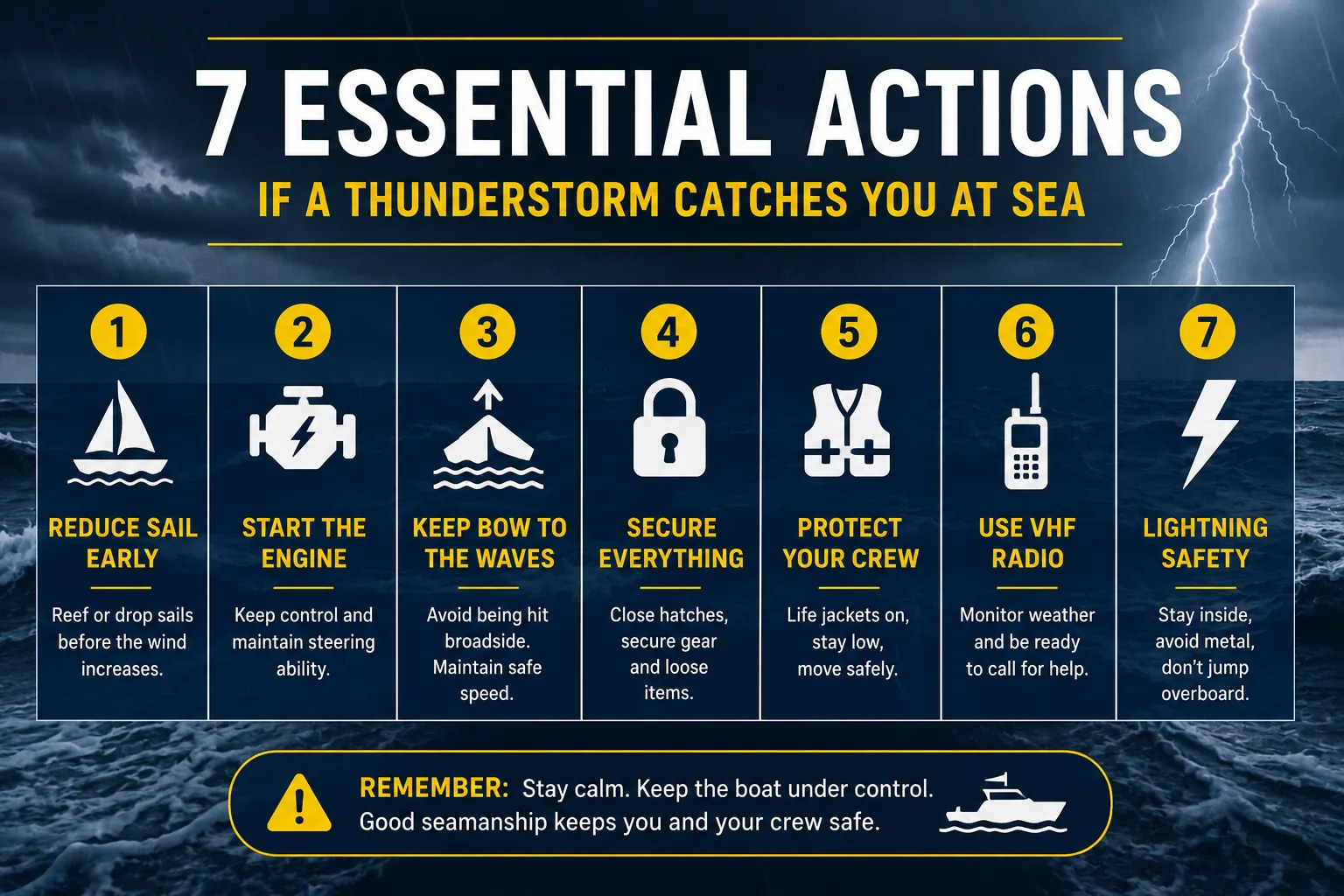
If a thunderstorm is approaching and you cannot shelter in time, follow this sequence:
| Step | Action | Reason |
|---|---|---|
| 1 | Check position and nearest hazards | Know your sea room and danger zones |
| 2 | Put life jackets on everyone | Protect crew before conditions worsen |
| 3 | Reduce sail or prepare engine control | Avoid being overpowered |
| 4 | Start the engine | Maintain maneuverability |
| 5 | Close hatches and secure gear | Prevent water ingress and injuries |
| 6 | Assign crew positions | Reduce panic and confusion |
| 7 | Choose a safe heading | Manage waves and avoid beam seas |
| 8 | Monitor VHF and visibility | Stay informed and avoid collisions |
| 9 | Prepare for lightning | Reduce unnecessary exposure |
| 10 | Reassess after the storm passes | Check damage, crew, and route |
After the Storm Passes
Do not assume everything is safe immediately after the rain weakens. The sea may remain confused, visibility may still be poor, and another storm cell may follow.
After the worst part passes, check:
- Every crew member is safe and uninjured
- No one is seasick, cold, panicked, or exhausted
- Bilge levels are normal
- Engine is operating normally
- Steering works correctly
- Rigging and sails are not damaged
- Navigation lights and instruments work
- VHF radio still works
- Anchor and deck gear are secure
- Your route is still safe
If anything is damaged, change your plan. The safest decision may be to head to the nearest suitable marina, return to base, or wait for conditions to settle before continuing.
Special Advice for Motorboats
Motorboats can react differently from sailing yachts in sudden storms. They may be faster, but they can also slam harder into steep waves and become difficult to control if speed is too high.
For motorboats:
- Reduce speed before waves become steep
- Keep the bow at a safe angle to waves
- Avoid running directly down steep following seas if control is poor
- Do not make sharp turns in large waves
- Keep passengers seated low and secure
- Monitor bilge and engine alarms
High speed is not always safer. Control, visibility, and wave angle matter more than arriving quickly.
Special Advice for Sailing Yachts
Sailing yachts are usually stable offshore, but they can become overpowered if too much sail is left up. The key is reducing sail before the gust front arrives and keeping the boat balanced.
For sailing yachts:
- Reef early
- Keep sheets ready to ease
- Avoid accidental gybes
- Secure the boom
- Use engine support when needed
- Keep crew away from loaded lines
- Prepare for sudden wind shifts
If necessary, dropping sails and motoring under control may be safer than trying to continue sailing through violent gusts.
Frequently Asked Questions
What should I do first if a thunderstorm catches me at sea?
Put life jackets on everyone, reduce sail or speed, start the engine if needed, secure the boat, check your position, and choose a safe heading that keeps the boat under control.
Is it safer to head for shore during a thunderstorm?
Not always. If shore is close, sheltered, and easy to approach, it may be safer. But a rocky coast, shallow water, lee shore, or difficult harbor entrance can be more dangerous than staying offshore with sea room.
Should I anchor during a thunderstorm?
Only if the depth, seabed, sea room, and conditions make anchoring safe. Anchoring in the wrong place during strong wind can be dangerous, especially near rocks or shallow water.
What is the safest direction to point the boat in big waves?
Often the safest approach is to keep the bow toward the waves or slightly off the bow, depending on the boat and sea state. Avoid taking steep waves directly on the beam if possible.
Should I keep sailing during a thunderstorm?
If the boat is under control with reduced sail, it may be possible. However, if the boat becomes overpowered or the crew is at risk, reducing or dropping sail and using the engine may be safer.
What should passengers do during lightning?
Passengers should stay low, avoid unnecessary movement on deck, keep away from metal rigging and rails, and move inside the cabin when practical.
Can lightning strike a sailboat mast?
Yes, a sailboat mast can be struck by lightning. Direct strikes are not common, but they can be dangerous and can damage electronics, rigging, and onboard systems.
Is a mobile phone enough for emergency communication?
A mobile phone is useful but should not be the only emergency communication method. A VHF radio is designed for marine communication and can reach nearby vessels and coast stations.
How fast can storm conditions change at sea?
Conditions can change in minutes. A gust front ahead of a thunderstorm can cause a rapid wind shift, stronger gusts, and quick wave development before heavy rain arrives.
Should everyone wear life jackets during bad weather?
Yes. During strong wind, rough seas, lightning, reduced visibility, or any emergency situation, everyone should wear a properly fitted life jacket.
What should I check after the storm passes?
Check crew condition, bilge water, engine, steering, rigging, sails, electronics, VHF radio, navigation lights, and your route before continuing.
Can I prevent being caught in a thunderstorm?
You cannot control the weather, but you can reduce risk by checking forecasts, monitoring clouds and wind, planning shelter options, and avoiding departure when thunderstorms are likely.
Final Thoughts
A thunderstorm at sea is serious, but it does not have to become a disaster. The key is early preparation, calm leadership, and conservative boat handling. Reduce sail early, keep the engine ready, protect the crew, monitor the VHF radio, avoid dangerous shorelines, and do not let waves hit the boat from an unsafe angle if you can prevent it.
Good seamanship is not about pretending the weather is harmless. It is about respecting the sea, preparing before conditions become critical, and making decisions that keep the boat and crew safe.
Before your next trip, review the Boat Safety Checklist, learn how to use your radio with the Marine VHF Radio Basics guide, understand safe anchoring with How to Anchor a Boat Safely, and read the Safe Boating Croatia Best Practices guide.
Continue reading
Build your Croatia sailing knowledge with related TwoBoat guides, software, guides and planning tools.