
Understanding the Beaufort Wind Scale: Complete Guide for Boaters
The Beaufort Wind Scale is one of the most useful tools a skipper can learn. It helps sailors, boaters, charter guests, and coastal travelers understand what wind speed actually means on the water. A forecast that says 15 knots, 25 knots, or 35 knots is just a number until you understand how that wind affects waves, boat handling, anchoring, visibility, comfort, and safety.
This guide explains the Beaufort Wind Scale in practical boating terms. You will learn how each Beaufort force feels at sea, what wave conditions to expect, when to reef sails, when to avoid departure, and how to use wind forecasts more intelligently before every trip.
If you are planning a sailing trip, combine this guide with the Twoboat sailing weather Croatia guide, the Boat Safety Checklist, and the Safe Boating Croatia Best Practices.
What Is the Beaufort Wind Scale?
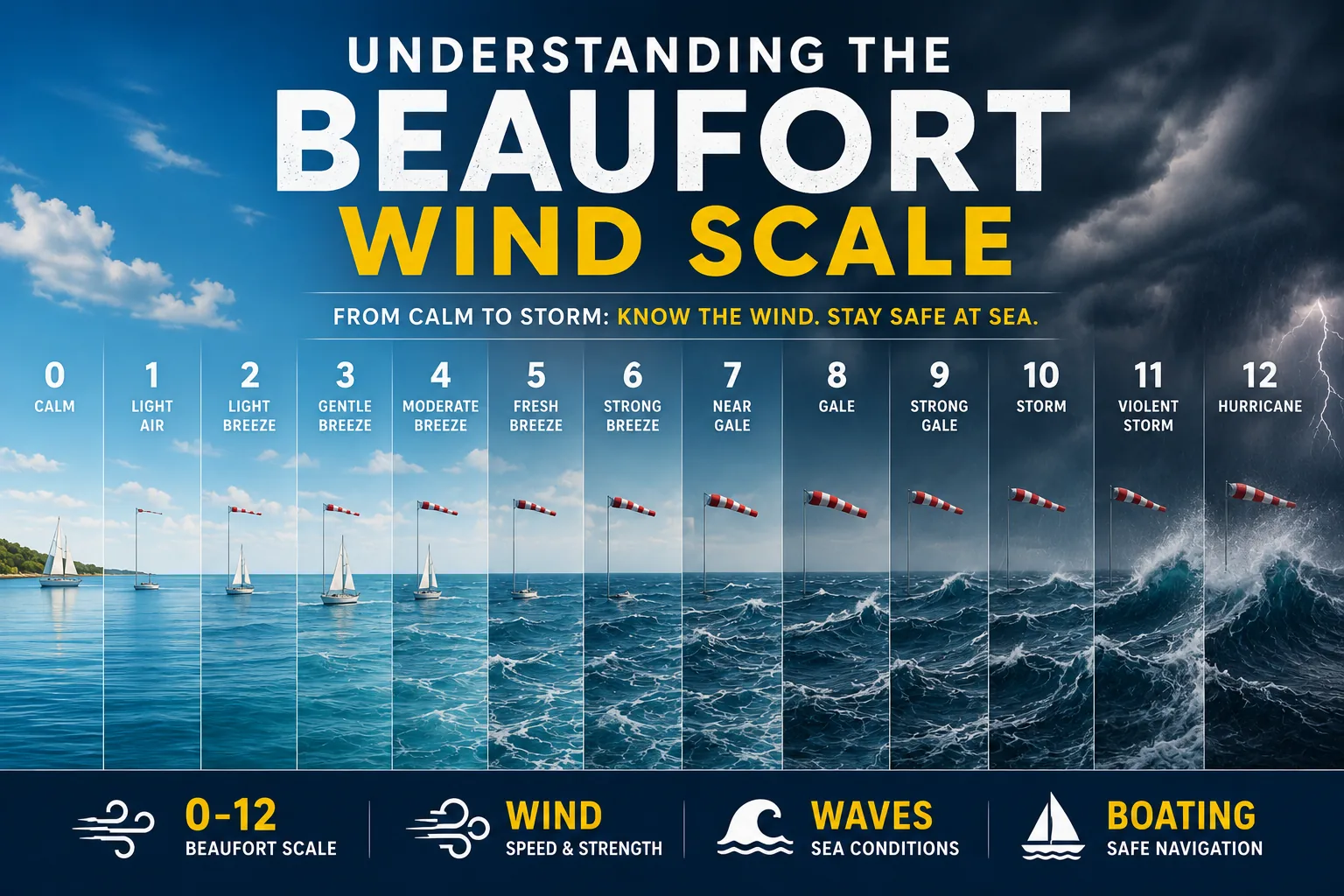
The Beaufort Wind Scale is a system for describing wind strength based on observable effects on land and sea. It was originally developed for sailors so they could estimate wind force without modern instruments. Today, it is still widely used in marine forecasts, weather education, and practical seamanship.
The scale runs from Beaufort Force 0, which means calm conditions, to Beaufort Force 12, which means hurricane-force winds. For boaters, the most important part of the scale is not the number itself, but what that number means for real conditions on the water.
- Beaufort 0–3: generally calm to comfortable boating conditions.
- Beaufort 4–5: moderate to fresh wind, often good sailing but requiring attention.
- Beaufort 6–7: strong wind, rougher seas, and conditions for experienced crews only.
- Beaufort 8+: gale conditions and above, generally dangerous for recreational boating.
Interactive Beaufort Wind Calculator
Use this calculator to convert wind speed into an estimated Beaufort force and practical boating recommendation. Enter wind speed in knots, km/h, mph, or m/s.
Beaufort Wind Calculator
Complete Beaufort Wind Scale Chart
The table below shows the full Beaufort scale with wind speeds, sea conditions, and practical boating guidance. Exact wave height depends on fetch, water depth, current, coastline shape, and how long the wind has been blowing.
| Beaufort | Description | Wind in knots | km/h | m/s | Sea condition | Boating recommendation |
|---|---|---|---|---|---|---|
| 0 | Calm | <1 | <1 | 0–0.2 | Mirror-like sea | Safe, but little sailing wind |
| 1 | Light air | 1–3 | 1–5 | 0.3–1.5 | Ripples without foam | Very easy |
| 2 | Light breeze | 4–6 | 6–11 | 1.6–3.3 | Small wavelets | Beginner friendly |
| 3 | Gentle breeze | 7–10 | 12–19 | 3.4–5.4 | Large wavelets, few whitecaps | Comfortable boating |
| 4 | Moderate breeze | 11–16 | 20–28 | 5.5–7.9 | Small waves, frequent whitecaps | Good sailing, monitor conditions |
| 5 | Fresh breeze | 17–21 | 29–38 | 8.0–10.7 | Moderate waves, many whitecaps | Experienced crews, consider reefing |
| 6 | Strong breeze | 22–27 | 39–49 | 10.8–13.8 | Large waves, spray possible | Reef early, avoid exposure |
| 7 | Near gale | 28–33 | 50–61 | 13.9–17.1 | Sea heaps up, breaking crests | Only experienced crews |
| 8 | Gale | 34–40 | 62–74 | 17.2–20.7 | High waves, foam streaks | Dangerous; avoid departure |
| 9 | Strong gale | 41–47 | 75–88 | 20.8–24.4 | High waves, reduced visibility | Do not sail recreationally |
| 10 | Storm | 48–55 | 89–102 | 24.5–28.4 | Very high waves | Emergency conditions |
| 11 | Violent storm | 56–63 | 103–117 | 28.5–32.6 | Exceptionally high waves | Severe danger |
| 12 | Hurricane force | 64+ | 118+ | 32.7+ | Air filled with foam and spray | Extreme danger |
Beaufort Force 0–3: Calm to Comfortable Conditions
Beaufort Force 0 to 3 usually represents the most comfortable range for beginner boaters, relaxed day trips, family cruising, and easy charter sailing. Conditions are generally manageable, waves are small, and crew comfort is usually high.
Beaufort 0: Calm
At Beaufort 0, the sea surface may look like glass. This can feel peaceful, but sailing yachts may have almost no natural propulsion. Motorboats will usually have easy handling, but visibility, currents, traffic, and heat may still matter.
Beaufort 1–2: Light Air to Light Breeze
This is gentle weather. Small ripples or wavelets form on the sea surface. It is comfortable for beginners, but sailing performance may be slow. In charter situations, this can be pleasant for swimming stops, short passages, and relaxed coastal cruising.
Beaufort 3: Gentle Breeze
Beaufort 3 is often an ideal balance for many crews. Sailing yachts move well, motorboats remain comfortable, and sea state is still moderate. There may be a few whitecaps, but the conditions are usually not intimidating.
Beaufort Force 4–5: Good Sailing, But Pay Attention
Beaufort Force 4 and 5 are where boating becomes more active. Many sailors enjoy this range because the boat feels alive and responsive. However, inexperienced crews may begin to feel uncomfortable, especially if waves build or the route is exposed.
Beaufort 4: Moderate Breeze
At Beaufort 4, whitecaps become more common. Sailing yachts may heel more noticeably, and crew should move carefully. This can still be excellent sailing weather, but the skipper should monitor gusts and local sea conditions.
Beaufort 5: Fresh Breeze
At Beaufort 5, many recreational crews begin to notice a clear difference. Waves become more developed, spray may appear, and the boat requires more active handling. Sailing yachts may need to reef depending on boat size, sail plan, crew experience, and gust strength.
Before leaving the marina in Beaufort 5, complete a detailed boat safety checklist, brief the crew, and choose a route with realistic shelter options.
Beaufort Force 6–7: Strong Wind and Rougher Seas
Beaufort Force 6 and 7 are serious conditions for most recreational boaters. Even if the average wind looks manageable on paper, gusts may be much stronger. Waves become larger, steering requires more concentration, and crew movement becomes more difficult.
Beaufort 6: Strong Breeze
At Beaufort 6, reefing should usually happen early on sailing yachts. Waiting too long can turn a manageable situation into a stressful one. Motorboats may slam into waves if driven too fast, and passengers may need to remain seated.
Beaufort 7: Near Gale
Beaufort 7 is not casual boating weather. Breaking crests, stronger gusts, and rougher handling create higher risk. If you are already at sea, focus on control, crew safety, and conservative decisions. If you are in port, strongly consider delaying departure.
If strong wind arrives suddenly with dark clouds and thunder, read the What to Do If a Thunderstorm Catches You at Sea guide.
Beaufort Force 8 and Above: Gale Conditions and Severe Risk
Beaufort Force 8 and above should generally be avoided by recreational boaters. These conditions involve gale-force wind, high waves, reduced visibility, and much greater consequences if equipment fails or the crew makes a mistake.
At this level, the question is not whether the boat can technically survive the wind. The better question is whether the crew, route, sea room, visibility, gear, and emergency plan are suitable for the conditions. For normal recreational boating, the answer is usually no.
If you are caught in severe conditions, use the VHF radio correctly and be ready to call for help. Review the Marine VHF Radio Basics and Emergency Procedures Croatia Yacht Charter guides.
Wind Speed Conversion Table
Marine forecasts often use knots, while general weather apps may use km/h, mph, or m/s. The table below helps you compare the most common wind units.
| Knots | km/h | mph | m/s | Approx. Beaufort |
|---|---|---|---|---|
| 5 | 9.3 | 5.8 | 2.6 | 2 |
| 10 | 18.5 | 11.5 | 5.1 | 3 |
| 15 | 27.8 | 17.3 | 7.7 | 4 |
| 20 | 37.0 | 23.0 | 10.3 | 5 |
| 25 | 46.3 | 28.8 | 12.9 | 6 |
| 30 | 55.6 | 34.5 | 15.4 | 7 |
| 35 | 64.8 | 40.3 | 18.0 | 8 |
| 40 | 74.1 | 46.0 | 20.6 | 8 |
| 45 | 83.3 | 51.8 | 23.2 | 9 |
| 50 | 92.6 | 57.5 | 25.7 | 10 |
| 60 | 111.1 | 69.0 | 30.9 | 11 |
| 65 | 120.4 | 74.8 | 33.4 | 12 |
Beaufort Scale and Wave Height
Wind speed alone does not determine wave height. A 20-knot wind in a small sheltered bay can feel very different from a 20-knot wind blowing for hours across open water. Wave height depends on wind duration, fetch, depth, current, coastline shape, and local topography.
| Beaufort | Typical wave height | What it feels like on a boat |
|---|---|---|
| 0 | 0 m | Flat calm |
| 1 | 0–0.1 m | Small ripples |
| 2 | 0.1–0.3 m | Very small wavelets |
| 3 | 0.3–0.6 m | Comfortable motion |
| 4 | 0.6–1.0 m | Noticeable chop |
| 5 | 1.0–2.0 m | Moderate motion, spray possible |
| 6 | 2.0–3.0 m | Rough for many recreational boats |
| 7 | 3.0–4.0 m | Difficult handling, uncomfortable crew |
| 8 | 4.0–5.5 m | Dangerous for small craft |
| 9 | 5.5–7.0 m | Severe conditions |
| 10 | 7.0–9.0 m | Storm seas |
| 11 | 9.0–14.0 m | Violent storm seas |
| 12 | 14.0 m+ | Extreme conditions |
How to Estimate Wind Without Instruments
Modern instruments are useful, but good seamanship also means observing the environment. If your anemometer fails or you are on a smaller boat without instruments, you can still estimate wind strength by looking at the sea surface and nearby objects.
- Smoke or flags: show wind direction and rough strength near shore.
- Ripples: indicate light wind.
- Whitecaps: usually appear more consistently around Beaufort 4 and above.
- Spray: suggests stronger wind and rougher conditions.
- Foam streaks: indicate gale-force or near-gale conditions.
- Boat motion: increased heel, slamming, or steering difficulty may indicate rising wind and sea state.
Always combine visual observation with the official forecast. A local gust, channel effect, or thunderstorm outflow can create much stronger wind than the general forecast suggests.
Beaufort Scale for Sailors
For sailors, the Beaufort scale is not only about comfort. It directly affects sail plan, crew movement, reefing decisions, route planning, and emergency preparation.
| Beaufort | Sailing impact | Suggested action |
|---|---|---|
| 0–2 | Slow sailing, light handling | Use light wind tactics or motor if needed |
| 3 | Comfortable sailing | Normal sail plan for most boats |
| 4 | Good power, more heel | Monitor gusts and crew comfort |
| 5 | Fresh wind, stronger heel | Consider first reef depending on boat |
| 6 | Strong wind, rougher waves | Reef early, reduce headsail, brief crew |
| 7 | Difficult sailing for many crews | Avoid if inexperienced; seek shelter |
| 8+ | Gale conditions | Avoid departure; storm tactics if caught |
When sailing upwind in stronger conditions, sail balance becomes especially important. If you want to improve boat handling, read the How to Sail Upwind guide.
Beaufort Scale for Motorboats
Motorboat skippers sometimes focus too much on engine power and not enough on sea state. A powerful motorboat may still become uncomfortable or unsafe if waves are steep, short, and hitting the boat at a bad angle.
| Beaufort | Motorboat impact | Suggested action |
|---|---|---|
| 0–3 | Usually comfortable | Normal operation with standard lookout |
| 4 | Chop and spray possible | Adjust speed and trim |
| 5 | More slamming and wet ride | Reduce speed, avoid unnecessary exposure |
| 6 | Rough for smaller boats | Proceed cautiously or delay |
| 7 | Potentially unsafe for many boats | Seek shelter and avoid open water |
| 8+ | Dangerous | Avoid departure |
Beaufort Scale in Croatia: Maestral, Bura, Jugo, and Nevera
In Croatia and the Adriatic, wind names matter because each wind type creates different boating conditions. The same Beaufort number can feel different depending on whether the wind is a steady maestral, a gusty bura, a long-fetch jugo, or a sudden thunderstorm outflow.
Maestral
Maestral is often a pleasant summer northwesterly or westerly sea breeze. It may build during the afternoon and weaken in the evening. Beaufort 3–4 maestral can be excellent for sailing, but local channels may still create stronger gusts and short chop.
Bura
Bura is a dry, often gusty wind from the northeast. It can be very sudden and much stronger in gusts than the average forecast suggests. A forecast that appears manageable can become dangerous near exposed coastal areas, mountain gaps, and channels.
Jugo
Jugo usually blows from the southeast and can build larger, longer waves over time. Even if wind speed is not extreme at first, sea state may become uncomfortable because the wind often has a longer fetch.
Nevera
A nevera is a sudden summer thunderstorm. It can bring rapid wind shifts, strong gusts, lightning, heavy rain, and short steep waves. A calm or moderate day can change quickly. If you see dark clouds and hear thunder, prepare early.
For more local context, read the thunderstorm at sea guide and the Sailing Weather Croatia guide.
Should You Sail? Practical Safety Recommendations
The table below gives general recreational boating guidance. It is not a replacement for skipper judgment, local forecasts, vessel limitations, or legal requirements.
| Beaufort | Beginners | Experienced sailors | Motorboats | General recommendation |
|---|---|---|---|---|
| 0 | Safe | Safe | Safe | Watch for lack of sailing wind |
| 1 | Safe | Safe | Safe | Easy conditions |
| 2 | Safe | Safe | Safe | Good beginner weather |
| 3 | Safe | Safe | Safe | Comfortable boating |
| 4 | Use caution | Good sailing | Use caution | Monitor gusts and waves |
| 5 | Avoid exposed water | Manageable with skill | Use caution | Reef if sailing, brief crew |
| 6 | Avoid | Experienced only | Rough for many boats | Delay or choose shelter |
| 7 | Avoid | High caution | High caution | Seek shelter |
| 8 | Do not go | Avoid | Avoid | Gale conditions |
| 9 | Do not go | Do not go | Do not go | Strong gale |
| 10+ | Do not go | Do not go | Do not go | Storm or worse |
Common Mistakes When Reading Beaufort Forecasts
The Beaufort scale is simple, but it is often misunderstood. Avoid these common mistakes:
- Looking only at average wind: gusts can be much stronger than the average forecast.
- Ignoring wave height: 20 knots in flat water is very different from 20 knots in exposed seas.
- Ignoring wind direction: offshore, onshore, and crosswind conditions affect safety differently.
- Ignoring fetch: longer open water allows larger waves to build.
- Assuming all boats react the same: size, hull shape, sail plan, load, and crew skill matter.
- Waiting too long to reef: reefing early is usually safer and easier than reefing late.
- Underestimating local effects: channels, capes, islands, and mountains can accelerate wind.
Beaufort Scale and Anchoring
Wind strength matters when choosing an anchorage. A calm bay in Beaufort 2 can become uncomfortable or unsafe if the wind shifts and increases to Beaufort 6 or 7. Before anchoring, consider not only the current wind but also the forecast direction and strength for the next several hours.
Important anchoring considerations include:
- Protection from the forecast wind direction
- Holding quality of the seabed
- Enough swing room
- Sufficient anchor scope
- Nearby hazards if the anchor drags
- Ability to leave safely if conditions change
For a step-by-step anchoring guide, read How to Anchor a Boat Safely.
Frequently Asked Questions
What is the Beaufort Wind Scale?
The Beaufort Wind Scale is a 0 to 12 scale that describes wind strength based on wind speed and visible effects on land and sea. Boaters use it to understand how forecast wind may affect waves, comfort, and safety.
What Beaufort force is dangerous for boating?
For many recreational boaters, Beaufort Force 6 and above can become challenging, while Beaufort Force 8 and above is generally dangerous and should be avoided by recreational vessels.
What Beaufort force is good for sailing?
Beaufort Force 3 to 4 is often comfortable and enjoyable for many sailing yachts. Beaufort Force 5 can also be good for experienced crews, but reefing and careful route planning may be needed.
What Beaufort force is 20 knots?
Twenty knots is usually Beaufort Force 5, known as a fresh breeze. It can produce moderate waves, whitecaps, and stronger boat motion.
What Beaufort force is 30 knots?
Thirty knots is usually Beaufort Force 7, known as near gale. This is serious wind for recreational boating and should be treated with caution.
How many knots is Beaufort Force 6?
Beaufort Force 6 is approximately 22 to 27 knots. It is called a strong breeze and can create large waves and rougher boating conditions.
Can beginners sail in Beaufort Force 5?
Beginners should be cautious in Beaufort Force 5, especially in exposed waters. Conditions may be manageable with an experienced skipper, reefed sails, and a suitable boat, but they are not ideal for inexperienced crews.
Can you sail in Beaufort Force 7?
Beaufort Force 7 is near gale. It is generally suitable only for experienced crews on well-prepared boats. Recreational boaters should avoid departure if these conditions are forecast.
What Beaufort force is a gale?
Beaufort Force 8 is classified as a gale. Wind speeds are approximately 34 to 40 knots.
How does Beaufort relate to wave height?
Higher Beaufort numbers usually mean larger waves, but wave height also depends on fetch, wind duration, current, water depth, and coastline shape.
Is Beaufort the same as knots?
No. Knots measure wind speed directly. Beaufort is a scale that groups wind speeds into practical categories based on observed conditions.
Why can the sea be rough even if the wind is not extreme?
Sea state can be rough because of long fetch, wind against current, shallow water, passing storms, or leftover swell from earlier wind.
Should I use Beaufort or a weather app?
Use both. A weather app gives forecast numbers, while the Beaufort scale helps you interpret what those numbers may mean on the water.
What should I do if the wind increases suddenly?
Reduce sail early, secure the crew, start the engine if needed, monitor VHF radio, and consider returning or heading for shelter. If thunderstorm conditions appear, prepare immediately.
Final Thoughts
The Beaufort Wind Scale turns wind numbers into practical boating decisions. It helps you understand when conditions are comfortable, when they require caution, and when they become dangerous.
Before every trip, check the forecast, compare wind speed with Beaufort force, consider gusts and wave height, and make a conservative decision based on your boat and crew. Good seamanship is not about proving you can handle bad weather. It is about knowing when to go, when to wait, and when to turn back.
Continue learning with the Boat Safety Checklist, Sailing Weather Croatia, What to Do If a Thunderstorm Catches You at Sea, and Marine VHF Radio Basics.
Continue reading
Build your Croatia sailing knowledge with related TwoBoat guides, software, guides and planning tools.