
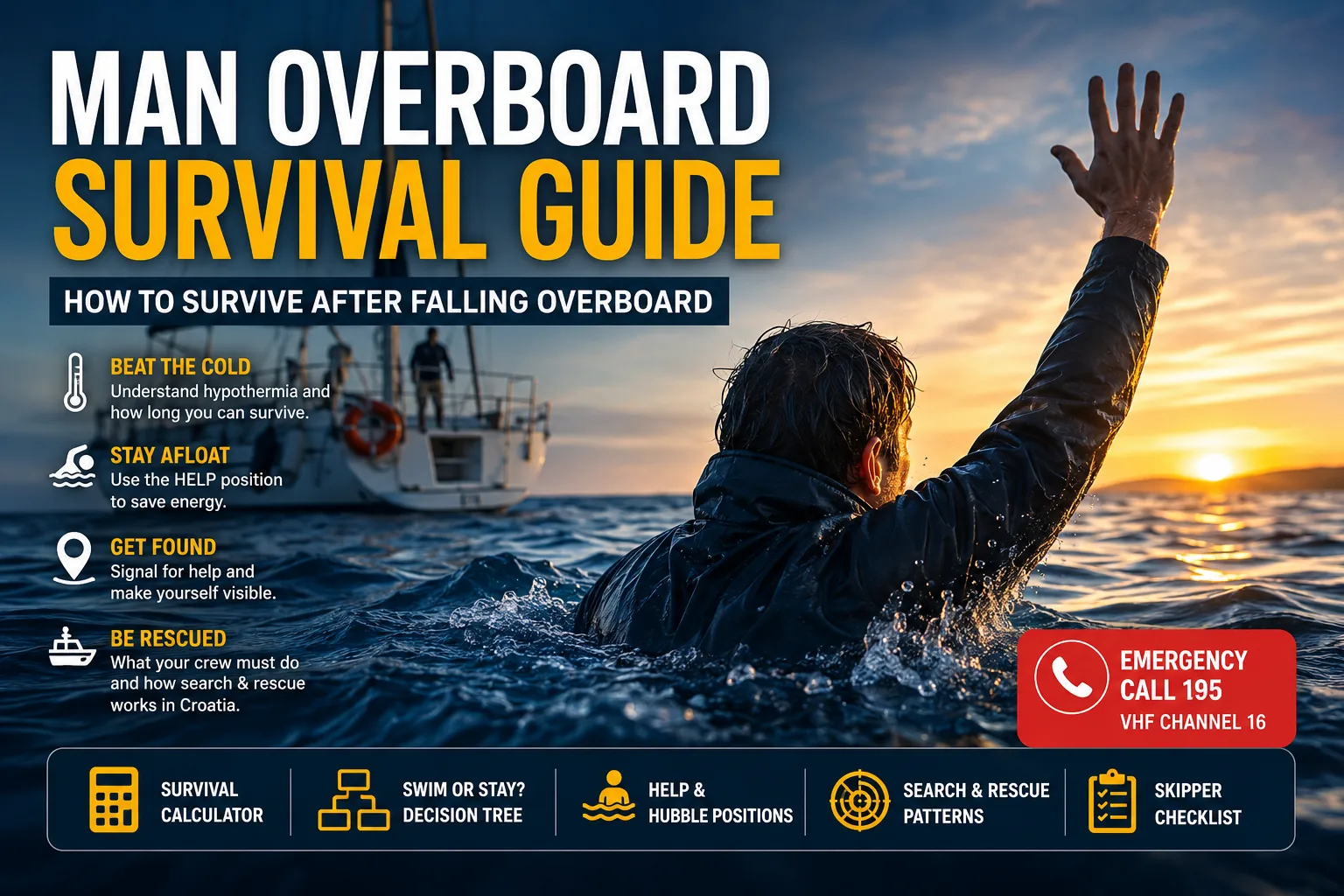
How to Survive After Falling Overboard
What to do in the first seconds, how to control cold shock, float without equipment, preserve heat, decide whether to swim, signal rescuers, survive at night and support a coordinated man-overboard search in Croatian waters.
The first 60 seconds: survive the cold-shock response
If you are in the water
- Do not sprint after the boat. Fight the urge to thrash.
- Get your mouth clear of the water. Lean back, spread your arms and use gentle sculling movements.
- Control the first breaths. Concentrate on a slow exhale. Keep your face out of spray.
- Turn toward the vessel and shout once or twice while it is still close.
- Look for anything floating: lifebuoy, fender, cushion, line, tender or debris.
- Then decide: float and wait, or make a very short swim to an immediately reachable object.
If you are on the vessel
- Shout “MAN OVERBOARD!” repeatedly.
- Assign one person to point continuously at the casualty.
- Throw flotation, a dan buoy, light or smoke marker.
- Press the chartplotter’s MOB button.
- Reduce speed, control the propeller and begin the appropriate recovery manoeuvre.
- Transmit a distress alert and call MRCC when the person is not immediately and safely recoverable.
Interactive MOB survival calculator
This calculator provides broad planning ranges only. It deliberately avoids presenting a precise “time left,” because real survival cannot be predicted reliably from temperature alone.
Survival timeline in cold water
Involuntary gasp, rapid breathing, panic and loss of breathing control can cause immediate drowning. Keep the airway clear and float.
Do not attempt a long swim while breathing is uncontrolled. Orient yourself, find flotation and signal.
Hands and arms may become weak before deep hypothermia develops. Perform essential actions early: secure flotation, activate a light or hold a line.
Minimize movement, protect the airway and keep as much of the body out of the water as possible.
Handle gently, keep the person horizontal where practicable, insulate them and obtain medical advice. Serious hypothermia needs professional treatment.
What should you do with your clothes?
Usually keep clothing on
Clothing can trap a layer of water and slow heat loss. Jackets, shirts and trousers may also trap small air pockets. Do not waste energy stripping without a clear reason.
Remove only a true hazard
Release a heavy backpack, tool belt or object that is pulling you under. Remove footwear only when it clearly prevents floating or a short essential swim.
Use clothing as a signal
Bright fabric can improve visibility. Hold it above the water only briefly when a vessel or aircraft is looking directly toward you; avoid exhausting arm movements.
Interactive body positions: Float, HELP and Huddle
Choose a position
Click FLOAT or HELP. Without reliable flotation, prioritize keeping your mouth and nose clear. HELP is primarily useful when a lifejacket keeps the airway stable.
Float to survive
Tilt your head back, let your ears enter the water, relax your neck, spread arms and legs and make only small movements. It is acceptable if your legs sink.
Huddle with others
Stay close, face inward, place children or injured people in the middle, link arms carefully and avoid pushing anyone’s face toward the water.
Decision tree: should you swim or stay?
How to move and rest in the sea
Best default: float and conserve energy
- Keep the airway facing away from breaking waves.
- Use gentle sculling with the hands.
- Do not hold both arms permanently above water.
- Use floating debris to lift the chest or upper body.
- Rest before exhaustion, not after it.
When a short swim is justified
- Only after breathing is controlled.
- Only toward a nearby, reliable target.
- Use a calm stroke and keep looking at the target.
- Stop and float again if breathing becomes ragged.
- Never chase a vessel moving away.
Night survival and signalling
Preserve orientation
Keep one reference: the vessel’s lights, moon, shoreline or a bright star. Avoid constantly turning in waves.
Use sound selectively
Shout in short bursts when engines, voices or searchlights are close. Continuous shouting wastes energy and can increase water inhalation.
Use light intelligently
A phone screen or flash may be visible at night. Protect it from water, use intermittent flashes and point it toward a searchlight or vessel—not into your own eyes.
Avoiding approaching vessels
- Assume the crew has not seen you until their speed and course clearly change.
- Stay away from the stern and propeller wash.
- When a vessel approaches, face it and signal, but be prepared to move sideways if it is not slowing.
- Do not attempt to grab a fast-moving rail, ladder or line. Wait for a controlled recovery.
- At night, preserve some night vision and watch navigation lights from slightly off-centre rather than staring directly.
Captain’s immediate MOB procedure
| Time | Action | Purpose |
|---|---|---|
| Immediately | Shout “MAN OVERBOARD”; throw flotation and assign a dedicated pointer. | Keep the casualty visible and provide buoyancy. |
| Within seconds | Press MOB on the plotter; note time, position, heading, speed, wind and sea. | Create a reliable datum for return and search. |
| Immediately after | Control sails/throttle and prevent propeller contact. | Stop separation and avoid a secondary injury. |
| Early | Transmit DSC distress and MAYDAY when recovery is not immediate, visibility is poor, the person is lost from sight, injured or at risk. | Start professional coordination without delay. |
| Approach | Approach at minimum steerage speed, preferably with the casualty on the windward side for shelter where conditions permit. | Create a controlled lee and prevent drift onto the propeller. |
| Recovery | Use a sling, ladder, halyard or recovery device. Stop propeller rotation before the person reaches the stern. | Recover a weak or unconscious person without crushing or propeller injury. |
Interactive MOB manoeuvres
Select a manoeuvre to view its general track. These diagrams are training aids; the correct manoeuvre depends on vessel type, sails, engine, wind, sea room and whether the casualty remains visible.
Calling Croatian search and rescue services
Call immediately when
- The casualty is lost from sight.
- Recovery is not immediate and controlled.
- It is night, foggy, rough or cold.
- The person is injured, unconscious or not wearing flotation.
- The vessel cannot manoeuvre safely.
- There is any reasonable doubt that the crew can recover the person quickly.
How to call in Croatia
- 195: MRCC Rijeka, maritime emergency number.
- 112: European emergency number; the call can be routed to MRCC.
- VHF channel 16: distress, urgency, safety and calling, 156.800 MHz.
- DSC channel 70: digital distress/safety/calling, 156.525 MHz; no voice traffic.
Example MAYDAY voice call
MAYDAY, MAYDAY, MAYDAY
THIS IS [VESSEL NAME repeated three times], CALL SIGN [call sign], MMSI [number].
MAYDAY [VESSEL NAME].
MAN OVERBOARD at position [latitude and longitude], time [UTC/local stated clearly].
One person in the water, [description of clothing/lifejacket], last seen [bearing and distance].
We are conducting recovery/search. Wind [direction/speed], sea [state], visibility [distance].
We require immediate assistance.
[number of persons remaining aboard].
OVER.
MRCC Rijeka coordinates the national maritime SAR system with harbour master offices in Pula, Rijeka, Senj, Zadar, Šibenik, Split, Ploče and Dubrovnik, coastal observation units, coastal radio stations and maritime, aviation and land units.
Interactive search patterns
Search patterns must normally be coordinated by MRCC or the on-scene coordinator. Do not improvise a complex pattern if it causes you to lose the last known position or creates collision risk.
Skipper checklist generator
Check completed actions and print or save the resulting incident record.
Would you survive? Scenario quiz
After recovery: prevent a second emergency
- Check responsiveness, airway and breathing immediately.
- Call for medical guidance after cold-water immersion, loss of consciousness, aspiration, injury or prolonged exposure.
- Remove wet clothing only when replacement insulation is ready and movement can be gentle.
- Protect from wind, insulate the trunk and head, and keep the person horizontal where practicable.
- Do not give alcohol. Do not force drinks on a drowsy or vomiting casualty.
- Do not rub cold limbs aggressively or place a severely hypothermic person in a very hot shower.
- Continue monitoring because breathing problems can appear after water aspiration.
Common fatal mistakes
Chasing the boat
A vessel moving at several knots quickly becomes unreachable.
Removing all clothes
It wastes energy and may accelerate cooling.
Waiting to call SAR
Early notification preserves the best search datum and mobilization time.
Losing the last-seen point
Without a reliable datum, the search area expands rapidly with wind and current.
Continue your safety training
Review Marine VHF Radio Basics before practising distress calls. Use the Boat Safety Checklist before departure, and read What to Do During a Thunderstorm at Sea for reduced-visibility and severe-weather preparation.
Skippers should also study the Bareboat Skippering Guide, test their decisions with the Bareboat Skipper Quiz, and review Is It Safe to Sail Around Croatia?.
Frequently asked questions
How long can a person survive in the sea?
There is no reliable single answer. Cold shock can cause drowning in the first minutes, loss of useful movement can occur before deep hypothermia, and flotation, clothing, sea state, injury and body characteristics can substantially change survival. Treat every minute as important and call for help immediately.
Should I remove shoes and trousers?
Usually not. Keep clothing unless a specific item is pulling you under, trapping you or preventing a very short essential movement. Avoid spending energy undressing.
Is treading water better than floating?
Hard treading uses more energy and exposes more body surface to moving water. Calm back-floating with gentle sculling is generally preferable when it keeps the airway clear.
When should a captain call MRCC?
Immediately when recovery is not certain and immediate, the casualty is lost from sight, conditions are poor, the person is injured or without flotation, or there is any reasonable doubt about a safe recovery.
What is the most important task for the crew?
Keep continuous visual contact while another crew member marks the position, deploys flotation, manoeuvres and raises the alarm.
Continue reading
Build your Croatia sailing knowledge with related TwoBoat guides, software, guides and planning tools.