
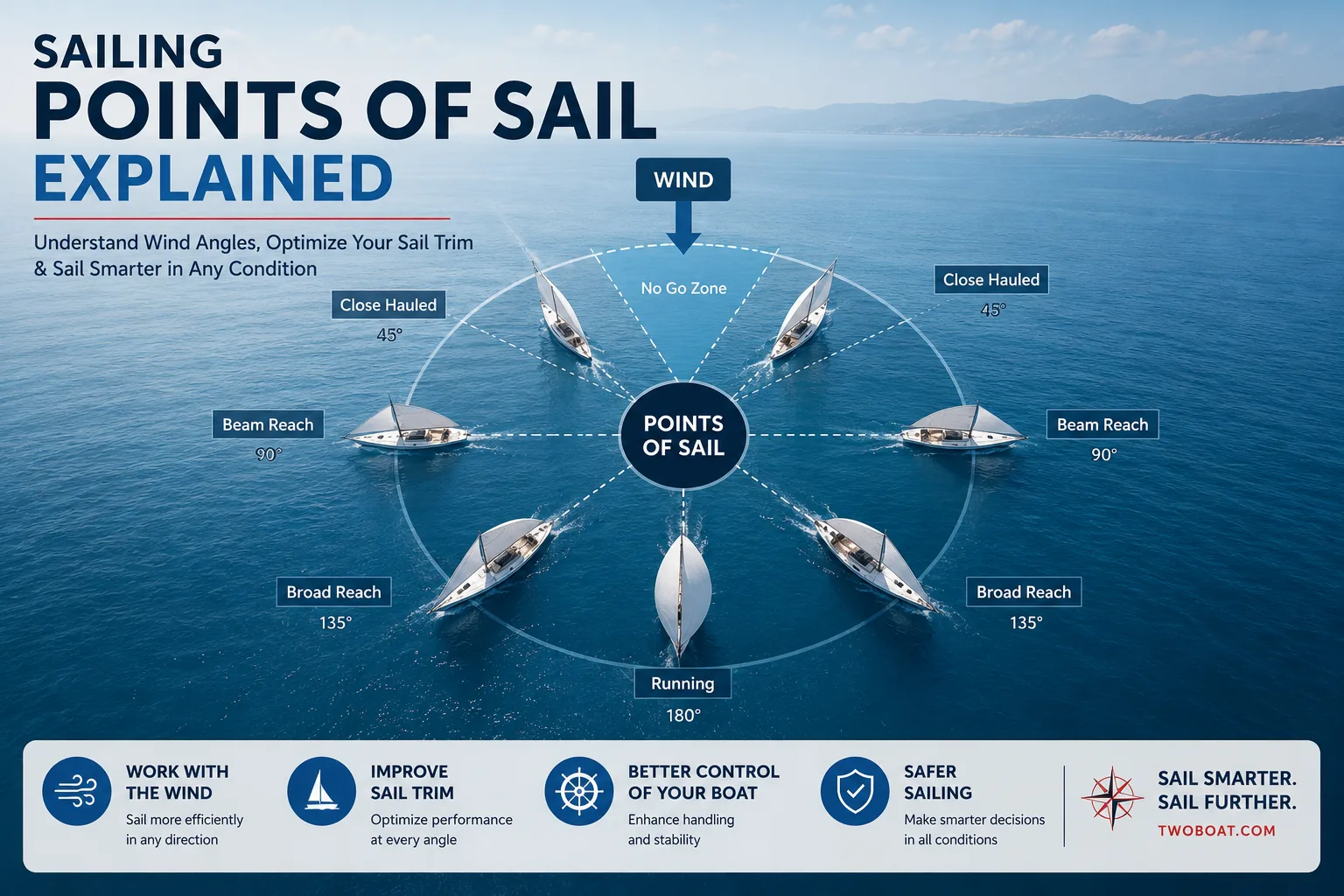
Sailing Points of Sail Explained
Points of sail describe the angle between a sailboat and the wind. For a beginner skipper, this is one of the most important sailing concepts to understand because every course requires a different sail angle, different steering style and different expectation of boat speed.
A boat does not sail the same way when it is close-hauled, reaching or running downwind. The sails need to be trimmed differently, the boom moves to a different position, the boat heels differently and the crew needs to understand where the power is coming from.
This guide explains all major points of sail with practical examples, tables and interactive simulators. If you are new to sail handling, also read How to Trim Sails Properly, How to Reef a Mainsail and How to Sail Upwind.
Important Safety Note
Points of sail are not only theory. They affect safety, especially in stronger wind, crowded waters, narrow channels and when sailing close to shore. A downwind course may feel calm because apparent wind is lower, while a close-hauled course may feel much stronger because apparent wind increases.
- Always check true wind direction before changing course.
- Keep crew clear of the boom when sailing downwind.
- Reef early when sailing close-hauled in stronger wind.
- Watch for accidental gybes on broad reach and run.
- Maintain sea room before tacking or gybing.
- Use a proper lookout at all times.
Before departure, use the Boat Safety Checklist and confirm the yacht systems with the Yacht Systems Functional Checklist.
What Are Points of Sail?
A point of sail is the name given to a boat’s course relative to the wind. The wind direction is the reference point. If the bow points almost into the wind, the boat is close-hauled. If the wind comes over the side, the boat is on a beam reach. If the wind comes from behind, the boat is running.
Understanding points of sail helps you decide how to trim the mainsail and headsail, how much heel to expect, whether you need to tack or gybe, and whether the boat is sailing efficiently.
| Point of Sail | Approximate Wind Angle | Sail Position | Typical Feeling |
|---|---|---|---|
| In Irons | 0° | Sails luffing | No drive, boat may stop |
| Close Hauled | 30–45° | Sails trimmed tight | Efficient upwind sailing |
| Close Reach | 45–60° | Sails slightly eased | Fast and controlled |
| Beam Reach | 90° | Sails halfway out | Often fastest and easiest |
| Broad Reach | 120–150° | Sails eased far out | Comfortable but watch the boom |
| Run | 170–180° | Sails fully eased | Downwind, gybe risk |
Interactive 360° Points of Sail Simulator
Move the slider to rotate the boat around the wind. The simulator identifies the current point of sail, recommends a basic mainsail position and explains whether the course is efficient, risky or impossible.
360° Points of Sail Simulator
Close Hauled
Close hauled is the course used to sail upwind. The sails are trimmed in tightly and the boat sails as close to the wind as it can while still maintaining speed. Most cruising yachts cannot sail closer than about 35° to 45° to the true wind.
This is the most technical point of sail because small steering and trim errors can slow the boat. If you point too high, the sails luff and speed drops. If you sail too low, the boat may move fast but make poor progress toward an upwind destination.
For a deeper explanation, read How to Sail Upwind.
Close Reach
A close reach is usually easier than close-hauled sailing. The boat is still sailing partly toward the wind, but the sails can be eased slightly and the boat often accelerates. For beginners, this is one of the best courses for practicing steering, sail trim and telltales.
Beam Reach
On a beam reach, the wind comes over the side of the boat. Many sailboats are fastest and most comfortable on a beam reach because the sails generate good power without requiring the boat to point high into the wind.
Broad Reach
A broad reach is a downwind angle where the wind comes from behind the beam. It can feel relaxed, but the boom is eased far out and the boat can accidentally gybe if the wind crosses the stern.
Run
Running means sailing almost directly downwind. This can feel calm because the apparent wind is reduced, but it requires attention. The mainsail is far out, the boom can move violently during an accidental gybe and the boat may roll in waves.
Interactive Sail Trim Recommendation Tool
Select a point of sail to see basic trim recommendations for the mainsail, headsail and crew focus.
Sail Trim Recommendation Tool
Apparent Wind and Points of Sail
The wind you feel on the boat is apparent wind. It is a combination of true wind and the wind created by the boat’s forward motion. Apparent wind is stronger and more forward when sailing upwind, and weaker when sailing downwind.
This is why a close-hauled course can feel windy and powerful, while a run can feel calm even when the true wind is strong.
Interactive Apparent Wind Estimator
This simplified calculator estimates how apparent wind feels on different points of sail. It is designed for learning, not navigation.
Apparent Wind Estimator
Point of Sail and Boat Speed
Boat speed varies by yacht design, sail condition, sea state and crew ability. As a general rule, many cruising yachts are slower very close to the wind, faster on a reach and more unstable when sailing deep downwind in waves.
Interactive Speed Potential Calculator
Select wind speed and point of sail to estimate relative performance. This is a simplified training tool for beginner skippers.
Speed Potential Calculator
Common Beginner Mistakes
- Trying to sail directly into the wind.
- Keeping sails too tight on a reach.
- Forgetting to ease sails after bearing away.
- Not trimming in after heading up.
- Ignoring boom position downwind.
- Confusing true wind and apparent wind.
- Not reefing when apparent wind increases upwind.
FAQ
What is the fastest point of sail?
For many cruising sailboats, a beam reach or close reach is often the fastest and easiest point of sail.
Can a sailboat sail directly into the wind?
No. A sailboat must sail at an angle to the wind. The area directly into the wind is called the no-go zone or in irons.
What is close-hauled sailing?
Close-hauled sailing means sailing as close to the wind as the boat can while still maintaining speed and sail drive.
Why is downwind sailing dangerous?
Downwind sailing can be dangerous because of accidental gybes, boom movement and rolling in waves.
How do points of sail affect sail trim?
As the boat bears away from the wind, the sails are gradually eased. As the boat heads up toward the wind, the sails are trimmed in.
Related Sailing Guides
- How to Trim Sails Properly
- How to Reef a Mainsail
- How to Sail Upwind
- Bareboat Skippering Guide
- Understanding Beaufort Wind Scale
- What to Do During a Thunderstorm at Sea
- Marine VHF Radio Basics
- How to Anchor a Boat Safely
- Boat Safety Checklist
- Yacht Systems Functional Checklist
- Sailing School
- Book a Yacht on TwoBoat
Book a Yacht and Practice Points of Sail
The best way to understand points of sail is to practice on a real boat in moderate wind. Browse available sailing yachts and catamarans on TwoBoat, then use this Sailing School guide series to prepare your crew before departure.
Conclusion
Points of sail are the foundation of practical sailing. Once you understand where the wind is coming from, sail trim, steering, reefing and maneuvering become much easier. Learn the no-go zone, practice reaching, respect downwind gybe risk and connect each course with the correct sail position.
Continue reading
Build your Croatia sailing knowledge with related TwoBoat guides, software, guides and planning tools.