
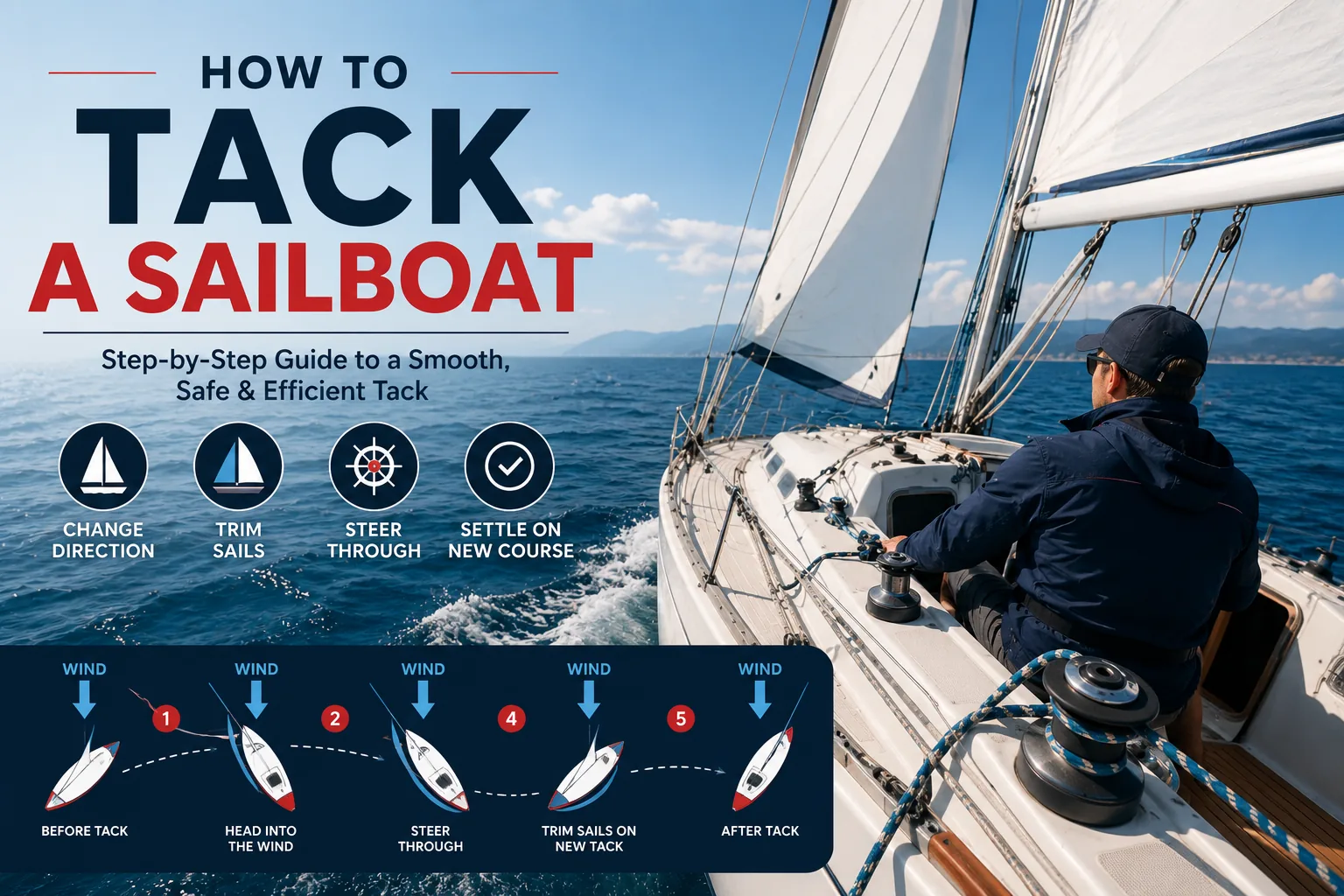
How to Tack a Sailboat
Tacking is the maneuver used to turn a sailboat through the wind from one close-hauled course to the other. It is one of the first maneuvers every sailor learns, but it is also one of the most important to perform smoothly. A good tack keeps boat speed, protects the crew and gets the sails working quickly on the new side.
This guide explains how to tack step by step, what each crew member should do, how to avoid getting stuck in irons and how to practice tacking safely. It includes interactive simulators for tack timing, boat speed, crew roles and common mistakes.
Before learning to tack, it helps to understand points of sail, upwind sailing and proper sail trim. In stronger wind, combine this with How to Reef a Mainsail.
Important Safety Note
A tack is usually safer than a gybe because the boom crosses the boat with less force. However, it still requires communication, lookout and control. Before tacking, check for traffic, shallow water, swimmers, mooring fields, other sailboats and crew position.
- Look around before turning.
- Communicate clearly with the crew.
- Keep hands clear of winches and loaded sheets.
- Do not stand in the path of the mainsheet or boom.
- Maintain enough speed before turning.
- Practice in open water before attempting tight maneuvers.
For preparation and safety, review the Boat Safety Checklist and the Yacht Systems Functional Checklist.
What Is a Tack?
A tack turns the bow of the boat through the wind. Before the tack, the wind is coming over one side of the boat. After the tack, the wind comes over the other side. The sails briefly luff as the bow passes through the no-go zone, then fill on the new tack.
Tacking is necessary because a sailboat cannot sail directly into the wind. To reach an upwind destination, the boat sails a zigzag course from one close-hauled angle to the other.
| Tack Phase | What Happens | Crew Focus |
|---|---|---|
| Prepare | Boat is close-hauled and crew gets ready | Lookout, sheets, communication |
| Turn | Helm turns the bow toward the wind | Smooth steering |
| In Irons | Sails luff as the bow crosses the wind | Do not panic, keep momentum |
| Release | Old headsail sheet is released | Avoid override and tangles |
| Trim | New headsail sheet is trimmed | Fast, clean trim |
| Accelerate | Boat settles on new close-hauled course | Rebuild speed |
Interactive Tack Sequence Simulator
Use this simulator to step through the tack. It shows the main phases and what the skipper and crew should focus on.
Tack Sequence Simulator
Standard Tacking Commands
- Ready about? The skipper asks if the crew is ready.
- Ready. The crew confirms sheets are prepared.
- Helm down / tacking. The skipper starts the turn.
- Release. The old headsail sheet is released.
- Trim. The new sheet is pulled in.
- Course made good. The boat accelerates on the new tack.
Step 1: Build Speed Before the Tack
A slow boat tacks poorly. Before turning, keep the boat moving and avoid pointing too high. Speed gives the rudder flow and momentum needed to cross the no-go zone.
Step 2: Check the Area
Before tacking, look around. Check leeward, windward and ahead. Tacking changes course quickly and may surprise other vessels. In crowded charter areas, marinas, anchorages and narrow channels, this matters as much as sail handling.
Step 3: Prepare the Sheets
The working headsail sheet should be ready to release. The lazy sheet on the new side should be wrapped around the winch and ready to trim. Avoid knots, overrides and loose lines around feet.
Step 4: Turn Smoothly Through the Wind
The helm turns the boat toward the wind and continues through the no-go zone. The goal is not to spin the boat aggressively, but to turn with enough authority to cross the wind without stopping.
Interactive Tack Timing Calculator
This calculator estimates how difficult a tack may be based on boat speed, wind and crew readiness.
Tack Timing Calculator
Step 5: Release the Old Sheet
The old headsail sheet should be released as the sail begins to back or as the bow passes through the wind, depending on the boat and conditions. If released too early, the sail loses power before the turn. If released too late, it can backwind and slow the boat.
Step 6: Trim the New Sheet
As the sail crosses the foretriangle, trim the new sheet quickly but do not over-trim. The first goal is to fill the sail and accelerate. Once speed returns, fine-tune trim using telltales.
For detailed telltale and trim guidance, use How to Trim Sails Properly.
Step 7: Accelerate Before Pointing High
After the tack, many beginners immediately steer too high. This stalls the boat. Instead, sail slightly lower for a few seconds, rebuild speed and then gradually head up to close-hauled.
Interactive Crew Role Trainer
Select a crew position to see the main responsibility during a tack.
Crew Role Trainer
Getting Stuck in Irons
Getting stuck in irons means the boat stops head-to-wind and cannot complete the tack. This usually happens because the boat started the tack too slowly, the helm turned poorly, the headsail was released at the wrong time or waves stopped the bow.
To recover, push the boom or back the headsail to help the bow fall off on one side. On a cruising yacht, engine assistance may be appropriate if safety, traffic or shallow water requires immediate control.
Interactive Tacking Mistake Diagnoser
Select the symptom after a tack to see the likely cause and correction.
Tacking Mistake Diagnoser
Tacking in Strong Wind
In strong wind, the boat may have plenty of power but too much heel or weather helm. Reef before practicing tacks in stronger conditions. A balanced reefed boat tacks better than an overpowered boat.
Use the How to Reef a Mainsail guide and check the Understanding Beaufort Wind Scale article before leaving harbor.
Tacking in Light Wind
Light wind tacks require patience. The boat has less momentum, so avoid sharp rudder movements. Turn smoothly, keep crew weight steady and do not over-trim immediately after the tack.
Tacking on a Bareboat Charter
On a charter yacht, crew may be inexperienced and the boat may be heavier than expected. Assign simple roles: helm, old sheet, new sheet and lookout. Practice a few tacks in open water before approaching narrow channels, marinas or anchorages.
If you are preparing for your first independent charter, read the Bareboat Skippering Guide.
Common Tacking Mistakes
- Starting the tack without enough speed.
- Turning too slowly and stopping head-to-wind.
- Turning too sharply and killing speed.
- Releasing the headsail too early.
- Releasing the headsail too late.
- Trimming the new sheet too slowly.
- Over-trimming before the boat accelerates.
- Pointing too high immediately after the tack.
- Not checking traffic before turning.
FAQ
What does tacking mean in sailing?
Tacking means turning the bow of the boat through the wind so the sails fill on the opposite side.
Why do sailboats tack?
Sailboats tack because they cannot sail directly into the wind. Tacking allows them to make progress toward an upwind destination.
What is the difference between tacking and gybing?
In a tack, the bow passes through the wind. In a gybe, the stern passes through the wind. Gybing is usually more powerful and requires extra boom control.
Why does my boat stop during a tack?
The boat may have started too slowly, turned too slowly, faced waves, or had poor headsail timing.
Should I tack with the engine on?
Normally no, but on a cruising or charter yacht, engine assistance can be appropriate in tight spaces, heavy traffic or safety-critical situations.
How can beginners practice tacking?
Practice in open water, moderate wind and flat sea. Assign roles, use clear commands and repeat the maneuver until crew timing improves.
Related Sailing Guides
- How to Trim Sails Properly
- How to Reef a Mainsail
- How to Sail Upwind
- Bareboat Skippering Guide
- Understanding Beaufort Wind Scale
- What to Do During a Thunderstorm at Sea
- Marine VHF Radio Basics
- How to Anchor a Boat Safely
- Boat Safety Checklist
- Yacht Systems Functional Checklist
- Sailing School
- Book a Yacht on TwoBoat
Book a Yacht and Practice Tacking
The best way to improve tacking is repeated practice in real wind with a prepared crew. Browse available sailing yachts and catamarans on TwoBoat and prepare using the Sailing School guides before departure.
Conclusion
A good tack is smooth, prepared and controlled. Build speed before the maneuver, communicate clearly, release and trim the headsail at the right time and allow the boat to accelerate on the new tack before pointing too high. With practice, tacking becomes one of the most reliable maneuvers in sailing.
Continue reading
Build your Croatia sailing knowledge with related TwoBoat guides, software, guides and planning tools.